Claude Fable 5 vs OpenAI GPT-5.5: Which Frontier AI Model Fits Your Workflow?
Quick Comparison
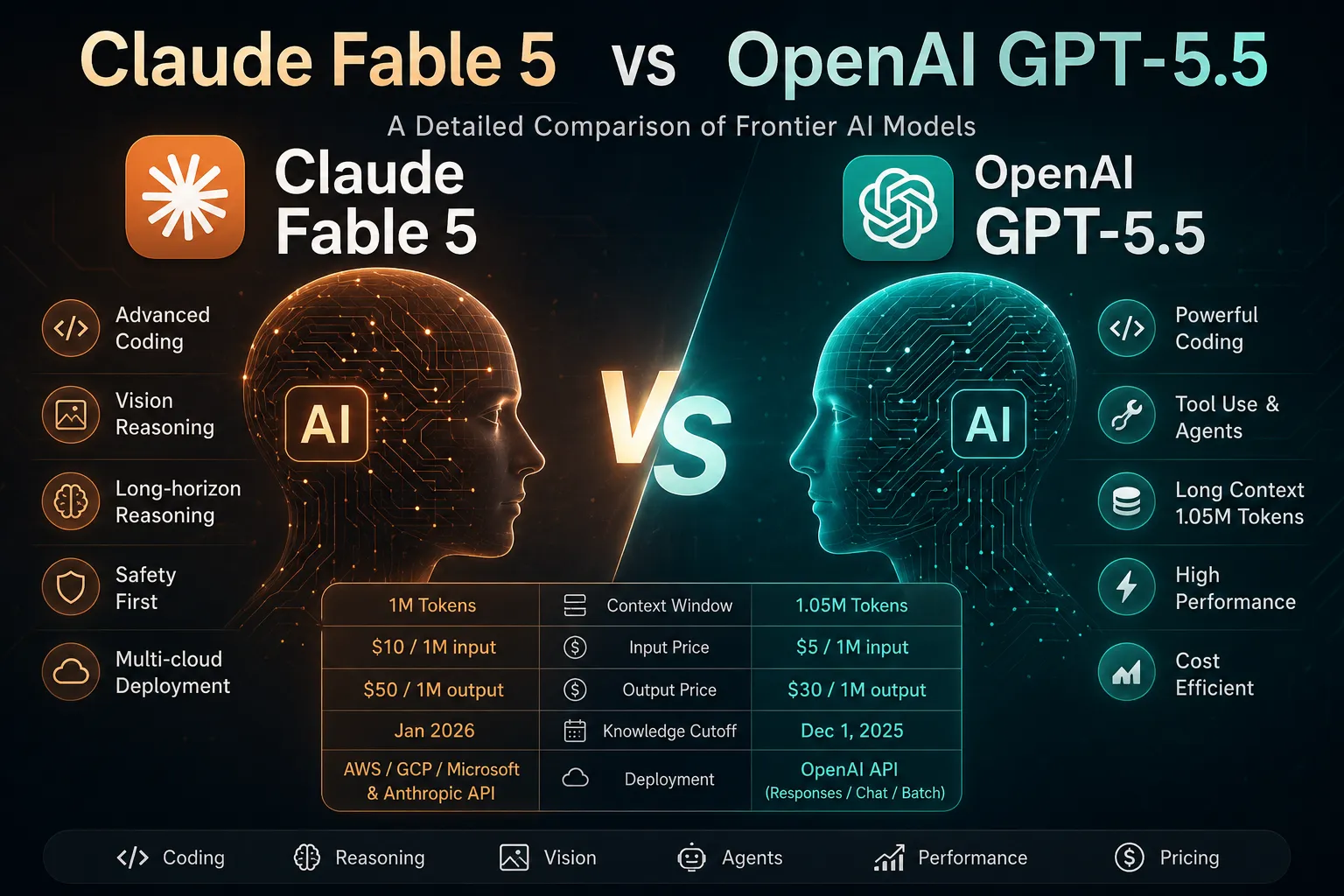
Claude Fable 5 and OpenAI GPT-5.5 target the same high-end market: complex reasoning, coding, agentic workflows, long-context retrieval, vision, and professional knowledge work. The difference is not simply “which model is smarter.” The practical question is which model offers the better trade-off for a specific workflow, cost profile, safety requirement, and infrastructure stack.
| Category | Claude Fable 5 | OpenAI GPT-5.5 |
|---|---|---|
| Provider | Anthropic | OpenAI |
| Model ID | claude-fable-5 | gpt-5.5 |
| Positioning | Anthropic’s most capable widely released model for demanding reasoning and long-horizon agentic work | OpenAI’s flagship model for complex reasoning and coding |
| Input price | $10 / 1M tokens | $5 / 1M tokens |
| Output price | $50 / 1M tokens | $30 / 1M tokens |
| Cached input | $1 / 1M cache hits and refreshes | $0.50 / 1M cached input tokens |
| Context window | 1M tokens | 1.05M tokens |
| Max output | 128K tokens | 128K tokens |
| Knowledge cutoff | Reliable knowledge through Jan 2026 | Dec 1, 2025 |
| Core API surfaces | Claude API, Claude Platform on AWS, Bedrock, Vertex AI, Microsoft Foundry | Responses API, Chat Completions, Batch API |
| Tooling emphasis | Claude API, Claude Code, cloud deployment through AWS/GCP/Microsoft | Responses API, function calling, hosted tools, file search, web search, computer use |
| Best-fit workloads | Long-horizon coding, vision-heavy reasoning, cautious enterprise workflows, cloud-provider deployment flexibility | Tool-heavy agents, coding, long-context assistants, product workflows, customer-facing execution quality |
The headline trade-off is clear: GPT-5.5 is cheaper on standard input and output tokens, while Claude Fable 5 emphasizes Anthropic’s strongest widely released reasoning model, 1M-token context, and broad cloud-platform availability. Claude Fable 5 is generally available across Anthropic’s API and major cloud providers, while GPT-5.5 is available through OpenAI’s API with a 1.05M-token context window and 128K max output.
Model Positioning: Two Different Paths to Frontier AI
Claude Fable 5 is positioned as Anthropic’s most capable widely released model, aimed at the most demanding reasoning and long-horizon agentic work. Anthropic separates Fable 5 from Mythos 5: Fable 5 is broadly available, while Mythos 5 remains limited through Project Glasswing-style access.
OpenAI positions GPT-5.5 as a new class of intelligence for coding and professional work. OpenAI’s developer documentation recommends starting with GPT-5.5 for complex reasoning and coding, while using smaller GPT-5.4 variants for lower-latency and lower-cost workloads.
The practical interpretation is straightforward:
- Claude Fable 5 is aimed at teams that want Anthropic’s strongest generally available model, especially for long-horizon coding, vision reasoning, and enterprise workflows where cautious safeguards are part of the product design.
- GPT-5.5 is aimed at teams that need a high-capability model with strong API tooling, competitive pricing, and broad fit across coding, tool use, long-context retrieval, and customer-facing products.
Neither model should be treated as a universal replacement for cheaper models. Both are premium systems that make the most sense when the cost of a wrong answer, poor execution, or repeated retries is higher than the model bill.
Pricing: GPT-5.5 Has the Lower Standard Token Cost
Pricing is one of the clearest differences.
Claude Fable 5 is priced at $10 per million input tokens and $50 per million output tokens. Its cache-write pricing is higher, while cache hits and refreshes are listed at $1 per million tokens. Anthropic also lists batch pricing for Fable 5 at $5 per million input tokens and $25 per million output tokens.
GPT-5.5 is priced at $5 per million input tokens, $0.50 per million cached input tokens, and $30 per million output tokens. GPT-5.5 Pro is a separate, more expensive tier at $30 per million input tokens and $180 per million output tokens.
| Cost Item | Claude Fable 5 | GPT-5.5 | GPT-5.5 Pro |
|---|---|---|---|
| Input | $10 / 1M tokens | $5 / 1M tokens | $30 / 1M tokens |
| Cached input / cache hit | $1 / 1M tokens | $0.50 / 1M tokens | Not listed in the same way |
| Output | $50 / 1M tokens | $30 / 1M tokens | $180 / 1M tokens |
| Batch input | $5 / 1M tokens | Available through Batch API | Available through Batch API |
| Batch output | $25 / 1M tokens | Available through Batch API | Available through Batch API |
For cost-sensitive production systems, GPT-5.5 has the more attractive default economics. A workload with 100M input tokens and 20M output tokens would cost about $2,000 on Claude Fable 5 versus about $1,100 on GPT-5.5, before caching, batching, retries, or provider-specific discounts.
However, raw token pricing is not the full cost model. If Claude Fable 5 completes a difficult coding or analysis task in fewer turns, fewer retries, or with less human correction, its effective task cost may narrow or even beat a cheaper model. The same logic applies in reverse: if GPT-5.5 performs equally well for a workload, its lower token price creates a direct margin advantage.
Context Window and Output Length: Both Are Built for Long Workflows
Claude Fable 5 supports a 1M-token context window and 128K max output. GPT-5.5 supports a 1.05M-token context window and 128K max output. In practical terms, both models are suitable for long documents, large codebases, extended conversations, retrieval-augmented workflows, and multi-step agent traces.
The 50K-token context difference between 1M and 1.05M is unlikely to matter for most applications. What matters more is how each model handles the content inside that window:
- Can it retrieve the relevant detail without over-weighting irrelevant context?
- Can it maintain instructions across long tasks?
- Can it avoid drifting when documents, logs, and tool outputs conflict?
- Can it summarize intermediate states without losing important constraints?
For long-context use, teams should benchmark with their own documents rather than relying only on headline context size. A 1M-token window is useful only if the model can reason reliably over the right parts of it.
Performance: Public Claims Point to Different Strengths
Claude Fable 5’s launch materials emphasize long-horizon coding, vision, scientific figure understanding, web-app reconstruction from screenshots, autonomous game-like planning, and complex analytical tasks. Anthropic also says more than 95% of Fable sessions involve no fallback, and that for those sessions Fable 5’s performance is effectively the same as Mythos 5.
OpenAI’s GPT-5.5 materials emphasize coding, research, data analysis, tool-heavy agents, long-context retrieval, product-spec-to-plan workflows, and customer-facing workflows. OpenAI reports benchmark figures including 84.9% on GDPval, 78.7% on OSWorld-Verified, and 98.0% on Tau2-bench Telecom without prompt tuning.
The comparison is not perfectly apples-to-apples because each provider highlights different benchmarks and internal evaluations. Publicly available numbers suggest this practical breakdown:
| Dimension | Claude Fable 5 | GPT-5.5 |
|---|---|---|
| Coding | Strong emphasis on long-horizon coding and agentic engineering | Strong emphasis on coding, product execution, and tool-heavy development |
| Vision | Anthropic specifically highlights scientific figure extraction and screenshot-to-code tasks | Supports image input and vision across latest OpenAI models |
| Agentic workflows | Strong positioning around long-horizon autonomous work | Strong positioning around tool-heavy and customer-facing agents |
| Benchmarks | Strong launch claims and customer benchmarks, but fewer directly comparable public standardized figures | More explicit public benchmark numbers across GDPval, OSWorld-Verified, and Tau2-bench Telecom |
| Safety behavior | More visible fallback/classifier design for high-risk areas | Strong API-level safety tooling, but less centered on model fallback in public product positioning |
A neutral reading is that GPT-5.5 currently offers clearer published benchmark comparability, while Claude Fable 5 offers strong qualitative and customer-reported evidence around long-horizon coding, vision-heavy reasoning, and advanced enterprise tasks.
Coding and Software Engineering
Both models are designed for advanced coding workflows, but they may suit different engineering styles.
Claude Fable 5 is especially interesting for:
- Large codebase reasoning.
- Long-running refactors.
- Screenshot-to-frontend reconstruction.
- Multi-file planning.
- Code review with nuanced trade-offs.
- Autonomous coding agents that need to preserve project intent over many steps.
GPT-5.5 is especially interesting for:
- API-driven coding assistants.
- Tool-heavy software agents.
- Product-spec-to-implementation planning.
- Debugging with logs, traces, and external tools.
- Customer-facing coding copilots.
- Workflows that benefit from OpenAI’s Responses API and hosted tools.
For engineering teams, the best evaluation is not a generic benchmark. A useful test set should include:
- A real bug from production.
- A medium-size refactor across 5–20 files.
- A vague product requirement that must become an implementation plan.
- A UI reconstruction task from screenshot or Figma-like input.
- A regression test generation task.
- A code review task with security and maintainability concerns.
If the model reduces senior engineer review time, its higher token cost may be justified. If both models solve the task equally well, GPT-5.5’s lower pricing becomes a clear advantage.
Tool Use and Agentic Workflows
GPT-5.5 has a strong advantage in OpenAI’s integrated tool ecosystem. OpenAI’s model documentation lists support for function calling, structured outputs, image input, streaming, and API surfaces including v1/chat/completions, v1/responses, and v1/batch. OpenAI’s GPT-5.5 guide also highlights prompt caching, hosted tools, tool search, compaction, and reasoning-effort tuning.
Claude Fable 5 also supports major production deployment surfaces, including Claude API, Claude Platform on AWS, Amazon Bedrock, Vertex AI, and Microsoft Foundry. Anthropic’s documentation states that current Claude models support text and image input, text output, multilingual capabilities, and vision.
The trade-off is ecosystem shape:
- OpenAI GPT-5.5 is attractive when the application depends heavily on OpenAI-native tools, hosted tool calling, file search, web search, computer use, structured outputs, and the Responses API.
- Claude Fable 5 is attractive when the application needs enterprise cloud deployment flexibility, especially across AWS Bedrock, Vertex AI, and Microsoft Foundry.
For agentic systems, tool reliability often matters as much as model intelligence. The right choice depends on which provider’s execution stack better matches the product architecture.
Vision and Multimodal Workflows
Both models support image input, but Claude Fable 5’s launch messaging places unusually strong emphasis on vision-heavy reasoning. Anthropic says Fable 5 can extract precise numbers from detailed scientific figures and perform complex vision-based tasks such as rebuilding a web app’s source code from screenshots.
GPT-5.5 also supports image input, and OpenAI states that its latest models support text and image input, text output, multilingual capabilities, and vision.
For multimodal applications, teams should separate three categories:
- Visual extraction: reading charts, tables, UI screenshots, diagrams, and scientific figures.
- Visual reasoning: interpreting what the image implies, not just what it contains.
- Visual-to-action: turning screenshots, diagrams, or mockups into code, plans, or tool calls.
Claude Fable 5 may be especially strong for high-difficulty visual reasoning and UI reconstruction. GPT-5.5 may be easier to integrate when visual input is part of a larger OpenAI tool-using workflow.
Safety, Risk, and Enterprise Controls
Claude Fable 5 includes a notably explicit safeguard architecture around high-risk domains. Anthropic says Fable 5 has classifiers that detect potential misuse in cybersecurity, biology and chemistry, and distillation-related areas. When classifiers detect certain high-risk requests, the response can be handled by Claude Opus 4.8 instead.
This design has two business implications:
- It may reduce misuse risk in sensitive deployments.
- It may create false positives or fallback behavior that product teams need to explain to users.
GPT-5.5 also has safety controls, but its public developer documentation emphasizes production workflow quality, reasoning controls, tool use, and migration guidance more than a model-specific fallback architecture. OpenAI recommends treating GPT-5.5 as a new model family and tuning reasoning effort, verbosity, tool descriptions, and output formats against representative examples.
For regulated or high-risk enterprise deployments, Claude Fable 5’s explicit fallback behavior may be attractive. For broad product workflows where flexibility and direct tool execution matter, GPT-5.5 may feel more straightforward.
API Access and Developer Experience
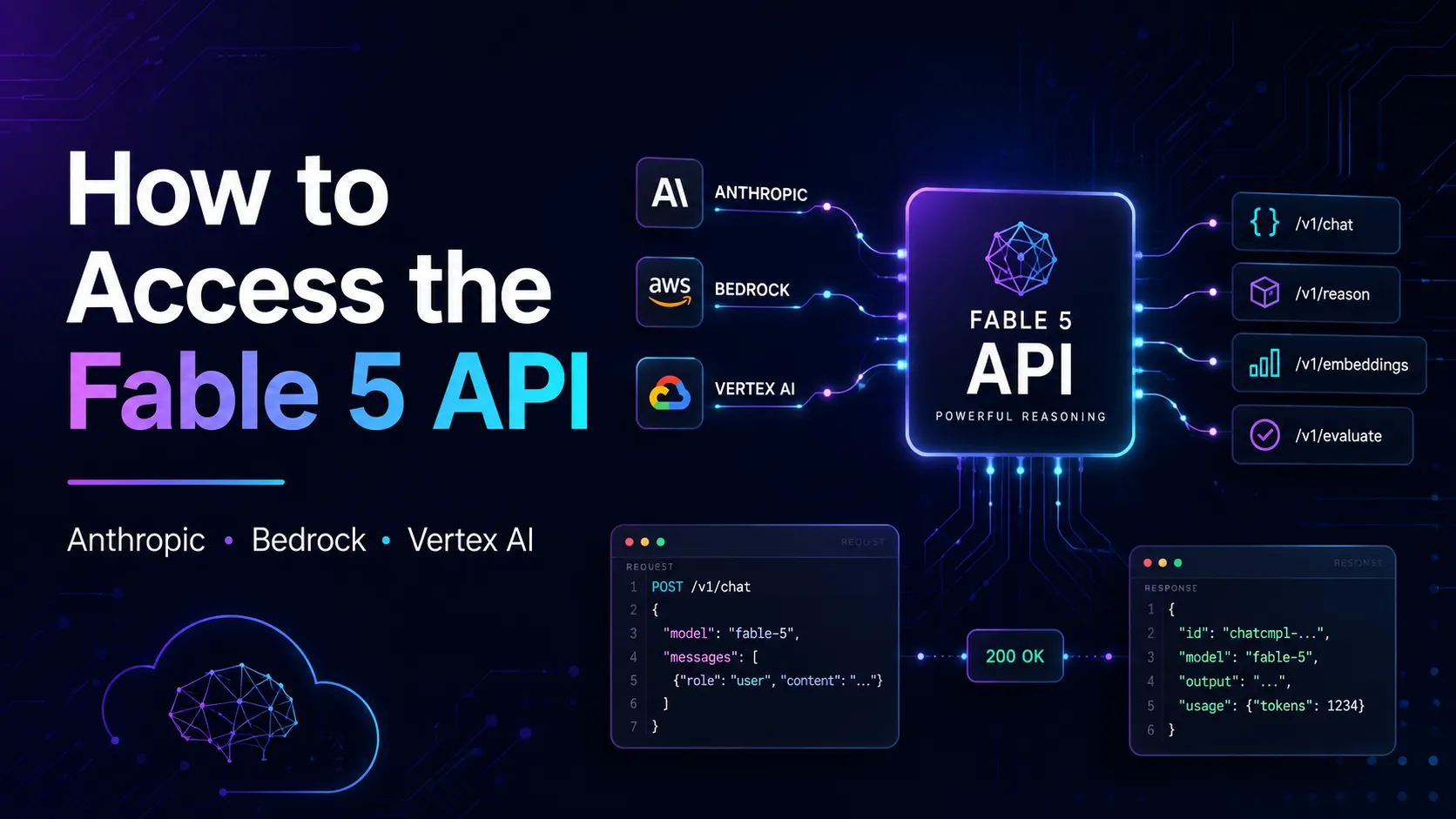
Claude Fable 5 uses the Claude API model ID:
text claude-fable-5
It is also listed for AWS Bedrock as:
text anthropic.claude-fable-5
And for Vertex AI as:
text claude-fable-5
Anthropic states that Fable 5 is generally available through Claude API, Claude Platform on AWS, Amazon Bedrock, Vertex AI, and Microsoft Foundry.
GPT-5.5 uses the OpenAI model ID:
text gpt-5.5
OpenAI lists GPT-5.5 as available through API endpoints including v1/chat/completions, v1/responses, and v1/batch, with support for streaming, function calling, structured outputs, and image input.
Developer experience depends on the stack:
- Choose Claude Fable 5 if the team wants the same model available across first-party API, AWS, Google Cloud, and Microsoft enterprise surfaces.
- Choose GPT-5.5 if the team is already building around OpenAI’s Responses API, hosted tools, structured outputs, and agent framework patterns.
Ecosystem and Deployment
Claude Fable 5 has a strong multi-cloud story. Its availability across Anthropic, AWS, Google Cloud, and Microsoft surfaces matters for enterprises that care about procurement, data residency, IAM, audit logs, and existing cloud contracts.
GPT-5.5 has a strong product and developer ecosystem story. OpenAI’s API platform includes model comparison, Responses API, batch processing, tool support, and a large developer base. Its lower default token price also makes it easier to deploy at scale before aggressive optimization.
The deployment trade-off can be summarized this way:
| Deployment Need | Better Fit |
|---|---|
| AWS-native governance | Claude Fable 5 via Bedrock |
| Google Cloud-native AI stack | Claude Fable 5 via Vertex AI or GPT-5.5 through external API integration |
| Microsoft enterprise procurement | Claude Fable 5 via Microsoft Foundry, depending on availability and requirements |
| OpenAI-native agent tools | GPT-5.5 |
| Lowest standard frontier-token price | GPT-5.5 |
| Broad cloud-provider availability | Claude Fable 5 |
Real-World Scenario Comparison
Scenario 1: AI Coding Agent for a SaaS Product
A coding agent needs to read product specs, inspect repositories, generate patches, run tests, and explain trade-offs.
GPT-5.5 advantage: lower token cost, strong coding positioning, mature OpenAI tool ecosystem, and good fit for tool-heavy workflows.
Claude Fable 5 advantage: strong long-horizon coding positioning, strong customer feedback around agentic engineering, and potential strength on UI/screenshot-to-code tasks.
Recommendation: benchmark both. Use GPT-5.5 as the default if quality is close. Use Claude Fable 5 for escalation on the hardest refactors, ambiguous bugs, or vision-heavy UI tasks.
Scenario 2: Enterprise Knowledge Assistant
A company needs a model to search policies, documents, contracts, and internal data while respecting access controls.
GPT-5.5 advantage: strong long-context retrieval positioning, lower standard token pricing, and OpenAI-native file/tool workflows.
Claude Fable 5 advantage: 1M-token context, multi-cloud deployment flexibility, and enterprise-friendly availability across major cloud platforms.
Recommendation: choose based on infrastructure. OpenAI-first teams should start with GPT-5.5. AWS, GCP, or Microsoft-governed enterprises should evaluate Claude Fable 5 through their preferred cloud route.
Scenario 3: Legal, Compliance, or Policy Review
The model must compare documents, identify risk, and write structured analysis with careful language.
GPT-5.5 advantage: strong professional-work positioning and lower cost for large document review.
Claude Fable 5 advantage: strong reasoning positioning and cautious safety behavior that may align with sensitive workflows.
Recommendation: run blind review with domain experts. Measure factual accuracy, citation faithfulness, missed risks, and overconfident claims rather than relying on generic scores.
Scenario 4: Customer Support Automation
The model handles multi-step service workflows, tool calls, account data, and customer-facing messages.
GPT-5.5 advantage: OpenAI reports strong Tau2-bench Telecom performance and emphasizes customer-facing workflow execution.
Claude Fable 5 advantage: strong reasoning and long-context ability, especially when support cases involve complex documents or engineering escalation.
Recommendation: GPT-5.5 is the more natural starting point for high-volume support automation because of lower cost and OpenAI’s explicit workflow positioning. Claude Fable 5 can be used for complex escalations.
Scenario 5: Scientific or Technical Research Assistant
The model needs to analyze papers, charts, experimental results, and uncertain hypotheses.
GPT-5.5 advantage: OpenAI highlights scientific and technical research workflows and reports gains on genetics and bioinformatics-style evaluations.
Claude Fable 5 advantage: Anthropic emphasizes scientific figure understanding, vision-based reasoning, and high-end analytical judgment.
Recommendation: evaluate task by modality. If the workflow is tool-heavy and text/data-centric, GPT-5.5 is a strong default. If the workflow involves dense scientific figures, diagrams, or visual reconstruction, Claude Fable 5 deserves direct testing.
Cost-Control Strategy for Both Models
Both Claude Fable 5 and GPT-5.5 are premium models. Teams should not route every request to either model by default.
A practical production architecture looks like this:
- Use cheaper models for simple tasks. Classification, short extraction, rewriting, and routine support should usually start on lower-cost models.
- Escalate hard tasks. Send only complex reasoning, coding, long-context, or high-risk workflows to Fable 5 or GPT-5.5.
- Cache stable context. Repeated system prompts, documentation, and policy text should use caching where available.
- Limit output length. Output tokens are more expensive than input tokens for both models.
- Use batch processing. Offline analysis, document review, and evaluation jobs should use batch routes when latency is not critical.
- Measure cost per successful task. Token price alone is incomplete; retries, human correction, and failed outputs matter.
Which Should You Choose?
Choose OpenAI GPT-5.5 if:
- Token cost matters and the workload will run at scale.
- The product depends heavily on tool calling, structured outputs, hosted tools, file search, web search, or computer use.
- The team already uses OpenAI’s Responses API.
- The workload is customer-facing and needs polished, concise execution.
- Published benchmark comparability is important for internal buy-in.
- GPT-5.5 quality matches Claude Fable 5 in your own tests.
Choose Claude Fable 5 if:
- The workload requires Anthropic’s strongest widely released model.
- Long-horizon coding, advanced reasoning, or vision-heavy tasks are central.
- The enterprise needs deployment through AWS Bedrock, Vertex AI, Microsoft Foundry, or Anthropic’s own API.
- The product benefits from explicit high-risk fallback behavior and cautious safeguards.
- The model will be used for high-value expert work where fewer turns and better judgment may offset higher token prices.
Use both if:
- The product has heterogeneous workloads.
- Cost and quality vary by task type.
- The company wants vendor redundancy.
- The system can route requests based on complexity, modality, user tier, or failure mode.
The most defensible architecture is a model router: GPT-5.5 as a cost-efficient frontier default for many complex workflows, Claude Fable 5 as an escalation model for difficult long-horizon, visual, or enterprise-governed tasks, and smaller models underneath both for routine traffic.
Conclusion
Claude Fable 5 and OpenAI GPT-5.5 are both frontier models built for serious professional work. GPT-5.5 has the lower standard token price, strong OpenAI-native tooling, a 1.05M-token context window, and clear published benchmark figures across several agentic and professional evaluations. Claude Fable 5 has Anthropic’s strongest widely released capability tier, a 1M-token context window, 128K output, broad cloud-provider availability, and strong positioning around long-horizon coding, vision-heavy reasoning, and cautious enterprise deployment.
The neutral conclusion is not that one model universally wins. GPT-5.5 is the stronger default for cost-sensitive, tool-heavy, OpenAI-native production systems. Claude Fable 5 is the stronger candidate for teams prioritizing Anthropic’s highest general capability, multi-cloud enterprise deployment, advanced visual reasoning, and long-horizon agentic work.
The best next step is to build a 20–50 task evaluation set from real workloads, measure accuracy, latency, retries, token cost, human correction time, and user acceptance, then route each task category to the model that performs best in production rather than relying on brand-level assumptions.
Continue Reading
More articles connected to the same themes, protocols, and tools.

Referenced Tools
Browse entries that are adjacent to the topics covered in this article.


PaidSync.ai
MCP ServersPaidSync.ai is a hosted MCP server for paid advertising that exposes 610+ tools across 14 advertising, analytics, tagging, and commerce platforms. It supports read/write workflows from AI clients including ChatGPT, Claude, Gemini, Cursor, Claude Code, and Codex, with a free plan.

Hyper3D MCP
MCP ServersHyper3D MCP is Hyper3D's hosted Rodin MCP server for creating 3D assets from natural-language instructions or supported references, checking asynchronous generation progress, and retrieving model download links inside AI coding clients. Official setup is documented for Codex, Claude Code, and Kimi Code CLI.