How to Use Claude Fable 5: Complete 2026 Guide to Anthropic’s Most Powerful Public AI Model

Key Takeaways
- Claude Fable 5 is Anthropic’s first publicly available Mythos-class model, delivering state-of-the-art performance in long-horizon reasoning, agentic coding, vision, and complex knowledge work while sharing core capabilities with the restricted Claude Mythos 5.
- Access is immediate for Claude Pro, Max, Team, and Enterprise users on claude.ai until June 22, 2026 (then usage-based); API model ID is
claude-fable-5with 1M token context and 128K output limits. - Pricing is $10 per million input tokens and $50 per million output tokens—roughly double Claude Opus 4.8 but optimized for fewer, higher-quality completions on demanding tasks.
- Adaptive thinking runs automatically; control depth with effort levels (
highdefault,xhighfor maximum capability,medium/lowfor routine work). - Safety classifiers may trigger refusals on cybersecurity, biology, or chemistry topics (routing to Opus 4.8 via fallback); plan for
stop_reason: "refusal"handling in production. - Specialized prompting patterns—like brevity instructions, progress grounding, and subagent delegation—unlock Fable 5’s full autonomous potential and prevent overplanning or hallucinations.
- Benchmarks indicate superior first-shot correctness and sustained multi-hour autonomy compared to prior Claude models, making it ideal for large codebases, multi-day research, and enterprise workflows.
What Is Claude Fable 5?
Claude Fable 5 represents Anthropic’s most capable generally available model as of June 2026. Released alongside the restricted Claude Mythos 5, Fable 5 delivers Mythos-class intelligence with built-in safety classifiers for broad accessibility.
Analysis of Anthropic’s documentation shows it excels on nearly all benchmarks, particularly in software engineering (SWE-Bench Pro), spatial reasoning, vision-based tasks, and long-context agentic workflows. It maintains a 1 million token context window and supports up to 128,000 output tokens, enabling sustained operation across complex, multi-step projects that previous models would fragment or abandon.
The key distinction: Fable 5 routes high-risk queries (offensive cybersecurity, certain biology/chemistry topics) to Claude Opus 4.8 via classifiers, while Mythos 5 removes these restrictions for approved Project Glasswing partners. This design balances frontier capability with responsible deployment.
How to Access Claude Fable 5
On Claude.ai Web and Apps
- Log in to claude.ai with a Pro, Max, Team, or eligible Enterprise subscription.
- Start a new chat or open an existing one.
- Select Claude Fable 5 from the model dropdown (available immediately upon release for qualifying plans until June 22, 2026).
- For Claude Code or desktop apps, use the slash command:
/model claude-fable-5(restart the app if the option does not appear).
After June 22, usage shifts to credits on paid plans. Community feedback suggests heavy early adoption during the inclusion window to test long-running sessions.
Via Claude API and Cloud Platforms
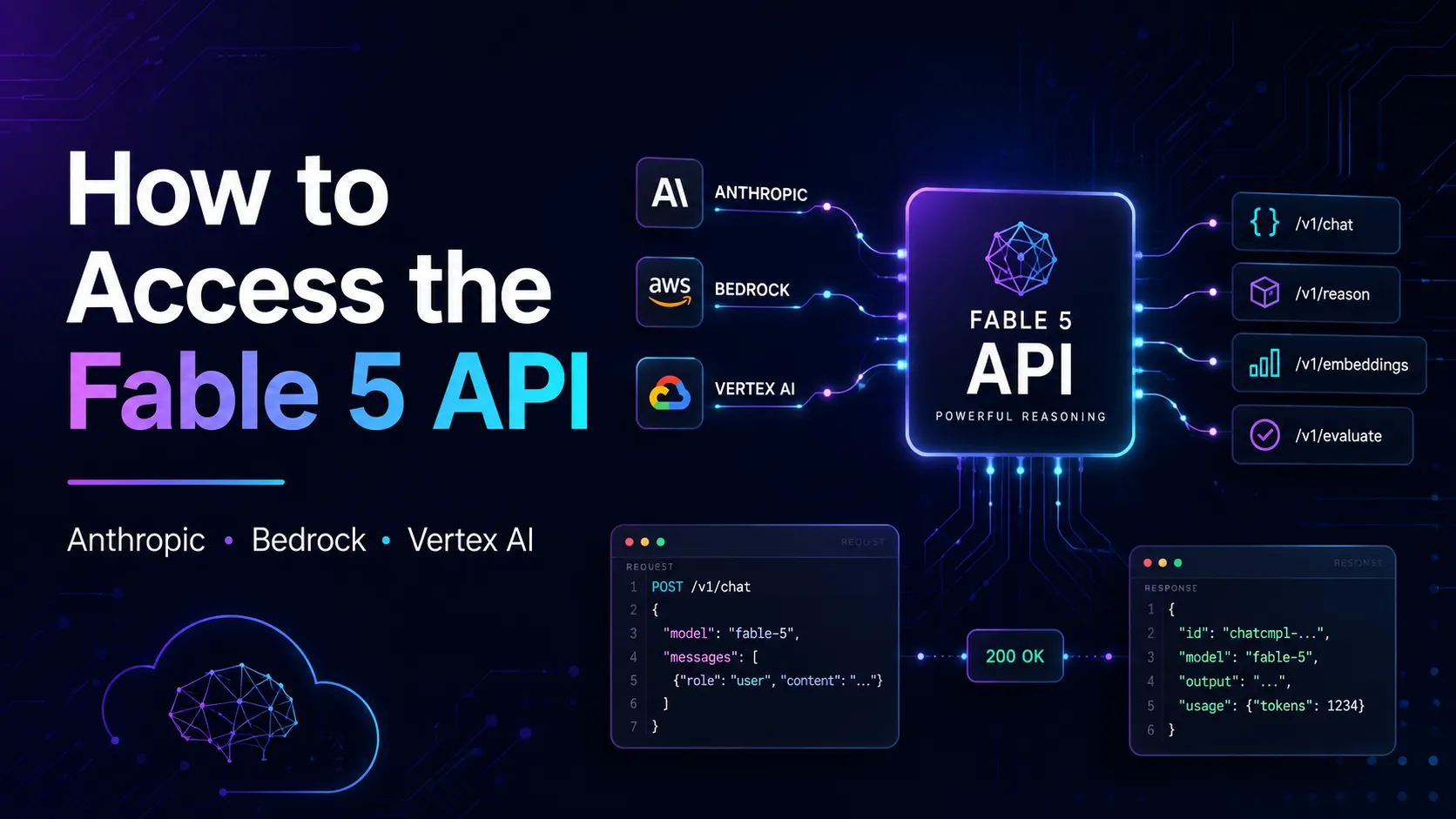
Use the model ID claude-fable-5 across official endpoints:
- Claude Platform / API: Standard Messages API calls.
- Amazon Bedrock, Google Vertex AI, Microsoft Foundry: Available with region-specific endpoints.
Example API request structure (Python SDK):
from anthropic import Anthropic

client = Anthropic()
response = client.messages.create(
    model="claude-fable-5",
    max_tokens=128000,
    messages=[{"role": "user", "content": "Your prompt here"}],
    # effort and other params below
)
Mastering Prompting for Claude Fable 5
Fable 5 responds to standard Claude techniques but benefits from Mythos-specific patterns due to its adaptive thinking engine (always enabled) and enhanced autonomy.
Effort Levels
Control reasoning depth and cost:
high(default): Balanced for most tasks.xhigh: Maximum capability for sensitive, high-stakes work.mediumorlow: Faster responses for routine operations (often outperforming prior models at higher effort).
Pass via the effort parameter in API calls or interface settings.
Core Prompting Patterns
Brevity Instruction (prevents over-elaboration):
Lead with the outcome. Your first sentence after finishing should answer "what happened" or "what did you find": the thing the user would ask for if they said "just give me the TLDR." Supporting detail and reasoning come after.
Prevent Overplanning (critical at xhigh effort):
Don't add features, refactor, or introduce abstractions beyond what the task requires. Do the simplest thing that works well. Avoid premature abstraction.
Ground Progress Claims (avoids hallucinated status):
Before reporting progress, audit each claim against a tool result from this session. Only report work you can point to evidence for.
State Boundaries (stops unsolicited changes):
When the user is describing a problem rather than requesting a change, the deliverable is your assessment. Report findings and stop.
Autonomous Pipeline Reminder (for long-running agents):
You are operating autonomously. The user is not watching in real time. For reversible actions that follow from the original request, proceed without asking.
Parallel Subagents:
Delegate independent subtasks to subagents and keep working while they run. Intervene if a subagent goes off track.
Memory System (for multi-session continuity):
Create and reference a persistent Markdown file of lessons learned:
Reflect on previous sessions. Store core themes and corrections in [memory.md]. Reference it for future use.
Handling Safety Classifiers and Refusals
Fable 5 includes classifiers that return stop_reason: "refusal" (HTTP 200, not error) for restricted topics. The response includes the triggering classifier.
Best Practices:
- Implement server-side or client-side fallback to Claude Opus 4.8 (Anthropic provides SDK middleware).
- Use the
fallbacksparameter in API calls for automatic retry. - Refusals are not billed if no output is generated; fallback credits cover prompt-cache costs.
Benchmarks and early testing show refusals affect under 5% of typical developer queries but can appear on benign biology or code-review tasks involving sensitive domains.
Advanced Use Cases and Edge Cases
Long-Horizon Agentic Work: Supply the full project context and intent upfront. Fable 5 sustains multi-hour sessions with tools, code execution, and vision analysis.
Vision and Technical Images: Upload screenshots, diagrams, or web UIs directly. Pair with bash/crop tools for noisy inputs.
Large Codebase Operations: One-shot complex refactors, migrations, or full application builds. Provide intent context: “I’m working on [larger task] for [audience]. They need [outcome].”
Edge Cases to Watch:
- Context-budget warnings: Add “You have ample context remaining. Continue the work.”
- Premature termination: Use checkpoint behavior to pause only on true user input needs.
- High-effort verbosity: Combine brevity + no-abstraction instructions.
Community reports highlight 17x code speedups and successful one-shot games or CAD models in single prompts.
Pricing, Cost Optimization, and Comparisons
Pricing Breakdown:
- Input: $10 / million tokens
- Output: $50 / million tokens
- Prompt caching offers up to 90% discounts on repeated inputs.
Compared to Claude Opus 4.8 ($5/$6.25), Fable 5 costs roughly double per token but often completes tasks with fewer total tokens due to higher first-shot accuracy and autonomy.
Optimization Tips:
- Use
medium/loweffort for non-critical subtasks. - Leverage caching aggressively.
- Structure sessions to minimize redundant context.
- Monitor via Anthropic Console dashboards.
Benchmarks indicate Fable 5 outperforms Opus 4.8 and rivals on long-context and agentic metrics, with the largest gains on multi-day, vision-heavy, or delegation-intensive workflows.
Conclusion
Claude Fable 5 sets a new standard for publicly available frontier AI, combining Mythos-class reasoning with practical safeguards and developer-friendly tooling. By mastering its access methods, effort controls, and specialized prompting patterns, users can tackle previously intractable projects with sustained autonomy and precision.
Head to claude.ai or the Anthropic Console today to select Claude Fable 5 and begin building. For production integrations, review the full API reference and implement fallback logic early. The era of reliable long-horizon AI agents has arrived—Fable 5 makes it accessible now.
Continue Reading
More articles connected to the same themes, protocols, and tools.

Referenced Tools
Browse entries that are adjacent to the topics covered in this article.

Hyper3D MCP
MCP ServersHyper3D MCP is Hyper3D's hosted Rodin MCP server for creating 3D assets from natural-language instructions or supported references, checking asynchronous generation progress, and retrieving model download links inside AI coding clients. Official setup is documented for Codex, Claude Code, and Kimi Code CLI.

PaidSync.ai
MCP ServersPaidSync.ai is a hosted MCP server for paid advertising that exposes 610+ tools across 14 advertising, analytics, tagging, and commerce platforms. It supports read/write workflows from AI clients including ChatGPT, Claude, Gemini, Cursor, Claude Code, and Codex, with a free plan.