
How to Access the Fable 5 API: A Developer’s Guide to Claude’s Mythos-Class Model
Key Takeaways
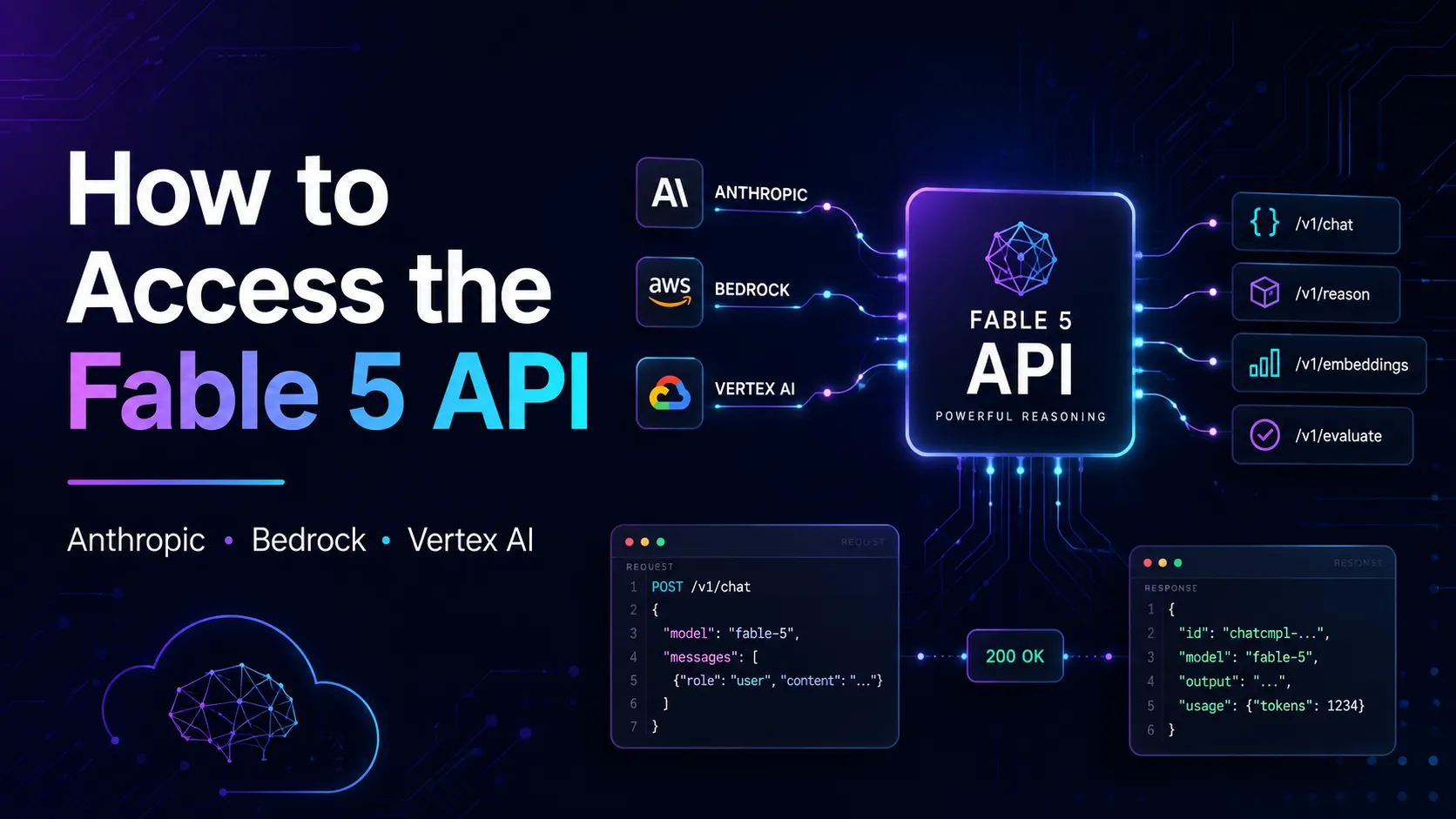
Claude Fable 5 is available through the Claude API, AWS Bedrock, and Google Vertex AI, making it accessible through both direct and enterprise cloud routes.
Pricing is positioned at the premium frontier-model tier: Fable 5 and Mythos 5 are listed at $10 per million input tokens and $50 per million output tokens, which makes cost control, prompt caching, batching, and response-length discipline essential for production deployments.
Fable 5 is not the same as Mythos 5. Fable 5 is the widely released, safeguarded model for demanding reasoning and long-horizon agentic work, while Mythos 5 remains limited through Project Glasswing and trusted-access pathways.
The most practical access path for developers is the Anthropic Console. Create or sign in to an Anthropic account, open the Claude Console, generate an API key, and call the Messages API using the Fable 5 model ID.
Enterprise teams should evaluate all three routes: direct Anthropic API for fastest access, AWS Bedrock for AWS-native governance, and Vertex AI for Google Cloud-native infrastructure.
What Is the Fable 5 API?
The Fable 5 API refers to programmatic access to Claude Fable 5, Anthropic’s widely released Mythos-class model. It is designed for workloads that require deep reasoning, complex software engineering, visual understanding, structured analysis, and longer agentic workflows.
Analysis shows that Fable 5 sits above ordinary chatbot usage. It is best understood as a premium reasoning engine for production systems where accuracy, planning depth, and tool use matter more than raw token price.
Typical use cases include:
- AI coding agents that need to inspect, refactor, and reason across large codebases.
- Research assistants that synthesize long technical documents.
- Data analysis copilots that explain trends, generate SQL, and audit assumptions.
- Enterprise workflow agents that plan multi-step operations with safety constraints.
- Productivity systems that require high-quality writing, review, and decision support.
Community feedback suggests that demand for Fable 5 is likely to concentrate around coding, security-aware software review, long-context reasoning, and high-value professional automation rather than casual Q&A.
Is the Fable 5 API Publicly Available?
Yes, Fable 5 is listed in Anthropic’s Claude API model documentation as a supported model with the Claude API ID claude-fable-5. It is also listed for AWS Bedrock and Google Vertex AI, although cloud availability can vary by region, account type, and provider rollout timing.
The important distinction is this:
- Claude Fable 5: broadly available, safeguarded, production-oriented model.
- Claude Mythos 5: restricted model available through Project Glasswing or trusted-access programs.
That means most developers searching for “Fable 5 API access” should not apply for Mythos 5. They should use Fable 5 unless they are part of a vetted security, research, or infrastructure program.
How to Access the Fable 5 API Through Anthropic
The direct Anthropic route is usually the fastest way to start building.
Step 1: Create an Anthropic Console Account
Go to the Claude developer platform and sign in to the Anthropic Console. The Console is where developers manage workspaces, billing, API keys, usage, and model access.
Step 2: Add Billing
Frontier models require paid API usage. Since Fable 5 is priced at a premium tier, teams should configure billing alerts before running large batch jobs or autonomous agents.
A practical starting budget depends on workload size:
- Prototype chatbot: low daily cap.
- Internal coding assistant: moderate cap with per-user monitoring.
- Batch document analysis: strict job-level token limits.
- Agentic coding system: hard stop-loss limits and logging.
Step 3: Generate an API Key
Create an API key inside the Console. Store it as an environment variable rather than hardcoding it in source code.
Recommended environment variable:
bash export ANTHROPIC_API_KEY="your_api_key_here"
Security best practices:
- Use separate keys for development, staging, and production.
- Rotate keys regularly.
- Never expose keys in browser-side JavaScript.
- Restrict key access through secrets managers such as AWS Secrets Manager, Google Secret Manager, Doppler, or 1Password Secrets Automation.
Step 4: Use the Correct Fable 5 Model ID
For the direct Claude API, use:
text claude-fable-5
A minimal Python request looks like this:
`python import anthropic
client = anthropic.Anthropic()
message = client.messages.create( model="claude-fable-5", max_tokens=1024, messages=[ { "role": "user", "content": "Analyze the trade-offs between PostgreSQL and ClickHouse for product analytics." } ] )
print(message.content[0].text) `
A minimal Node.js request looks like this:
`js import Anthropic from "@anthropic-ai/sdk";
const anthropic = new Anthropic({ apiKey: process.env.ANTHROPIC_API_KEY, });
const message = await anthropic.messages.create({ model: "claude-fable-5", max_tokens: 1024, messages: [ { role: "user", content: "Design a scalable architecture for an AI document analysis platform." } ] });
console.log(message.content[0].text); `
How to Access Fable 5 Through AWS Bedrock
AWS Bedrock is the best route for teams already standardized on AWS security, networking, IAM, logging, and procurement.
The Bedrock model ID is typically:
text anthropic.claude-fable-5
A typical AWS Bedrock deployment flow is:
- Open the AWS Bedrock console.
- Request access to Anthropic models if needed.
- Confirm Fable 5 availability in the target region.
- Configure IAM permissions for
bedrock:InvokeModelor Converse API usage. - Route application calls through
bedrock-runtime.
Bedrock is especially useful when an organization needs:
- Centralized AWS billing.
- IAM-based access control.
- VPC, CloudTrail, and enterprise audit workflows.
- Multi-model routing inside AWS.
- Procurement through existing AWS contracts.
The trade-off is that Bedrock availability can lag behind direct Anthropic access in some regions or account configurations.
How to Access Fable 5 Through Google Vertex AI
Google Vertex AI is the strongest option for teams already running on Google Cloud.
The Vertex AI model ID is typically:
text claude-fable-5
Vertex AI is a good fit when the application already depends on:
- BigQuery analytics.
- Google Cloud IAM.
- Cloud Run or GKE.
- Vertex AI model governance.
- Google-native data pipelines.
For data-heavy AI products, Vertex AI can simplify architecture because prompts, retrieval pipelines, analytics workloads, and model calls can live inside the same cloud environment.
Fable 5 API vs Mythos 5 API
Many developers confuse Fable 5 with Mythos 5 because both belong to Anthropic’s Mythos-class model family. The difference matters for access, safety, and product planning.
| Feature | Claude Fable 5 | Claude Mythos 5 |
|---|---|---|
| Availability | Broadly released | Restricted |
| Main access route | Claude API, Bedrock, Vertex AI | Project Glasswing / trusted access |
| Intended users | Developers, enterprises, product teams | Vetted security and research partners |
| Safeguards | Stronger public safeguards | Fewer restrictions |
| Claude API ID | claude-fable-5 | claude-mythos-5 |
| Best fit | Production apps and general advanced reasoning | Controlled high-risk research contexts |
Analysis shows that Fable 5 is the correct target for almost all commercial product builders. Mythos 5 access should be treated as a specialized program, not a standard API upgrade path.
Fable 5 API Pricing and Cost Strategy
Fable 5 is priced at:
- Input tokens: $10 per million tokens.
- Output tokens: $50 per million tokens.
That pricing places Fable 5 in the high-end reasoning model category. The model may still be cost-effective for difficult tasks if it reduces retries, improves accuracy, or completes workflows that cheaper models fail to finish.
Example Cost Scenarios
| Scenario | Input Tokens | Output Tokens | Estimated Cost |
|---|---|---|---|
| Short reasoning request | 2,000 | 800 | ~$0.06 |
| Long technical analysis | 20,000 | 4,000 | ~$0.40 |
| Codebase review batch | 200,000 | 30,000 | ~$3.50 |
| Heavy agentic workflow | 1,000,000 | 150,000 | ~$17.50 |
These estimates show why Fable 5 should not be used blindly for every task. It is better suited for the hardest 10–30% of requests where quality matters most.
When Should Developers Use Fable 5 Instead of Cheaper Models?
Benchmarks and deployment patterns indicate that premium reasoning models create the most value when the task has high complexity, high ambiguity, or high cost of failure.
Use Fable 5 for:
- Architecture decisions where poor reasoning can create expensive technical debt.
- Complex debugging across multiple files, logs, and dependency chains.
- Long-form technical writing requiring structure, accuracy, and synthesis.
- Multi-step agents that need planning and self-correction.
- High-stakes business analysis involving trade-offs, assumptions, and edge cases.
Use cheaper models for:
- Simple rewriting.
- Classification.
- Short FAQ responses.
- Basic extraction.
- Routine customer-support drafts.
- Low-risk summarization.
A strong production pattern is model routing:
- Send simple tasks to a cheaper model.
- Escalate complex tasks to Fable 5.
- Use Fable 5 as a reviewer for high-value outputs.
- Cache stable responses and repeated system prompts.
Recommended Architecture for Fable 5 API Applications
A production Fable 5 application should not be a thin wrapper around a single API call. The best architecture includes routing, observability, safety, and cost control.
1. Request Router
Classify requests before sending them to Fable 5.
Routing signals can include:
- Prompt length.
- User tier.
- Task type.
- Required reasoning depth.
- Prior model failure.
- Whether tool use is needed.
2. Prompt Compression Layer
Because input tokens cost $10 per million, long prompts should be compressed before execution.
Useful tactics:
- Remove duplicate context.
- Summarize old conversation turns.
- Use retrieval instead of pasting entire documents.
- Keep system prompts short and stable.
- Split large jobs into structured chunks.
3. Output Budgeting
Output tokens cost five times more than input tokens. Set max_tokens intentionally.
Practical defaults:
- Short answer: 512–1,024 tokens.
- Technical analysis: 2,000–4,000 tokens.
- Long report: 6,000–10,000 tokens.
- Agent step: keep narrow, then loop.
4. Observability
Track:
- Tokens per request.
- Cost per user.
- Cost per workflow.
- Latency.
- Error rate.
- Refusal rate.
- Escalation rate.
- User satisfaction or acceptance rate.
Without observability, Fable 5 can become expensive before teams understand where the value is coming from.
5. Safety and Policy Handling
Fable 5 includes stronger public safeguards than Mythos 5. Applications should expect some high-risk requests to be blocked, redirected, or constrained.
Product teams should design explicit fallback behavior:
- Explain policy boundaries clearly.
- Offer safe alternatives.
- Avoid repeated retry loops on blocked tasks.
- Log refusal categories for product analysis.
- Do not attempt to bypass model safeguards.
Common Fable 5 API Errors and Fixes
Model Not Found
Likely causes:
- Wrong model ID.
- Account does not yet have access.
- Cloud provider region does not support the model.
- SDK version is outdated.
Fixes:
- Confirm the model ID is
claude-fable-5for Anthropic direct API. - Update the Anthropic SDK.
- Check account access and billing.
- If using Bedrock or Vertex AI, verify regional model availability.
Authentication Failed
Likely causes:
- Missing API key.
- Expired or revoked key.
- Key stored under the wrong environment variable.
- Serverless environment not loading secrets.
Fixes:
- Confirm
ANTHROPIC_API_KEYis available at runtime. - Rotate the key.
- Check deployment secrets.
- Never test with keys exposed in client-side code.
Rate Limit Exceeded
Likely causes:
- Too many concurrent requests.
- Long-running agent loops.
- Batch jobs without throttling.
- Shared API key across multiple services.
Fixes:
- Add exponential backoff.
- Queue large jobs.
- Use per-user quotas.
- Split workloads by API key or workspace where appropriate.
- Contact the provider for higher limits if usage is legitimate.
Unexpected Refusal or Fallback
Likely causes:
- Prompt touches restricted cybersecurity, biological, chemical, or other high-risk content.
- The system prompt asks the model to ignore safeguards.
- The application is using ambiguous instructions.
Fixes:
- Rewrite the task in a clearly defensive, educational, or benign frame.
- Remove unsafe operational details.
- Provide compliance context when relevant.
- Use safer analysis modes rather than exploit-generation requests.
Best Practices for Prompting Fable 5
Fable 5 is most effective when prompts are structured, explicit, and outcome-driven.
A strong prompt usually includes:
- Role: what expertise the model should apply.
- Task: what output is required.
- Context: only the relevant information.
- Constraints: format, length, tools, assumptions.
- Evaluation criteria: how success should be judged.
Example:
text You are a senior backend architect. Analyze the following API design for scalability, security, and developer experience. Return the answer in four sections: risks, trade-offs, recommended changes, and implementation priority. Be specific. Do not rewrite the entire API unless necessary.
For coding tasks, include:
- Runtime version.
- Framework version.
- File structure.
- Error logs.
- Expected behavior.
- Current behavior.
- Constraints such as “minimal patch” or “do not change public API.”
Fable 5 API vs Claude Opus 4.8
Fable 5 is positioned above earlier Claude models for the most demanding reasoning and long-horizon agentic work. Opus 4.8 remains an important option for coding, professional work, and agentic tasks at a lower tier.
| Dimension | Fable 5 | Opus 4.8 |
|---|---|---|
| Best for | Hardest reasoning and long-horizon work | Strong general coding and professional tasks |
| Cost | Higher | Lower |
| Public availability | Broad API/cloud access | Broad API/cloud access |
| Ideal usage | Escalation model, expert agent, final reviewer | Primary daily workhorse |
| Cost strategy | Use selectively | Use broadly where quality is sufficient |
The practical recommendation is not to replace every model call with Fable 5. Instead, use Fable 5 where better reasoning changes the outcome.
Production Checklist for Fable 5 API Access
Before launching a Fable 5-powered product, teams should complete this checklist:
- Confirm model access in the chosen provider.
- Validate model ID and SDK version.
- Add billing alerts and usage caps.
- Implement request retries with exponential backoff.
- Log token usage by feature and user.
- Add prompt and response evaluation tests.
- Create fallback behavior for refusals and rate limits.
- Use server-side key storage only.
- Separate development and production API keys.
- Add model routing to avoid overusing Fable 5.
- Evaluate output quality against real user tasks.
- Monitor cost per successful task, not just cost per token.
Who Should Use the Fable 5 API?
Fable 5 is best suited for teams building products where model quality is directly tied to revenue, reliability, or user trust.
Strong fits include:
- AI coding platforms.
- Developer tools.
- Technical research assistants.
- Legal or policy analysis tools with human review.
- Enterprise knowledge systems.
- Data-analysis copilots.
- AI workflow automation platforms.
- High-end writing and review tools.
Weak fits include:
- Commodity chatbots.
- Low-margin content generation.
- Simple summarization apps.
- Basic extraction workflows.
- High-volume support bots with repetitive questions.
For many applications, the best architecture is hybrid: cheaper models handle volume, while Fable 5 handles complexity.
Conclusion
Accessing the Fable 5 API is straightforward if the goal is to use Claude Fable 5 rather than restricted Mythos 5. Developers can use the direct Anthropic API with claude-fable-5, or deploy through AWS Bedrock and Google Vertex AI depending on infrastructure needs.
The strategic question is not simply how to get access. The deeper question is where Fable 5 creates enough value to justify premium pricing.
Analysis shows that Fable 5 is best deployed as a high-intelligence layer for complex reasoning, coding, long-horizon agents, and expert review. Teams that combine model routing, prompt compression, output budgeting, and observability will get better economics than teams that send every request to the most expensive model by default.
For developers and product teams, the next step is clear: start with a small controlled prototype, measure cost per successful task, compare Fable 5 against lower-cost Claude models, and promote it only where the quality difference is visible to users.
Continue Reading
More articles connected to the same themes, protocols, and tools.


Referenced Tools
Browse entries that are adjacent to the topics covered in this article.

Hyper3D MCP
MCP ServersHyper3D MCP is Hyper3D's hosted Rodin MCP server for creating 3D assets from natural-language instructions or supported references, checking asynchronous generation progress, and retrieving model download links inside AI coding clients. Official setup is documented for Codex, Claude Code, and Kimi Code CLI.





PaidSync.ai
MCP ServersPaidSync.ai is a hosted MCP server for paid advertising that exposes 610+ tools across 14 advertising, analytics, tagging, and commerce platforms. It supports read/write workflows from AI clients including ChatGPT, Claude, Gemini, Cursor, Claude Code, and Codex, with a free plan.