Fable 5 Subscription Guide: Plans, Usage Credits, Pricing, Limits, and When It’s Worth Paying For
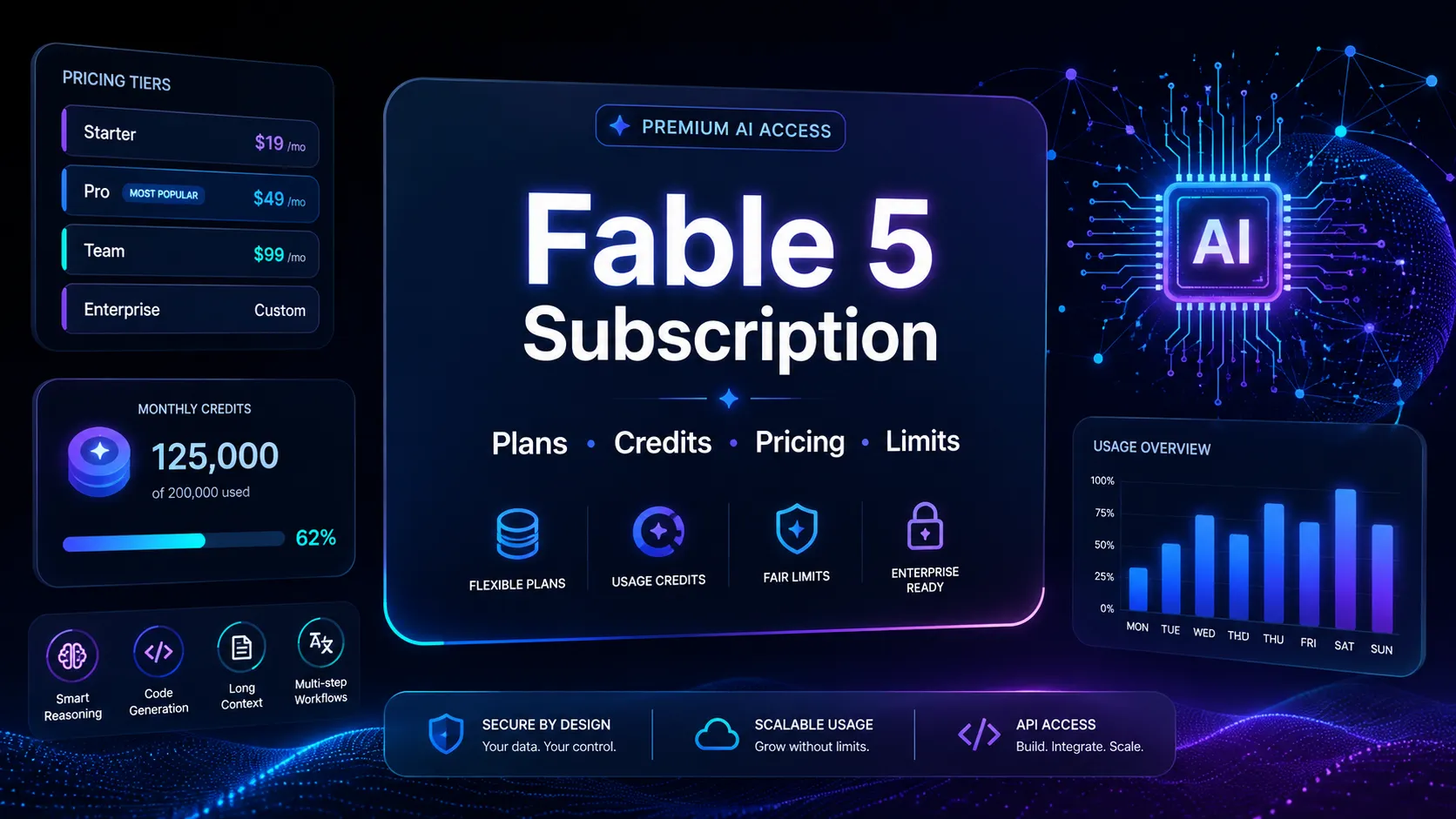
Key Takeaways
- Claude Fable 5 is not best understood as a simple “monthly subscription model.” It is available through several access paths: Claude subscription plans, usage credits, consumption-based Enterprise, Claude API, and major cloud marketplaces.
- As of June 2026, Fable 5 is temporarily included on Pro, Max, Team, and seat-based Enterprise plans at no extra cost through June 22. From June 23 onward, continued use on those plans is expected to require usage credits unless capacity changes.
- API pricing is usage-based: $10 per million input tokens and $50 per million output tokens, with a 90% input-token discount for prompt caching.
- Fable 5 is designed for expensive, high-value work: long-horizon coding, agentic workflows, document-heavy analysis, vision tasks, and complex research—not routine chatbot queries.
- The biggest subscription pitfall is assuming “included” means unlimited. Capacity, credits, model routing, safety fallbacks, and data-retention rules all affect the real cost and usability.
- Teams handling sensitive data should review retention carefully. Fable 5 requires 30-day data retention for safety monitoring and is not currently a zero-data-retention model.
What Is a Fable 5 Subscription?
A Fable 5 subscription refers to paid access to Claude Fable 5 through Claude’s consumer, team, enterprise, or developer channels. The phrase can be confusing because Fable 5 is not sold only as a fixed monthly product.
In practice, there are four main access models:
| Access path | Best for | Pricing style | Main caveat |
|---|---|---|---|
| Claude Pro / Max | Individual power users | Subscription plus possible usage credits | Included access may be capacity-limited |
| Claude Team | Small teams and operators | Seat-based subscription plus possible usage credits | Needs governance around shared usage |
| Seat-based Enterprise | Larger organizations | Seat-based plan plus staged Fable access | May require credits after included window |
| Consumption-based Enterprise / API | Developers and production workloads | Token-based usage | Cost depends heavily on prompt size and output length |
The most important distinction is this: subscription access controls eligibility, while credits or token billing control actual high-volume usage.
That means a user can be subscribed to Claude and still encounter practical limits if:
- Fable 5 demand exceeds available capacity.
- The included access window changes.
- Usage credits are required for continued access.
- The request is routed away from Fable 5 due to safeguards.
- Enterprise data-retention policies do not allow the workload.
Current Fable 5 Availability for Subscription Plans
Claude Fable 5 launched with staged subscription availability because demand is expected to be high. The current rollout is structured around capacity management rather than a permanent unlimited entitlement.
As of the June 2026 rollout:
- Pro, Max, Team, and seat-based Enterprise plans include Fable 5 at no extra cost through June 22.
- Starting June 23, Fable 5 usage on those plans is expected to require usage credits.
- Anthropic has indicated that Fable 5 may later return as a standard part of subscription plans when capacity is sufficient.
- Claude API and consumption-based Enterprise users get full usage-based access from launch.
This creates a practical buying rule:
For casual use, a subscription may be enough during the included window. For predictable business use, credits or API billing should be treated as the real cost model.
Fable 5 Pricing: Subscription vs API vs Usage Credits
Fable 5 has two different pricing conversations: subscription access and usage-based compute cost.
The official API price is:
text Input: $10 per 1,000,000 tokens Output: $50 per 1,000,000 tokens
Prompt caching can reduce repeated input costs:
text Cached input discount: 90% Effective cached input price: about $1 per 1,000,000 cached input tokens
For US-only inference, the listed multiplier is:
text US-only inference: 1.1x input and output token pricing
That means Fable 5 becomes expensive when the workload generates long outputs, repeated reasoning, or large document contexts. The model is most cost-effective when it saves human time on tasks that would otherwise require senior engineering, legal, research, or analysis work.
Example Cost Scenarios
The following examples show why subscription users should think in terms of task economics, not only monthly plan price.
| Scenario | Input tokens | Output tokens | Estimated API cost |
|---|---|---|---|
| Short coding question | 10,000 | 2,000 | $0.20 |
| Large codebase analysis | 300,000 | 20,000 | $4.00 |
| Long document review | 700,000 | 30,000 | $8.50 |
| Agentic coding run | 1,500,000 | 100,000 | $20.00 |
| Heavy multi-step research | 3,000,000 | 200,000 | $40.00 |
Approximate formula:
text cost = (input_tokens / 1,000,000 * 10) + (output_tokens / 1,000,000 * 50)
With prompt caching:
text cached_input_cost = cached_input_tokens / 1,000,000 * 1 new_input_cost = new_input_tokens / 1,000,000 * 10 output_cost = output_tokens / 1,000,000 * 50
The key insight: output tokens are five times more expensive than input tokens. Long, verbose answers can cost more than large prompts. For production use, controlling output length is as important as compressing input context.
Who Should Pay for Fable 5?
Fable 5 is most compelling when the task has one or more of these characteristics:
- Long horizon: The task requires many steps, decisions, validations, or revisions.
- High ambiguity: The model must infer goals, resolve trade-offs, and plan execution.
- Large context: The task requires reading many files, documents, diagrams, tables, or screenshots.
- High leverage: A correct answer saves hours of senior work.
- Agentic execution: The model uses tools, writes code, runs tests, checks results, and iterates.
Good use cases include:
- Large code migrations.
- Multi-file refactors.
- Deep technical research.
- Complex spreadsheet and finance analysis.
- Contract and document review.
- Long-form product planning.
- Agent workflows in Claude Code or managed agent environments.
- Vision-heavy work involving charts, PDFs, UI screenshots, or diagrams.
Poor use cases include:
- Simple rewriting.
- Short brainstorming.
- Basic Q&A.
- Translation.
- Lightweight summarization.
- Routine customer support macros.
- Low-stakes content generation.
For those simpler tasks, a cheaper or faster Claude model may deliver better cost-performance.
Fable 5 vs Other Claude Plans and Models
The subscription decision should not be framed as “Fable 5 or nothing.” A better framework is model routing.
| Workload | Recommended model strategy |
|---|---|
| Simple chat and rewriting | Use a lower-cost model first |
| Normal coding help | Use Sonnet or Opus-class models unless stuck |
| Hard debugging | Escalate to Fable 5 after cheaper attempts fail |
| Multi-day coding agents | Start with Fable 5 if the work is high-value |
| Sensitive data workflows | Review retention before using Fable 5 |
| Biology or cybersecurity queries | Expect possible safeguards or fallback behavior |
| Long document workflows | Use Fable 5 when reasoning quality matters more than cost |
The optimal setup for teams is usually:
text Default model: lower-cost Claude model Escalation model: Fable 5 Fallback model: Opus-class model Governance: usage caps + logging + review
This keeps Fable 5 reserved for work that justifies the compute cost.
Subscription Limits and Usage Credits Explained
A common mistake is assuming that a paid Claude subscription automatically means unlimited Fable 5 access. Frontier models are constrained by GPU capacity, safety review, and cost.
In practice, access may depend on:
- Plan type.
- Regional availability.
- Temporary launch-window rules.
- Usage credits.
- Demand and capacity.
- Organization settings.
- Safety classifiers.
- Data-retention eligibility.
Usage credits are especially important after the initial included window. They allow Anthropic to make Fable 5 available to subscribers without promising unlimited access under a fixed monthly price.
For users, this means:
- A subscription is the entry point.
- Credits are the throttle for expensive usage.
- API billing is the most predictable option for production systems.
Data Retention: The Subscription Detail Many Teams Miss
Fable 5 currently requires 30-day data retention for safety monitoring. This matters because some organizations require zero-data-retention processing for confidential, regulated, or customer-sensitive workloads.
Before using Fable 5 for enterprise work, teams should classify data into three buckets:
| Data type | Fable 5 suitability |
|---|---|
| Public documentation | Generally suitable |
| Internal non-sensitive planning | Usually suitable with policy review |
| Source code | Depends on company policy |
| Customer data | Requires legal/security review |
| Regulated health, finance, or legal data | Requires strict review |
| Secrets, credentials, private keys | Do not send |
Best practice:
text Never paste secrets, tokens, passwords, private keys, unreleased financials, or regulated personal data into any AI system unless the organization has approved that exact workflow.
This is not just a compliance issue. It is also an operational issue: once teams start using frontier models for long-running agentic work, they often expose more context than intended.
Safeguards, Refusals, and Fallback Behavior
Fable 5 includes safety classifiers for sensitive domains such as cybersecurity and biology. When a request is flagged, the system may decline the request or route it to another model.
For API developers, this creates an important integration requirement: a refusal can be returned as a successful HTTP 200 response rather than a normal API error.
A robust application should check the stop reason:
json { "stop_reason": "refusal" }
Recommended handling pattern:
`text
- Send task to Fable 5.
- Check whether the response is completed or refused.
- If refused, retry with an approved fallback model.
- Inform the user when the model changed.
- Track cost, latency, and refusal rate. `
This matters for subscription users too. A request may appear to “not work” when the issue is not subscription status, but safeguard routing.
How to Decide Whether Fable 5 Is Worth the Subscription Cost
Use this decision matrix:
| Question | If yes | If no |
|---|---|---|
| Does the task save at least 30–60 minutes of expert work? | Fable 5 may be worth it | Use a cheaper model |
| Does the task require long-context reasoning? | Fable 5 is a strong fit | Use standard Claude models |
| Is the task simple and repetitive? | Automate with cheaper models | Fable 5 is likely overkill |
| Is data retention acceptable? | Proceed with controls | Avoid or use a ZDR-compatible path |
| Does the workflow need predictable production cost? | Use API or Enterprise consumption | Subscription alone may be insufficient |
| Is output length large? | Add output caps | Cost may spike |
A practical rule:
Use Fable 5 when the cost of a wrong or shallow answer is higher than the cost of frontier inference.
That makes it suitable for senior-level analysis, complex coding, and high-value operational work. It is less suitable for everyday content tasks where cheaper models already perform well.
Advanced Cost Optimization Tips
1. Use Fable 5 only as an escalation model
Do not route every request to Fable 5. Use a cheaper model to classify task difficulty first.
text If task_complexity < high: use standard model else: use Fable 5
2. Cap output length
Because output tokens are expensive, ask for structured, concise outputs.
`text Return only:
- final answer
- changed files
- test results
- unresolved risks `
3. Reuse context with prompt caching
For repeated work on the same project, cache stable context such as:
- System instructions.
- Repository architecture.
- Product requirements.
- Style guides.
- API documentation.
- Long reference documents.
4. Split large tasks into checkpoints
Long-running work should be staged:
text Plan → execute → test → summarize → continue
This reduces runaway cost and improves reviewability.
5. Add fallback models
For apps and workflows, define a fallback path so a Fable refusal does not break the user experience.
text Primary: Fable 5 Fallback: Opus-class model Final fallback: ask user to revise request
6. Track cost per completed task, not cost per message
The correct metric is not “price per prompt.” It is:
text cost_per_successful_deliverable = total_model_cost / accepted_outputs
A model that costs more per token can still be cheaper if it needs fewer retries, fewer corrections, and less human cleanup.
Common Pitfalls
Pitfall 1: Buying Fable 5 for basic chatbot use
Fable 5 is a frontier model for difficult work. Using it for simple writing prompts is like using a supercomputer as a calculator.
Pitfall 2: Ignoring the June 23 credit change
Users who rely on included subscription access should plan for the post-window credit requirement. Teams should budget before moving workflows onto Fable 5.
Pitfall 3: Forgetting retention requirements
Data retention is not a footnote. It can determine whether Fable 5 is usable for regulated or confidential work.
Pitfall 4: Not handling refusals
Developers should not treat every HTTP 200 response as a completed answer. The application must inspect the response status and stop reason.
Pitfall 5: Letting agents run without budgets
Agentic workflows can expand quickly. Use task budgets, checkpoints, and explicit completion criteria.
Pitfall 6: Comparing subscription price without comparing productivity
A cheaper model is not always cheaper if it requires many retries. Fable 5 should be evaluated by completed task quality, not only token price.
Recommended Setup for Individuals
For individual users, the best approach is:
- Use Claude Pro or Max if Fable 5 is available in the plan.
- Reserve Fable 5 for high-value work.
- Use cheaper models for drafts, summaries, and simple coding questions.
- Avoid sending sensitive personal or business data.
- Track which tasks actually benefit from Fable 5.
Suggested workflow:
text Simple task → standard Claude model Hard task → Fable 5 Sensitive task → verify retention and policy first Repeated task → create reusable prompt + cached context
Recommended Setup for Teams
Teams should treat Fable 5 as a premium internal capability, not a casual chat upgrade.
Recommended controls:
- Define approved use cases.
- Create a data classification policy.
- Require review for customer or regulated data.
- Set usage budgets by team or workflow.
- Log model selection and fallback events.
- Track refusal rates.
- Measure accepted deliverables.
- Compare Fable 5 against cheaper Claude models on real internal tasks.
A mature team setup looks like this:
`text
- Intake task
- Classify sensitivity
- Classify complexity
- Route to standard model or Fable 5
- Apply budget
- Run task
- Validate output
- Store cost and quality metrics `
This approach prevents overuse while preserving Fable 5 for tasks where it creates the most value.
Fable 5 Subscription FAQ
Is Fable 5 included with Claude Pro?
During the initial rollout window, Fable 5 is included on Pro, Max, Team, and seat-based Enterprise plans through June 22, 2026. After June 23, usage credits are expected to be required unless capacity allows an extension or policy change.
Is Fable 5 unlimited?
No. Fable 5 should not be assumed to be unlimited. Access can depend on plan type, credits, demand, safeguards, and capacity.
How much does Fable 5 cost through the API?
The listed API price is $10 per million input tokens and $50 per million output tokens. Prompt caching can reduce repeated input-token cost by 90%.
Is Fable 5 available on AWS, Google Cloud, and Microsoft Foundry?
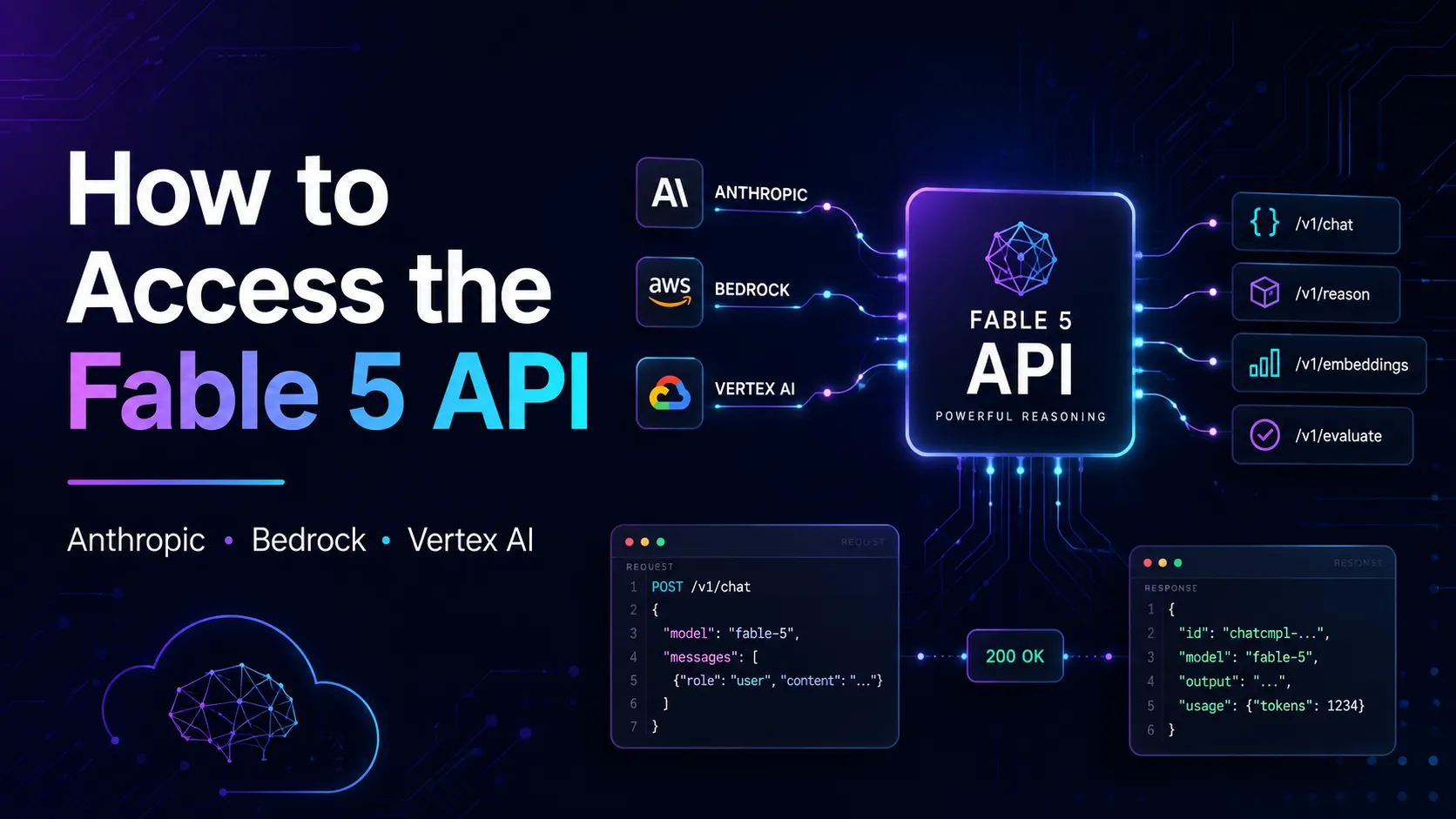
Yes. Fable 5 is available through the Claude Platform and supported cloud marketplaces, including AWS, Google Cloud, and Microsoft Foundry.
Does Fable 5 support long context?
Yes. Fable 5 supports a 1 million token context window by default and up to 128,000 output tokens per request in the documented API specs.
Does Fable 5 return raw chain of thought?
No. Raw reasoning content is not returned. Developers can use summarized thinking display where supported, but raw chain-of-thought content is not exposed.
Can Fable 5 refuse requests?
Yes. Fable 5 includes safety classifiers and may refuse or route certain sensitive requests, especially in domains such as cybersecurity and biology.
Is Fable 5 good for coding?
Benchmarks and partner feedback position Fable 5 as a top-tier model for long-horizon coding, agent workflows, migrations, testing, and complex implementation work.
Is Fable 5 good for normal content writing?
It can write well, but it may be overkill for routine content. For standard blog drafts, summaries, and rewrites, cheaper models may be more efficient.
Should businesses use Fable 5 with confidential data?
Only after reviewing data retention, legal, security, and compliance requirements. Fable 5 currently requires 30-day data retention for safety monitoring.
Conclusion
Fable 5 subscription access is best viewed as premium access to frontier reasoning capacity, not a simple unlimited monthly chatbot upgrade.
For individuals, it is most valuable when used selectively for complex coding, research, document analysis, and high-stakes reasoning. For teams, the strongest setup is a routed workflow: standard models for routine tasks, Fable 5 for hard problems, clear usage budgets, and strict data controls.
The smartest next step is to audit current AI workflows and identify the tasks where better reasoning, longer context, and fewer retries would save the most time. Those are the tasks where Fable 5 is most likely to justify its subscription, credits, or API cost.
Continue Reading
More articles connected to the same themes, protocols, and tools.


Referenced Tools
Browse entries that are adjacent to the topics covered in this article.

PaidSync.ai
MCP ServersPaidSync.ai is a hosted MCP server for paid advertising that exposes 610+ tools across 14 advertising, analytics, tagging, and commerce platforms. It supports read/write workflows from AI clients including ChatGPT, Claude, Gemini, Cursor, Claude Code, and Codex, with a free plan.

Hyper3D MCP
MCP ServersHyper3D MCP is Hyper3D's hosted Rodin MCP server for creating 3D assets from natural-language instructions or supported references, checking asynchronous generation progress, and retrieving model download links inside AI coding clients. Official setup is documented for Codex, Claude Code, and Kimi Code CLI.