Anthropic’s 1GW Data Center Push: Why AI Companies Are Now Fighting for Power, Not Just Models
Key Takeaways
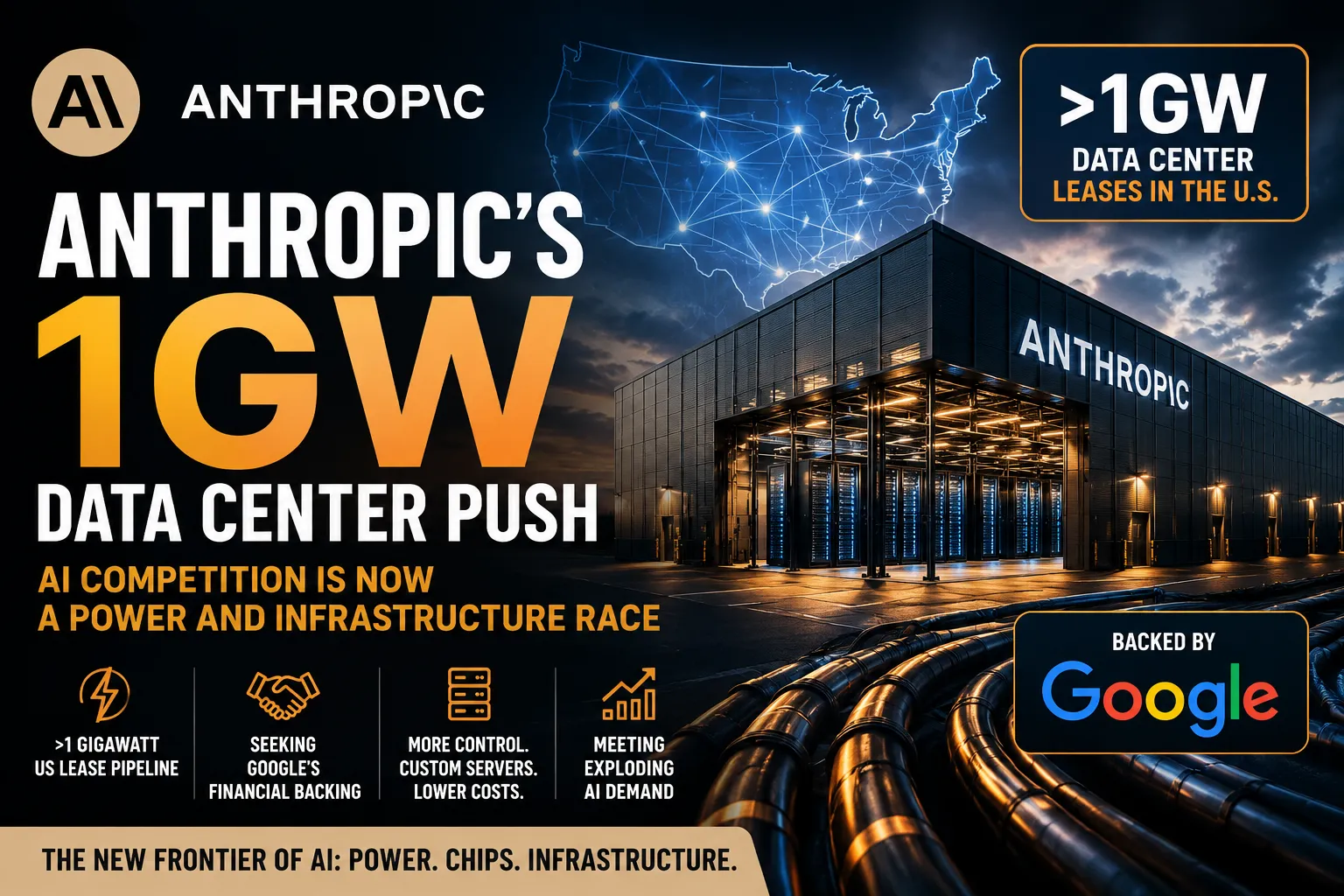
- Anthropic is reportedly pursuing more than 1GW of U.S. data center lease capacity, marking a major shift from cloud-only compute procurement to direct infrastructure control.
- The corrected figure is 1GW+, not 10GW signed capacity. The 10GW number appears closer to long-term planning or market speculation rather than confirmed lease commitments.
- Google’s potential financial backing matters because large AI data center leases require long-term credit support, chip alignment, and infrastructure confidence.
- Anthropic’s compute strategy is becoming multi-layered: AWS Trainium, Google TPU, Nvidia GPU capacity, Fluidstack facilities, SpaceX-linked compute, and now direct data center leasing.
- The AI race is turning into an energy and infrastructure race, where power access, cooling, land, grid interconnection, and financing may become as important as model quality.
- Bitcoin miners and power-rich data center operators may benefit, but only if they can convert raw power access into enterprise-grade AI infrastructure.
Anthropic’s 1GW Data Center Move Signals a New Phase in the AI Race
Anthropic, the company behind Claude, is reportedly pursuing its first major direct data center leasing push in the United States. According to reporting cited by Reuters from The Information, the company has signed more than a dozen preliminary agreements for U.S. data center leases with total capacity exceeding 1 gigawatt.
That number is the core of the story.
A gigawatt is not a normal software metric. It is an energy infrastructure metric. When an AI company begins discussing expansion in gigawatts, the competitive battleground has moved far beyond model benchmarks, chatbot interfaces, and API pricing.
The deeper signal is this:
Leading AI labs are no longer only buying compute from cloud providers. They are starting to lock down the physical infrastructure behind compute itself.
That means power, land, cooling, substations, servers, custom chips, long-term leases, and financing structures.
In simple terms, Anthropic is moving closer to the infrastructure layer that determines whether Claude can keep scaling.
The Correct Number: 1GW+, Not 10GW
One important clarification is necessary.
Some social media discussion initially framed the development as a 10GW data center leasing move. That appears to be inaccurate based on the currently reported information.
The stronger, more defensible version is:
- Anthropic has reportedly signed more than a dozen preliminary data center lease agreements.
- The combined U.S. capacity is more than 1GW.
- The company is reportedly seeking Google’s financial support to back part of the lease obligations.
- The larger 10GW figure is better treated as a possible long-term planning number or market interpretation, not confirmed signed lease capacity.
This distinction matters because data center capacity is often discussed across several different stages:
- Signed lease capacity: Contracted or preliminarily agreed capacity.
- Secured power: Power access reserved or controlled, but not necessarily deployed.
- Development pipeline: Sites that may be built over several years.
- Long-term target capacity: Strategic ambition rather than near-term operational capacity.
Confusing these categories can dramatically overstate what has actually been committed.
Why 1GW Is a Huge Number for AI Infrastructure
A single gigawatt equals 1,000 megawatts. In data center terms, that is enormous.
For comparison, many traditional enterprise data centers operate in the tens of megawatts. Hyperscale campuses can reach hundreds of megawatts. A gigawatt-scale AI infrastructure program belongs in the category of national-scale industrial infrastructure.
The reason is simple: modern AI workloads are extremely power-intensive.
Large-scale AI systems require:
- GPU, TPU, or custom accelerator clusters
- High-bandwidth networking between compute nodes
- Massive power delivery systems
- Advanced cooling, increasingly including liquid cooling
- Reliable grid access and long-term energy contracts
- Dense server racks capable of supporting AI training and inference loads
A 1GW buildout is not just a server purchase. It requires coordination across real estate, utilities, semiconductor supply chains, construction, cooling vendors, network hardware providers, and financial institutions.
That is why this development is so important. Anthropic is not merely expanding compute usage. It is participating more directly in the industrial supply chain behind AI.
Why Anthropic Needs More Direct Control Over Compute
Anthropic’s compute demand has likely expanded rapidly because Claude is no longer just a consumer chatbot. It is increasingly used across enterprise workflows, coding, research, customer operations, document analysis, and agentic software tasks.
Claude Code and similar developer-facing AI systems are especially compute-intensive because they involve long-context reasoning, codebase analysis, tool usage, and repeated interactions over complex projects.
As usage grows, AI companies face three pressure points:
- Availability: Can enough compute be accessed when demand spikes?
- Cost: Can inference and training costs be controlled over time?
- Customization: Can infrastructure be optimized for specific model architectures and workloads?
Traditional cloud procurement works well when a company is scaling within available cloud capacity. But frontier AI labs operate at a different scale. They need guaranteed access to accelerators, power, cooling, and networking years in advance.
Direct leasing gives Anthropic several advantages:
- Greater control over capacity planning
- More influence over hardware configuration
- Better long-term cost visibility
- Reduced dependence on any single cloud provider
- Ability to align facilities with custom chips and AI-specific workloads
The strategic pattern is clear: Anthropic is trying to reduce compute bottlenecks before they limit product growth.
Google’s Role: More Than a Financial Backer
The reported involvement of Google is one of the most important parts of the story.
Anthropic is not simply looking for a landlord. Large AI data center leases can involve long-term obligations worth billions of dollars. Data center developers and financing partners need confidence that the tenant can meet future payments.
A major strategic backer such as Google can help provide that confidence.
But Google’s role is not only financial. Google has also been a major compute partner for Anthropic, particularly through TPU infrastructure. Anthropic has expanded its work with Google and Broadcom around next-generation compute capacity, while continuing to use AWS and Nvidia-based systems as part of a diversified infrastructure strategy.
That creates a larger picture:
AI infrastructure is becoming an alliance model.
Instead of one AI lab simply buying cloud credits, the new model connects:
- AI model developers
- Cloud platforms
- Custom chip designers
- Data center developers
- Power providers
- Private capital
- Networking and cooling vendors
This is closer to an industrial consortium than a typical software vendor relationship.
Anthropic’s Broader Compute Strategy
The data center lease report fits into a broader pattern. Anthropic has already been moving aggressively to secure compute capacity through multiple channels.
Its infrastructure strategy appears to include:
- AWS Trainium for large-scale training and cloud partnership capacity.
- Google TPU capacity through expanded Google and Broadcom collaboration.
- Nvidia GPU capacity for workloads that benefit from the Nvidia ecosystem.
- Fluidstack-linked facilities for dedicated AI infrastructure.
- SpaceX-linked data center capacity, including access to large Nvidia accelerator clusters.
- Direct U.S. data center leases, which would give Anthropic more control over physical capacity.
This multi-provider strategy reduces single-vendor dependency. It also allows Anthropic to match workloads to different chip architectures.
That matters because not all AI workloads are the same.
- Frontier model training may require tightly networked accelerator clusters.
- Enterprise inference may require cost efficiency and geographic availability.
- Coding agents may require long-context memory and frequent tool calls.
- Multimodal workloads may require specialized hardware and storage patterns.
The winning infrastructure strategy is not simply “buy more GPUs.” It is to create a diversified compute portfolio that balances cost, performance, resilience, and future supply.
The Real Shift: AI Companies Are Becoming Infrastructure Companies
The software industry traditionally celebrates asset-light business models. SaaS companies can scale revenue without building factories, power plants, or physical logistics networks.
AI changes that assumption.
Every model response has a compute cost. Every long-context coding session consumes infrastructure. Every enterprise agent workflow increases inference demand. Every new frontier model requires larger and more expensive training runs.
This makes AI structurally different from classic software.
In SaaS, marginal cost can be very low. In AI, marginal cost is directly tied to computation.
That is why top AI companies increasingly resemble a hybrid of:
- Software platforms
- Cloud infrastructure companies
- Semiconductor customers
- Energy-intensive industrial operators
- Long-term infrastructure finance vehicles
The companies that win may not only have the best models. They may also have the best access to power, chips, data centers, and financing.
Why Power Is Becoming the New AI Bottleneck
The AI bottleneck has evolved over time.
First, the constraint was model architecture and research talent. Then it became access to GPUs. Now the constraint is increasingly the full stack behind compute.
Key bottlenecks include:
- Grid interconnection delays: New high-load data centers may wait years for utility approvals and connections.
- Transformer and substation shortages: Power infrastructure components have long lead times.
- Cooling requirements: High-density AI clusters often need advanced liquid cooling systems.
- Land and permitting: Suitable locations require power availability, fiber access, and regulatory approval.
- Chip supply: Accelerators remain expensive and supply-constrained.
- Financing: Multi-gigawatt buildouts require enormous upfront capital.
This is why access to existing power-rich sites has become strategically valuable.
A company with secured power, available land, and data center development capability may become a critical supplier to AI labs. But raw power alone is not enough.
What This Means for Bitcoin Miners and Power-Rich Data Center Operators
The Anthropic news has also attracted attention from investors watching companies such as Hut 8 and IREN.
The logic is understandable.
Many Bitcoin mining companies already control large power sites. During the crypto boom, those sites were used for mining. In the AI era, the market is asking whether they can be repurposed for AI compute.
Potential advantages include:
- Existing power contracts
- Large land footprints
- Experience operating power-intensive facilities
- Faster time-to-market than greenfield projects
- Ability to offer capacity to AI infrastructure partners
However, the conversion is not automatic.
Bitcoin mining facilities and AI data centers have very different requirements.
Common Pitfall: Assuming Mining Sites Can Instantly Become AI Data Centers
A mining site can tolerate operational characteristics that an enterprise AI customer may not accept. AI workloads often require much higher standards for uptime, network performance, cooling, rack density, and customer service.
Key differences include:
- Network architecture: AI training clusters require low-latency, high-bandwidth interconnects.
- Cooling density: AI racks can require more advanced thermal management.
- Reliability: Enterprise AI customers demand stronger uptime guarantees.
- Security and compliance: AI customers may require stricter physical and operational controls.
- Hardware lifecycle: AI accelerators are expensive and must be managed carefully.
The best-positioned companies will not be those that merely have power. They will be those that can turn power into bankable, enterprise-grade AI capacity.
That is the difference between a power story and an infrastructure business.
The Financing Layer: Why Private Capital Is Entering AI Compute
AI infrastructure is becoming attractive to private capital because it resembles long-duration infrastructure finance.
A data center developer can sign a long-term capacity agreement with a major AI company. That contract can then support debt financing, construction financing, or structured investment from large capital providers.
This is why firms such as Apollo, Blackstone, and other infrastructure investors are increasingly relevant to AI. The opportunity is no longer limited to buying AI software stocks. It includes financing the physical layer that AI companies need to operate.
The model looks similar to other infrastructure markets:
- A high-credit tenant signs a long-term agreement.
- A developer builds or operates the facility.
- A financing partner funds construction or expansion.
- The customer receives committed capacity.
- The investor receives long-term contracted cash flows.
In this structure, AI demand becomes the anchor for massive infrastructure projects.
Why This Matters for Claude and Anthropic’s Product Roadmap
Infrastructure expansion directly affects product capability.
More reliable compute access can help Anthropic improve:
- Claude API availability
- Enterprise deployment capacity
- Coding agent performance
- Long-context processing
- Multimodal model scaling
- Model training cadence
- Pricing flexibility
- Latency and throughput
The key point is that AI product quality is no longer only a research question. It is also an infrastructure execution question.
A company may have excellent model researchers, but if it cannot access enough compute, it may struggle to serve customers, train next-generation systems, or reduce costs.
For Anthropic, securing data center capacity is therefore not just a back-office decision. It is a product strategy decision.
Competitive Implications: OpenAI, Google, Meta, xAI, and Anthropic
Anthropic’s move should be viewed in the context of the broader frontier AI race.
OpenAI, Google, Meta, xAI, Amazon, and Anthropic are all competing for the same scarce resources:
- Advanced AI chips
- High-density data center space
- Power availability
- Grid interconnection rights
- AI infrastructure engineering talent
- Long-term financing capacity
This creates a new competitive dynamic.
A model lab with superior infrastructure access may be able to:
- Train larger models faster
- Serve more users reliably
- Offer lower inference pricing
- Support more enterprise customers
- Launch agent products at scale
- Maintain availability during demand spikes
That means infrastructure capacity can become a strategic moat.
The next generation of AI competition may be less about who announces the most impressive demo and more about who can operate the most efficient, reliable, and scalable compute system.
Advanced Analysis: Why Direct Leasing Changes the Economics
Direct data center leasing can change AI economics in several ways.
1. Better Long-Term Cost Control
Cloud compute can be flexible but expensive at scale. Direct leasing may allow Anthropic to negotiate longer-term infrastructure economics and optimize hardware utilization more directly.
2. Custom Hardware Integration
If Anthropic uses a mix of TPU, GPU, and custom accelerator capacity, direct or semi-direct control over data center environments can improve deployment efficiency.
3. Capacity Certainty
AI labs cannot wait until demand arrives to start building infrastructure. Data center lead times are long. Direct leasing creates a stronger forward capacity pipeline.
4. Stronger Negotiating Position
A company with multiple infrastructure channels can negotiate better terms with cloud providers, chip vendors, and data center operators.
5. Operational Complexity
The downside is complexity. Managing or coordinating dedicated infrastructure requires engineering, procurement, finance, legal, and operations capabilities that go beyond normal software scaling.
This is the trade-off: lower strategic dependence, but higher operational burden.
Common Misreadings of the Anthropic Data Center Story
Misreading 1: “Anthropic Signed 10GW”
The better-supported figure is more than 1GW of reported preliminary U.S. data center lease agreements. The 10GW number should not be treated as confirmed signed capacity.
Misreading 2: “This Means Anthropic Is Leaving Cloud Providers”
The evidence suggests the opposite. Anthropic appears to be diversifying compute rather than abandoning cloud partners. AWS, Google, Nvidia-based capacity, and dedicated facilities can all coexist.
Misreading 3: “Any Power-Rich Miner Can Become an AI Winner”
Power is necessary but not sufficient. AI infrastructure requires high-performance networking, cooling, uptime, security, and enterprise-grade execution.
Misreading 4: “This Is Only About Training Bigger Models”
Inference may become just as important. As Claude usage grows across enterprises and coding workflows, serving existing users can require enormous compute capacity.
Misreading 5: “Data Center Spending Is Separate From Product Quality”
Infrastructure directly affects product reliability, latency, cost, feature rollout, and enterprise adoption.
What to Watch Next
Several indicators will reveal whether Anthropic’s infrastructure strategy is working.
Watch for:
- Confirmed lease conversions from preliminary agreements to binding contracts.
- Named data center partners beyond currently reported relationships.
- Power delivery timelines for U.S. sites.
- Chip mix disclosures, especially TPU, Trainium, Nvidia GPU, and custom ASIC usage.
- Enterprise Claude adoption growth, especially in coding and agent workflows.
- Inference pricing changes, which may reflect improved compute economics.
- New financing structures involving infrastructure funds or strategic partners.
- Miner-to-AI conversion deals, especially where large power sites become contracted AI capacity.
The most important question is not whether Anthropic can announce capacity. It is whether that capacity can be delivered on time, at acceptable cost, and with the performance profile required for frontier AI workloads.
Conclusion
Anthropic’s reported 1GW+ U.S. data center leasing push is more than another AI expansion headline. It shows that the frontier AI race is moving into a new phase where power, chips, cooling, data center execution, and financing are becoming core competitive advantages.
The public conversation often focuses on which model is smarter. But behind every Claude response is a physical infrastructure stack: electricity, silicon, fiber, racks, cooling systems, and capital.
That stack is now becoming one of the most important battlegrounds in AI.
For builders, investors, and technology strategists, the takeaway is clear: AI infrastructure is no longer a background layer. It is becoming the industry’s central constraint and one of its biggest opportunities.
The next AI winners will not only build better models. They will secure the power and compute required to run them at global scale.
Continue Reading
More articles connected to the same themes, protocols, and tools.

How to Use Claude Fable 5: Complete 2026 Guide to Anthropic’s Most Powerful Public AI Model
Ostris AI Toolkit Guide: The Practical LoRA Training Suite for FLUX, Qwen, Z-Image, Wan, and Modern Diffusion Models
What Is Taste Skill? The Most Valuable Creative Superpower in the AI Era
Referenced Tools
Browse entries that are adjacent to the topics covered in this article.