What Is Taste Skill? The Most Valuable Creative Superpower in the AI Era
Key Takeaways
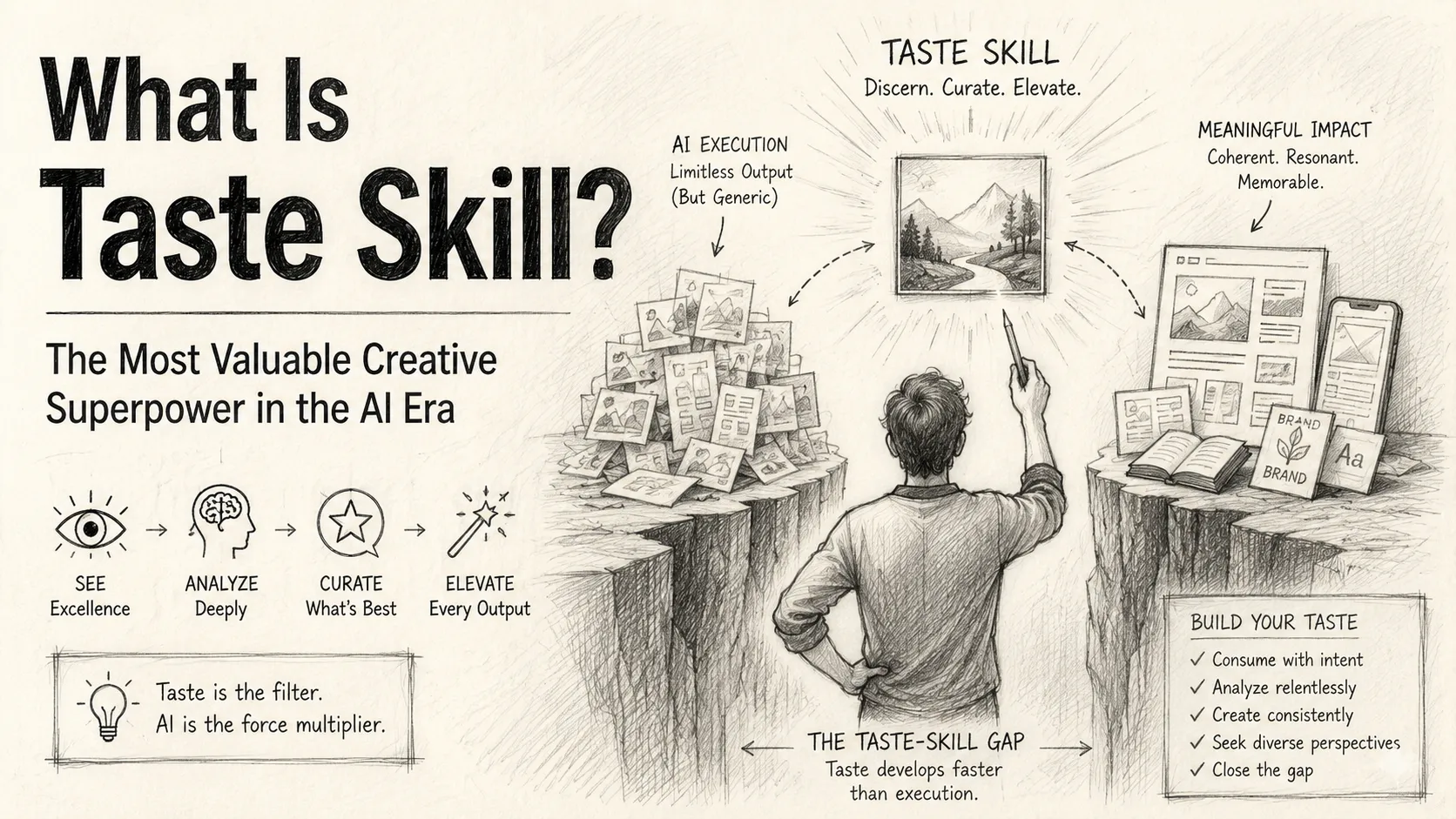
- Taste skill is the cultivated ability to recognize excellence in design, writing, code, and creative output—distinct from technical execution skills.
- The taste-skill gap explains why beginners feel frustrated: taste develops faster than the ability to produce matching results, a concept popularized by Ira Glass.
- In 2026, taste skill has become the ultimate differentiator as AI handles execution, making human judgment the rarest asset.
- Developing taste skill involves deliberate consumption, critical analysis, and consistent output—closing the gap through volume and feedback.
- Tools like portable AI agent skills now embed taste directly into workflows, preventing generic “slop.”
- Common pitfalls include echo-chamber consumption and trend-chasing; advanced practitioners curate cross-domain references and tune aesthetic parameters.
What Is Taste Skill?
Taste skill is the refined judgment that allows creators to identify what feels right—whether in layout, typography, narrative flow, user experience, or brand voice. It is not innate talent but a learnable competency built through exposure and analysis.
Unlike technical skills (writing clean code, mastering Figma shortcuts, or executing a perfect illustration), taste skill operates upstream. It answers questions like: Does this layout create visual hierarchy? Does this copy resonate emotionally? Is this UI calming or chaotic?
Analysis shows taste skill manifests as pattern recognition: the instinct for coherence, emotional impact, and strategic restraint. Benchmarks from creative communities indicate that professionals with strong taste skill consistently outperform peers in client satisfaction and market resonance, even when raw technical output is comparable.
The Taste-Skill Gap: Origins and Reality
The concept gained prominence through Ira Glass’s widely cited observation:
“All of us who do creative work, we get into it because we have good taste. But there is this gap. For the first couple years that you’re making stuff, it’s just not that good. It’s trying to be good, it has potential, but it’s not. But your taste—the thing that got you into the game—is still killer. And your taste is why your work disappoints you.”
Community feedback across design, writing, and product forums confirms this gap persists universally. Taste advances rapidly through passive consumption (scrolling exceptional work), while skill requires deliberate practice and iteration. The result? Beginners produce work that falls short of their own standards, leading to self-doubt or abandonment.
The gap is not permanent. Data from long-term creator studies shows it narrows through consistent volume: shipping weekly projects, soliciting targeted feedback, and dissecting masterworks element-by-element.
Why Taste Skill Matters More Than Ever in the AI Era
AI tools have commoditized execution. Models can generate production-ready code, polished visuals, and coherent copy in seconds. Yet the flood of output has made one factor irreplaceable: taste.
Recent discussions in tech and design communities highlight taste skill as the new core competency. When AI produces 100 variations, taste skill selects—or rejects—the one that actually matters. It prevents “slop”: generic, soulless interfaces that look functional but lack soul, hierarchy, or emotional resonance.
A prime example is the open-source Taste-Skill framework for AI agents. It delivers portable skills that enforce premium layout, typography, motion, and spacing. Features include adjustable dials for design variance, motion intensity, and visual density (scaled 1–10), plus specialized variants like minimalist, brutalist, or high-end soft UI. These skills transform boilerplate AI output into intentional, human-grade interfaces—demonstrating how taste can now be codified and scaled.
In marketing, product design, and content creation, taste skill drives differentiation. Benchmarks indicate that teams prioritizing taste curation see 2–3× higher engagement metrics compared to pure execution-focused workflows.
How to Develop Taste Skill: Actionable Strategies
Taste skill improves through structured practice rather than osmosis. Follow these evidence-based approaches:
- Curate high-signal references daily: Maintain a personal library of exceptional work across mediums. Analyze one piece per day: break down grid systems, color psychology, micro-animations, and copy rhythm.
- Practice critical consumption: For every piece you encounter, ask: “What works? What doesn’t? Why?” Document findings in a structured journal.
- Ship volume with constraints: Set weekly deadlines to produce and publish work. The Ira Glass method—consistent output—remains the fastest gap-closer.
- Seek external calibration: Share work in focused communities and request specific feedback on taste elements (hierarchy, emotional tone) rather than vague opinions.
- Cross-pollinate domains: Study architecture to improve UI spacing, film editing for narrative pacing, or typography history for modern branding.
Pro tip: Use AI as a sparring partner. Feed it your taste guidelines (e.g., “Apply premium editorial spacing with restrained motion”) and iterate until outputs align with your judgment.
Common Pitfalls That Kill Taste Skill Development
Even experienced creators fall into these traps:
- Echo-chamber consumption: Relying solely on algorithm-fed feeds homogenizes taste. Solution: deliberately seek outlier sources and historical references.
- Trend-chasing without understanding: Copying viral aesthetics without grasping underlying principles leads to dated work within months.
- Perfectionism paralysis: Waiting for skill to match taste prevents the volume needed to close the gap.
- Over-reliance on AI without guardrails: Accepting first-draft AI output without applying personal taste filters produces mediocre results at scale.
- Ignoring cultural context: Taste is contextual; what resonates in one market or demographic fails in another.
Avoiding these requires self-awareness and periodic taste audits: revisit work from six months ago and score it against current standards.
Advanced Techniques and Edge Cases
Seasoned practitioners elevate taste skill further:
- Parameter tuning: Mirror AI frameworks by creating personal “taste briefs”—documents listing non-negotiables (e.g., minimum contrast ratios, motion easing curves, whitespace philosophy).
- Redesign audits: Regularly take existing projects (yours or competitors’) and apply taste upgrades to hierarchy, density, and emotional flow.
- Image-to-code pipelines: Generate reference visuals first, then translate to code—ensuring taste leads technical execution.
- Edge case: taste-skill inversion: When skill exceeds taste (common in senior engineers), focus on consumption sprints to recalibrate judgment.
- Edge case: team scaling: Codify taste via shared style systems or AI skills so distributed teams maintain coherence without constant oversight.
These methods turn taste skill from a personal asset into an organizational multiplier.
Conclusion
Taste skill is no longer a nice-to-have—it is the defining creative advantage in an AI-saturated world. It bridges the gap between functional and unforgettable, between generic and ownable.
Start today: pick one reference project, dissect its taste elements, then recreate it under tight constraints. Build your personal taste library. Experiment with AI taste frameworks. The creators who close their taste-skill gap fastest will shape the next decade of design, products, and culture.
Take action now: Open your notes app and list three pieces of work you truly admire. Spend 30 minutes analyzing why they succeed. Your taste skill journey begins with that single deliberate step.
Continue Reading
More articles connected to the same themes, protocols, and tools.
What Is OC Maker? The AI Tool Revolutionizing Original Character Creation in 2026
Ostris AI Toolkit Guide: The Practical LoRA Training Suite for FLUX, Qwen, Z-Image, Wan, and Modern Diffusion Models
Javii Tools Review: The Tiny Browser Suite Behind Pixel-Perfect Creator Visuals
Referenced Tools
Browse entries that are adjacent to the topics covered in this article.

Hyper3D MCP
MCP ServersHyper3D MCP is Hyper3D's hosted Rodin MCP server for creating 3D assets from natural-language instructions or supported references, checking asynchronous generation progress, and retrieving model download links inside AI coding clients. Official setup is documented for Codex, Claude Code, and Kimi Code CLI.