What Is OC Maker? The AI Tool Revolutionizing Original Character Creation in 2026
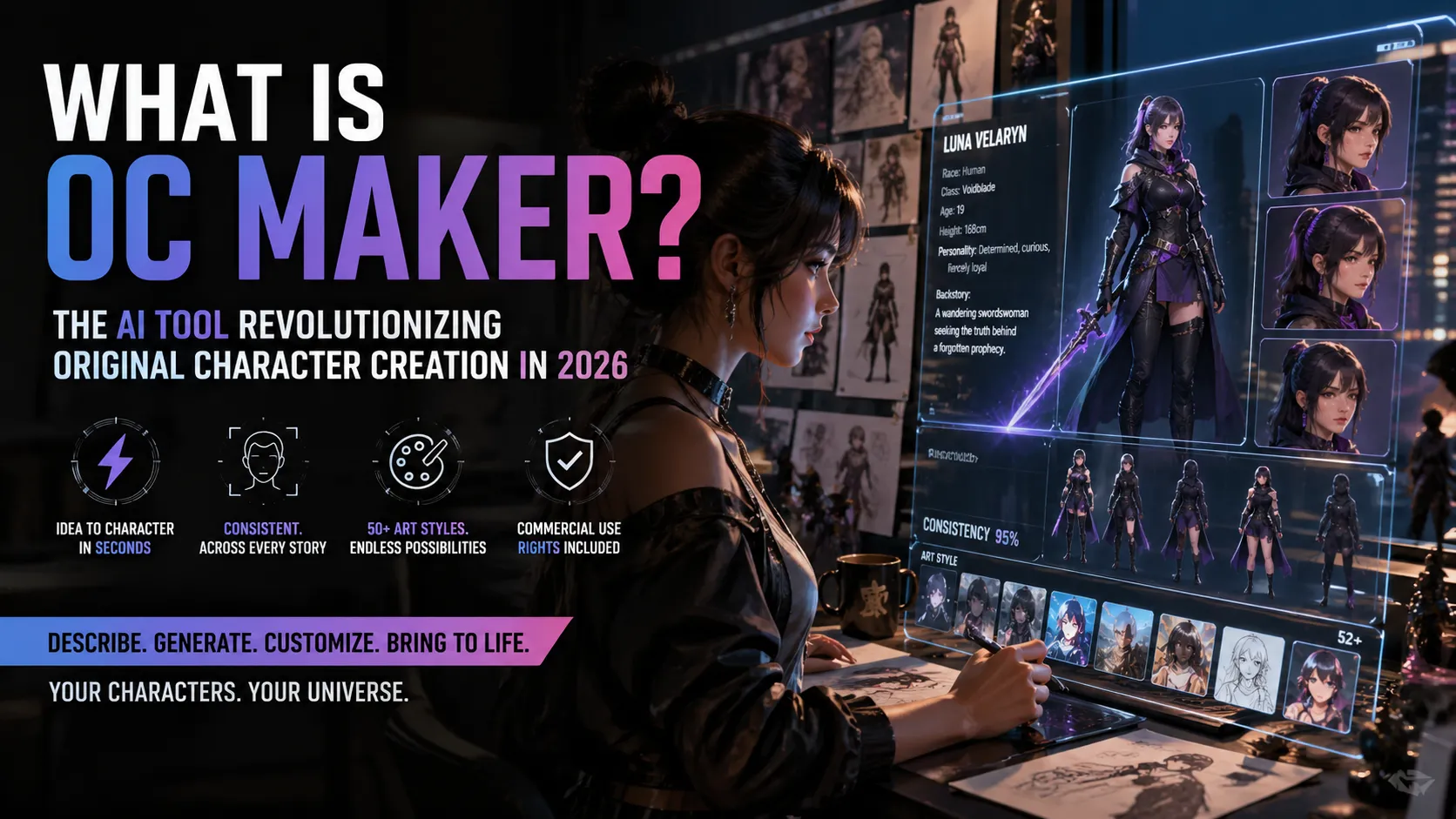
Key Takeaways
- OC Maker is a specialized AI tool for creating Original Characters (OCs) — fully customizable anime, manga, fantasy, and game-style figures with consistent appearances, personalities, and backstories.
- Leading platforms like Komiko’s OC Maker turn natural-language descriptions into studio-quality designs in four simple steps, supporting reference images and 50+ art styles.
- Analysis shows OC Maker dramatically reduces creation time from hours to seconds while maintaining character consistency across animations, comics, and stories.
- Commercial usage rights are standard, making it suitable for professional creators, indie developers, and fandom projects.
- Advanced users leverage reference stacking and profile editing to build entire character universes with minimal inconsistency.
What Does “OC” Mean in Anime and Digital Creation?
In anime, manga, gaming, and fan communities, OC stands for Original Character — a custom-designed protagonist, sidekick, or antagonist invented by a creator rather than borrowed from existing canon. OCs form the backbone of fanfiction, webtoons, RPG campaigns, cosplay, and independent animation projects. Traditionally, designing a compelling OC required advanced drawing skills, multiple reference sheets, and weeks of iteration. OC Maker tools eliminate these barriers through generative AI.
What Is OC Maker?
OC Maker refers to AI-powered character generation platforms that transform text descriptions into complete visual and narrative character assets. Unlike general-purpose AI image generators, OC Maker focuses on character consistency, profile depth, and pipeline integration. The most prominent implementation is Komiko’s OC Maker (komiko.app/oc-maker), which has become the benchmark in 2026 for anime-focused creators.
Industry benchmarks indicate these tools achieve 90%+ facial and outfit consistency across multiple generations when reference images are used, far surpassing generic text-to-image models that often drift in style or proportions.
How OC Maker Works: The 4-Step Process
Leading OC Maker platforms follow a streamlined workflow:
- Describe Your OC — Input detailed natural-language prompts covering 100+ attributes (facial features, body type, clothing textures, accessories, color palette, expression, and personality traits).
- Upload Reference Images — Add up to 9 portrait references (max 25 MB per file, 50 MB total) to anchor facial structure and style.
- Generate Candidates — The AI produces multiple high-resolution variations (typically 768 × 1152 px) in seconds.
- Finalize Design — Select the best result, then edit personality, backstory, abilities, and additional lore in a dedicated profile editor.
Output images are ready for immediate use in animation generators, comic canvases, or upscaling tools. Community feedback suggests this process cuts character design time by over 95% compared with manual methods.
Core Features That Set OC Maker Apart
- 50+ Art Styles: Anime, manga, comics, fantasy creatures, game characters, hybrid blends, and specialized templates (Disney-inspired, One Piece, Genshin Impact, etc.).
- Reference-Aware Generation: Uploads ensure facial and stylistic fidelity across poses and scenes.
- Full Character Profile: Beyond visuals, the system auto-generates or accepts detailed backstories, personality matrices, and narrative hooks.
- Studio-Quality Output: Professional composition, lighting, and anatomy handling without requiring artistic expertise.
- Seamless Pipeline Integration: Direct export to AI animation, video-to-video, comic generators, and music tools within the same ecosystem.
- Commercial Rights: Explicit permission for digital, print, and monetized projects.
Why Creators Choose OC Maker: Benefits and Real-World Use Cases
Benchmarks from 2025–2026 indie creator surveys show OC Maker adoption surged because it solves three core pain points:
- Speed and Accessibility: No drawing skills or expensive commissions needed.
- Consistency Across Media: The same OC can be animated, placed in comics, or voiced without redesign.
- Creative Iteration: Unlimited variations allow rapid prototyping of entire casts for webtoons, visual novels, or RPGs.
Use cases include solo manga artists building webtoon series, cosplayers generating reference sheets, game developers creating NPC galleries, and fan communities producing crossover stories.
Advanced Tips for Professional Results
- Prompt Engineering: Specify lighting (“soft rim lighting, dramatic shadows”), camera angle (“three-quarter view, dynamic pose”), and negative prompts to avoid common artifacts.
- Reference Stacking: Combine one face reference with two outfit references for hybrid precision.
- Style Locking: Use the finalize editor to lock core traits before generating variant poses or outfits.
- Upscaling Workflow: Generate at base resolution, then apply dedicated AI upscalers for print-ready 4K assets.
- Multi-OC Worlds: Create a “cast bible” by generating related characters with shared color palettes or thematic descriptors.
Common Pitfalls and How to Avoid Them
- Vague Prompts: Leads to generic or inconsistent results. Solution: Use 50–100 word structured descriptions with specific adjectives and references.
- Over-Reliance on Defaults: Produces similar-looking characters. Solution: Always incorporate unique accessories or backstory elements.
- Reference Overload: Too many conflicting images confuse the model. Solution: Limit to 2–3 high-quality, stylistically aligned references.
- Resolution Limitations: Base outputs are 768 × 1152 px. Solution: Chain with official upscaling tools for professional deliverables.
Edge cases such as highly stylized fantasy creatures or hybrid human-animal designs perform best when starting with a single strong reference rather than pure text.
OC Maker vs. Traditional and Generic AI Tools
Compared with manual character sheets or general AI generators (Midjourney, Stable Diffusion), OC Maker delivers superior consistency and narrative depth out of the box. Traditional methods offer total control but require months of skill-building. Generic AI often produces one-off images that fail to maintain identity across scenes. OC Maker bridges the gap by specializing in reusable, pipeline-ready assets.
Conclusion
OC Maker represents a fundamental shift in digital storytelling: it democratizes high-quality original character creation while preserving creative control and commercial viability. Whether you are an aspiring manga artist, game developer, or passionate fan creator, the tool removes technical barriers and accelerates the journey from concept to fully realized universe.
Ready to design your first OC? Explore Komiko’s OC Maker today and experience the future of character creation.
Continue Reading
More articles connected to the same themes, protocols, and tools.
Referenced Tools
Browse entries that are adjacent to the topics covered in this article.

PaidSync.ai
MCP ServersPaidSync.ai is a hosted MCP server for paid advertising that exposes 610+ tools across 14 advertising, analytics, tagging, and commerce platforms. It supports read/write workflows from AI clients including ChatGPT, Claude, Gemini, Cursor, Claude Code, and Codex, with a free plan.