Javii Tools Review: The Tiny Browser Suite Behind Pixel-Perfect Creator Visuals
Key Takeaways
- Javii Tools is best understood as a browser-based creator asset suite, not a general design platform and not a documented MCP server or AI-agent integration.
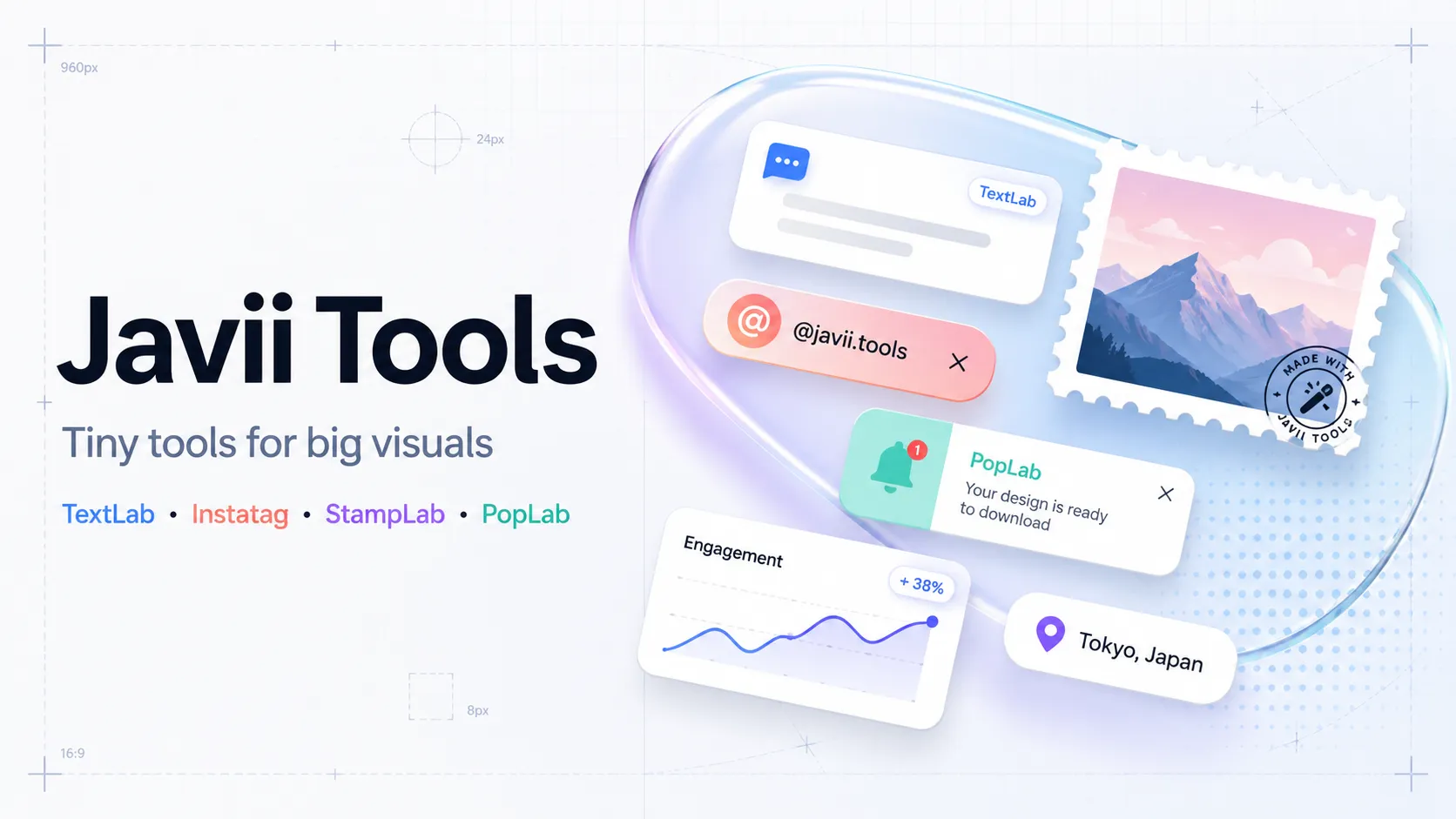
- Its strongest differentiator is pixel-accurate social UI generation: message bubbles, Instagram tags, postage-style cutouts, popups, charts, location pills, device/camera frames, and pixelation effects.
- Public product pages describe exports such as transparent PNG, HD/2K output, chroma-key MP4, and 4K video for Premium users, depending on the specific tool and plan. (javiitools — tiny tools for big visuals)
- The privacy posture is unusually relevant for creators handling drafts: the policy says uploads and typed text stay in the browser by default, while accounts, Premium status, saved dump designs, and optional Pinterest data require server-side storage. (javiitools — tiny tools for big visuals)
- The biggest pitfall is licensing: the free tier is described as personal and non-commercial, while Premium includes commercial rights for Javii Tools assets; Pinterest-sourced content remains subject to third-party rights. (javiitools — tiny tools for big visuals)
What Is Javii Tools?
Javii Tools is a collection of small browser apps for creating polished social visuals without opening a full design tool. The official homepage positions it as “all in one for content,” covering mockups, stamps, overlays, and tags across several focused tools. (javiitools — tiny tools for big visuals)
The suite is useful because it does not try to replace Canva, Figma, Photoshop, or a timeline editor. Instead, it compresses a narrow but common workflow: take a piece of text, a screenshot idea, a product note, a comment, a location, or a photo, then turn it into an export-ready visual asset.
That narrowness is the point. For creators, indie makers, newsletter writers, short-form video editors, and product marketers, many repeated tasks are not “design projects.” They are micro-assets:
- a fake message bubble for a thumbnail
- a transparent Instagram-style mention tag
- a postage-stamp cutout
- a pop-up overlay for a video
- a small chart with a native-app feel
- a pixelated region for privacy or dramatic effect
- a canvas composition for social posts
Javii Tools fits that use case better than heavyweight editors because it trades infinite control for fast, opinionated output.
Why Javii Tools Is Getting Attention
Analysis shows three reasons the product stands out in a crowded design-tool market.
First, it targets creator-native formats. TextLab supports message, text, media, and interface mockups such as iMessage-style messages, WhatsApp-style bubbles, Instagram and TikTok comments, YouTube comments, notifications, widgets, search bars, alert dialogs, reminders, and calendar rows. (javiitools — tiny tools for big visuals)
Second, the visual system is engineered rather than assembled from random templates. The public icon-grid page documents production SVG paths, proportional units, bubble geometry, stamp perforations, pill radii, rosettes, chart rings, and folder silhouettes. That matters because social mockups break quickly when spacing, rounding, alignment, or export scaling is slightly off. (javiitools — tiny tools for big visuals)
Third, it is structured around exports, not just editing. The homepage highlights transparent PNG, chroma-key MP4, animated motion, and higher-resolution outputs. For video creators, this is important: an overlay that can be dropped directly into CapCut, Premiere, Final Cut, DaVinci Resolve, or a browser editor saves more time than a beautiful template that still needs cleanup.
Main Tools and What They Are For
TextLab is the core attention-grabber. It turns typed text into UI-style mockups, including messaging bubbles, comments, notifications, notes, search bars, and interface elements. It is best for thumbnails, social posts, launch graphics, and “conversation screenshot” storytelling.
Instatag creates Instagram-style tag bubbles. The homepage lists light, dark, and story-style variants, optional verified checks, a tip arrow, and transparent PNG export. (javiitools — tiny tools for big visuals)
StampLab creates postage-style cutouts. Its workflow is designed around dropping a photo, dragging a cutter, choosing square/vertical/horizontal/circle shapes, applying perforated edges, adding overlays or tints, and exporting transparent PNG. (javiitools — tiny tools for big visuals)
PopLab is aimed at social video overlays: follow popups, banners, captions, reactions, and CTAs. It is useful when a creator wants motion-ready assets without building them manually in a video editor.
PixelLab is for pixelating photos and videos. Public snippets describe multi-region pixelation and premium pixel-size control, which makes it relevant for privacy blurring, spoiler hiding, or stylized “leak” visuals. (javiitools — tiny tools for big visuals)
ChartLab is a minimalist chart generator. Its public page lists chart types such as trend bars, highlight bars, weekly bars, donut charts, gradient rings, area charts, multi-line charts, range bars, ranked bars, sparklines, and stacked bars. (javiitools — tiny tools for big visuals)
dump.cam is the broader canvas editor attached to the ecosystem. Its interface exposes image/video upload, templates, Pinterest, stickers, text, tools, filters, frames, forms, drawing, layers, artboards, pages, and export controls. (javiitools — tiny tools for big visuals)
Javii Tools vs Canva, Figma, Kapwing, and Photopea
Javii Tools should not be evaluated as “another Canva clone.” A more accurate comparison is by workflow.
| Tool | Best for | Where Javii Tools is stronger | Where Javii Tools is weaker |
|---|---|---|---|
| Canva | templates, brand kits, social campaigns | faster micro-assets and social UI mockups | less broad template ecosystem |
| Figma | product design, UI systems, collaboration | one-click creator exports without rebuilding components | not a full design system or collaboration workspace |
| Kapwing | browser video editing | quick transparent/chroma-key overlays | not a full timeline editor |
| Photopea | Photoshop-like manual editing | faster opinionated assets | less advanced layer-level image editing |
| Remove.bg | background removal | bundled with other creator visuals | dedicated background-removal tools may offer more automation options |
The practical takeaway: Javii Tools is strongest when the desired output already matches one of its built-in visual metaphors. If the goal is a complex brand system, a long video edit, or a fully custom interface, broader tools still make more sense.
Pricing and License Considerations
As of the public homepage checked on 2026-06-29, Javii Tools lists a free personal-use tier and Premium options. The pricing section publicly showed €4.99/month, €19.99/year, and a limited €29.99 lifetime offer, though pricing pages can change and should be rechecked before purchase. (javiitools — tiny tools for big visuals)
The key licensing distinction is more important than the headline price:
- Free tier: personal, non-commercial use.
- Premium: commercial license for assets generated from Javii Tools.
- Pinterest content inside dump.cam: not automatically covered by the Javii Tools Premium license.
- Platform mockups: the terms warn users not to present generated mockups as official Apple, Meta, Google, or other platform screenshots. (javiitools — tiny tools for big visuals)
For client work, ads, paid thumbnails, product pages, marketplace assets, or merchandise, the safer default is to treat Premium as required unless the usage is clearly personal.
Privacy and Security Review
The privacy policy is unusually direct. It states that Javii Tools is a hobby project run by a single person and that apps run in the browser. It also says uploaded photos and typed text stay local by default, while account and payment state use providers such as Google and Stripe. (javiitools — tiny tools for big visuals)
Important details for teams:
- Uploaded photos and text: described as local to the browser by default.
- Saved dump designs: saved as JSON snapshots and preview PNGs linked to a user account.
- Pinterest integration: optional and read-only, using
boards:readandpins:read. - Background removal in dump: described as on-device WebAssembly processing using
@imgly/background-removal. - Hosting and database: the privacy page lists Railway and Postgres.
- Tracking: the policy says the apps do not embed tracking cookies, analytics, or ad networks. (javiitools — tiny tools for big visuals)
This does not mean every use case is risk-free. Sensitive client assets, unreleased product screenshots, private creator drafts, or regulated content should still be reviewed under the organization’s own data-handling policy. The better conclusion is: Javii Tools has a creator-friendly privacy model, but saved cloud features and OAuth integrations still deserve normal SaaS review.
Advanced Workflow Tips
Use Javii Tools as an asset factory, not as the final source of truth.
A practical workflow looks like this:
text Idea or script → TextLab / Instatag / StampLab / ChartLab → export transparent PNG or chroma-key MP4 → compose in dump.cam, Canva, Figma, CapCut, Premiere, or Final Cut → final export for social, landing page, newsletter, or thumbnail
For cleaner results:
- Start with the final platform ratio. Use 1080×1440 for portrait social posts, 1080×1920 for vertical video, and 1200×630 or 1600×900 for blog/OG graphics.
- Use transparent PNG for static overlays. It avoids background cleanup later.
- Use chroma-key MP4 for motion overlays. This is better when an editor does not support true alpha video.
- Do not over-stack effects. A message bubble, tag, stamp, and sticker can work together, but too many native UI metaphors make the image look fake.
- Check legibility at mobile size. Social UI mockups often look good on desktop and become unreadable in feed previews.
- Keep proof assets separate. Generated mockups are not evidence of real messages, official platform screens, or authentic comments.
Common Pitfalls
Mistaking mockups for screenshots. Javii Tools is built for generated assets. The terms specifically warn against pretending mockups are official or real platform screenshots. (javiitools — tiny tools for big visuals)
Using free exports commercially. Free personal use is not the same as commercial rights. This matters for paid newsletters, sponsored posts, client deliverables, and advertising.
Assuming Pinterest content is licensed. Premium covers Javii Tools assets, not third-party Pinterest images or pins.
Choosing Javii Tools for full design production. It is excellent for fast creator components. It is not a replacement for a brand system, collaborative UI design, advanced photo retouching, or long-form video editing.
Ignoring platform UI drift. Apple, Meta, TikTok, YouTube, and Google interfaces change. A mockup that looks accurate today may need adjustments later.
Is Javii Tools an MCP Server or AI Agent Tool?
No public evidence shows Javii Tools as an MCP server, A2A agent, AI-agent framework, CLI package, or documented API integration. The verified public materials describe a hosted browser suite for visual generation.
For directories covering MCP and agent infrastructure, the correct classification is therefore tools, not mcp-server. This distinction matters because builders searching for MCP integrations usually expect documented transports such as stdio, HTTP, SSE, or WebSocket, plus install commands or mcpServers configuration. Those setup details are not publicly documented for Javii Tools.
Who Should Use Javii Tools?
Javii Tools is a strong fit for:
- short-form video creators who need quick overlays and motion-ready graphics
- newsletter operators who need visual hooks for posts and landing pages
- indie hackers creating launch screenshots, changelog visuals, and social proof mockups
- marketers producing fast, platform-native creative tests
- designers who want a shortcut for common social UI assets
- bloggers and SEO publishers who need custom featured images without a full design workflow
It is less ideal for:
- enterprise teams requiring SSO, audit logs, admin controls, and vendor procurement
- teams needing a documented API, MCP server, or automation endpoint
- designers building full UI systems or complex multi-page layouts
- users needing guaranteed platform-perfect screenshots for legal, compliance, or evidentiary use
Best Alternatives to Consider
Use Canva when templates, brand kits, and broad campaign assets matter more than pixel-specific social UI components.
Use Figma when the project requires design systems, component libraries, collaboration, or exact control over every layer.
Use Kapwing when the primary job is timeline-based video editing.
Use Photopea when Photoshop-style editing, masking, and manual compositing matter.
Use Remove.bg or similar dedicated tools when background removal is the only workflow and batch automation is more important than the larger creative suite.
Use Javii Tools when the job is repetitive, visual, social-native, and export-driven.
SEO and Content Strategy Angle
For publishers and directory builders, Javii Tools is a useful example of a new category: micro-design utilities for creator workflows.
The search opportunity is not just “javii tools.” Related intent clusters include:
- text message mockup generator
- iMessage mockup generator
- Instagram tag generator
- transparent PNG overlay maker
- social media popup generator
- postage stamp photo effect
- pixelate video online
- Apple-style chart generator
- creator tools for thumbnails
- Canva alternatives for quick mockups
The strategic insight is that users are not always searching for a suite. They search for the one asset they need right now. Javii Tools bundles those single-purpose jobs into a suite, which can increase repeat usage if each tool solves one task faster than a general editor.
Conclusion
Javii Tools is one of the more interesting browser-based creator suites because it focuses on small, repeatable, high-impact visual assets rather than trying to become another all-purpose editor.
Its strengths are clear: fast social UI mockups, SVG-based visual precision, transparent and chroma-key exports, a growing set of focused tools, and a privacy model that keeps many inputs local by default. Its limits are equally important: it is not an MCP server, not an automation API, not a full design platform, and not a shortcut around licensing or third-party content rights.
The best way to evaluate Javii Tools is practical: choose one real asset needed for a post, video, thumbnail, or launch page, generate it with the most relevant sub-tool, and compare the time-to-export against Canva, Figma, Kapwing, or Photopea. If the desired output matches a built-in Javii Tools format, the time savings can be substantial.
Continue Reading
More articles connected to the same themes, protocols, and tools.

Referenced Tools
Browse entries that are adjacent to the topics covered in this article.