Claude Response Incomplete? The Real Causes, Fixes, and Prevention Checklist
Key Takeaways
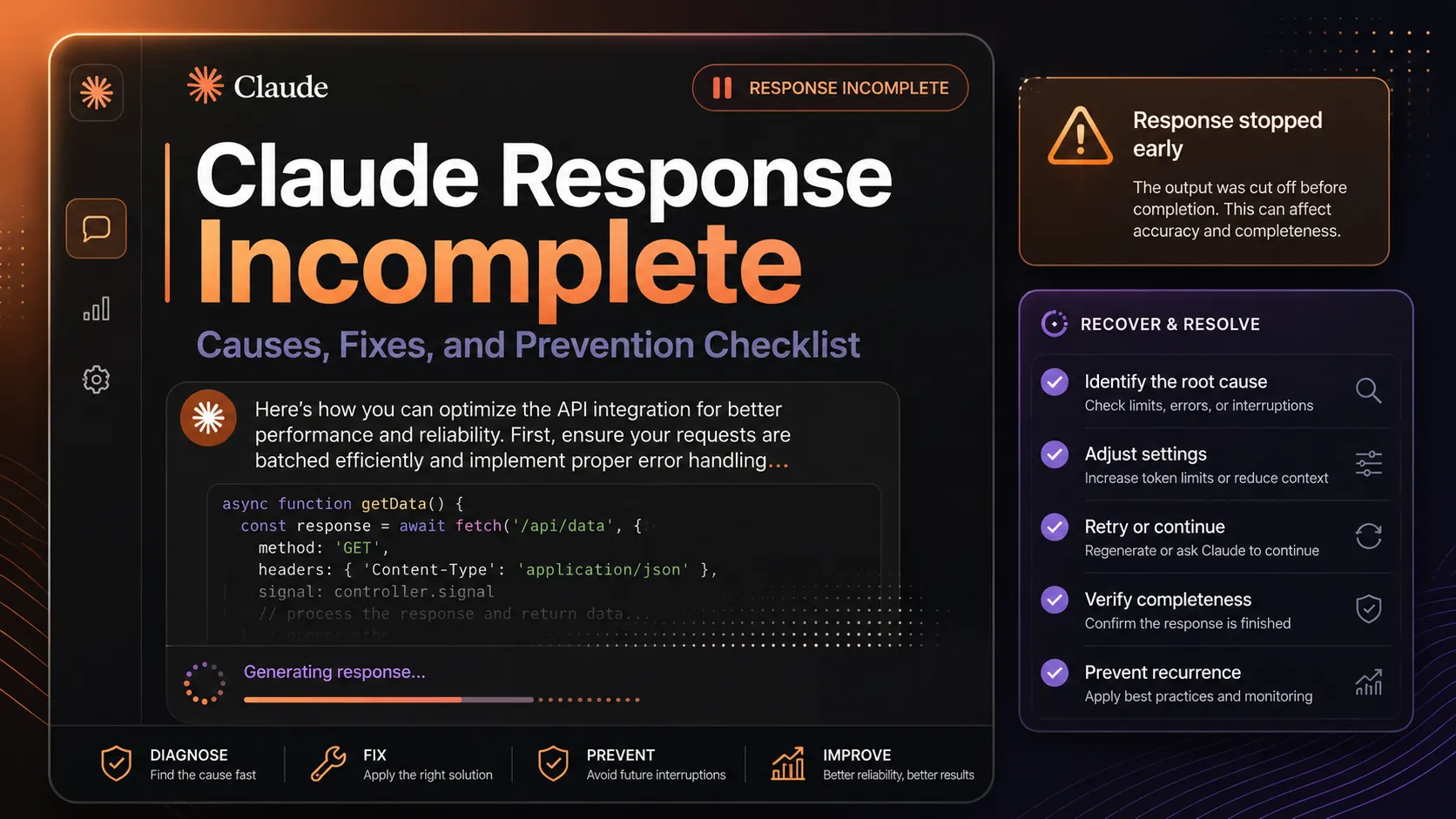
- An incomplete Claude response is usually caused by one of five things: output length limits, context window pressure, tool-use interruption, safety refusal, or service instability.
- For Claude API users, the most important field is
stop_reason. Anthropic documents values such asend_turn,max_tokens,stop_sequence,tool_use,pause_turn,refusal, andmodel_context_window_exceeded; each requires a different handling strategy. (Claude API Docs) - For Claude.ai users, long chats matter. Anthropic’s usage-limit guidance lists message length, file attachment size, current conversation length, tool usage, model choice, effort level, and artifacts as factors that can affect usage. (Claude帮助中心)
- The fastest fix is not always “please continue.” That can work for simple truncation, but API apps should inspect stop reasons, increase
max_tokens, continue apause_turn, execute pending tools, or restart a bloated conversation. - Recent Claude incidents show that incomplete or failed outputs can also be service-side. Anthropic’s status page recorded multiple June 2026 elevated-error and degraded-performance incidents across Claude models and services. (Claude状态)
What Does “Claude Response Incomplete” Mean?
“Claude response incomplete” usually means Claude started answering but stopped before the user received the full expected output.
The symptom can look different depending on where Claude is used:
- Claude.ai: the answer cuts off mid-sentence, stops after a few bullets, fails to finish an artifact, or asks the user to continue manually.
- Claude API: the response returns successfully but ends early because
stop_reasonismax_tokens,pause_turn,tool_use,stop_sequence, ormodel_context_window_exceeded. - Claude Code or agent workflows: Claude may stop after planning, tool calling, file reading, or partial edits.
- Browser or mobile app: the response may freeze, disappear, or fail during high load or degraded service.
The critical point: an incomplete response is not one single bug. It is a symptom. The right fix depends on whether Claude stopped naturally, hit a token ceiling, waited for a tool result, reached the context limit, refused part of the request, or encountered infrastructure errors.
Quick Diagnosis: Why Did Claude Stop?
Use this checklist first.
| Symptom | Most Likely Cause | Best Fix |
|---|---|---|
| Stops mid-sentence | Output token limit | Ask to continue or increase max_tokens |
API returns stop_reason: "max_tokens" | Response hit configured output cap | Raise max_tokens or chunk the task |
API returns stop_reason: "model_context_window_exceeded" | Input + output reached context window | Summarize context, split documents, reduce history |
API returns stop_reason: "tool_use" | Claude is waiting for a tool call to be executed | Execute the tool and send the result back |
API returns stop_reason: "pause_turn" | Server tool loop paused | Continue the conversation with the assistant response included |
Empty response with end_turn | Message structure issue after tool results | Fix tool-result formatting and add a new user continuation |
| Long Claude.ai chat stops often | Conversation is too large | Start a new chat with a compact checkpoint |
| Multiple models fail at once | Claude service incident | Check Claude status and retry later |
The Most Common Cause: Output Token Limits
The most straightforward reason Claude gives an incomplete answer is that the output reached its allowed token budget.
In the Claude API, Anthropic states that stop_reason: "max_tokens" means Claude stopped because it reached the max_tokens limit specified in the request. (Claude API Docs)
Example:
json { "model": "claude-opus-4-8", "max_tokens": 500, "messages": [ { "role": "user", "content": "Write a complete 5,000-word technical guide." } ] }
This request is structurally inconsistent. It asks for a long guide but caps the output at 500 tokens.
Better:
json { "model": "claude-opus-4-8", "max_tokens": 6000, "messages": [ { "role": "user", "content": "Write Part 1 of a technical guide. Cover only architecture, setup, and prerequisites. Stop after Part 1." } ] }
Best practice: match the requested deliverable to the available output budget. Long articles, code migrations, legal summaries, research briefs, and multi-file edits should be split into sections.
Claude.ai vs Claude API: Different Fixes
The same problem needs different handling depending on the product surface.
If Claude.ai gives an incomplete response
Try this order:
- Say: “Continue from the last complete sentence. Do not restart.”
- Ask for the missing section only. Example: “Write only sections 4–6.”
- Shorten the task. Ask for an outline first, then expand one section at a time.
- Start a new chat. Long conversations can increase context pressure.
- Remove unnecessary attachments. Large files consume context and usage budget.
- Check Claude Status. Service incidents can cause partial responses, failed generations, or slow output.
A strong continuation prompt:
text Continue exactly where the previous response stopped. Do not repeat earlier content. Start with the unfinished sentence if needed. Complete only the remaining sections.
If the Claude API gives an incomplete response
Do not rely only on visible text. Inspect the response metadata.
`js if (response.stop_reason === "max_tokens") { // Increase max_tokens or request a continuation. }
if (response.stop_reason === "tool_use") { // Execute the requested tool and return the tool_result. }
if (response.stop_reason === "pause_turn") { // Continue the server-tool loop. }
if (response.stop_reason === "model_context_window_exceeded") { // Reduce input, summarize history, or chunk documents. } `
Anthropic explicitly recommends checking stop_reason and handling truncation, context limits, tool use, pause turns, and refusals differently. (Claude API Docs)
API Stop Reasons That Cause Incomplete Responses
max_tokens
This is the classic truncation case.
Claude reached the maximum output tokens allowed by the request. The answer is valid but incomplete.
Fixes:
- Increase
max_tokens - Ask for a shorter output
- Generate in parts
- Continue with the previous assistant text included
- Add a visible completion rule, such as “End with
DONE”
Example continuation:
js const continuation = await client.messages.create({ model: "claude-opus-4-8", max_tokens: 2000, messages: [ { role: "user", content: originalPrompt }, { role: "assistant", content: partialText }, { role: "user", content: "Continue from the last sentence. Do not repeat earlier content." } ] });
model_context_window_exceeded
This means the combined input, conversation history, tool results, files, and output reached the model’s context window.
Anthropic documents model_context_window_exceeded as a stop reason available by default in Sonnet 4.5 and newer models, with earlier models requiring a beta header for that behavior. (Claude API Docs)
Fixes:
- Summarize older conversation history
- Remove irrelevant documents
- Split large inputs into chunks
- Ask for one output section at a time
- Use retrieval instead of pasting entire documents
- Keep only task-critical tool results
Bad prompt:
text Here are 12 full documents, 80 pages of logs, and a previous long chat. Now produce a complete audit report with all findings and appendices.
Better prompt:
`text Analyze only Document 1 and Document 2. Return:
- Critical findings
- Evidence table
- Open questions Do not write the final report yet. `
stop_sequence
A custom stop sequence can accidentally cut Claude off.
Anthropic documents stop_sequence as the stop reason returned when Claude encounters one of the developer’s custom stop sequences. (Claude API Docs)
Common mistakes:
- Using
ENDas a stop sequence when the answer naturally contains the word “end” - Using
###when Claude is writing Markdown headings - Using
</output>while also asking Claude to produce XML - Using a newline pattern that appears inside code blocks
Safer approach:
json { "stop_sequences": ["<FINAL_STOP_DO_NOT_WRITE>"], "messages": [ { "role": "user", "content": "Write the report. Do not output <FINAL_STOP_DO_NOT_WRITE>." } ] }
tool_use
tool_use does not mean Claude is finished. It means Claude is calling a tool and expects the application to execute it.
If the app fails to run the tool or fails to return a proper tool_result, the user may see a response that looks incomplete.
Fixes:
- Execute every requested tool call
- Return the result with the correct
tool_use_id - Preserve the assistant tool-use block in message history
- Send the tool result back before asking Claude for the final answer
pause_turn
pause_turn can happen when Claude is using server tools such as web search or web fetch. Anthropic states that this occurs when the server-side sampling loop reaches its iteration limit, and the application should continue by sending the assistant response back as-is. (Claude API Docs)
Fix:
`js if (response.stop_reason === "pause_turn") { messages.push({ role: "assistant", content: response.content });
const next = await client.messages.create({ model, max_tokens: 2000, tools, messages }); } `
Do not treat pause_turn as a failed answer. Treat it as a continuation step in an agent loop.
Empty end_turn
An empty answer with end_turn is especially confusing because end_turn normally means Claude finished naturally.
Anthropic notes that Claude can sometimes return an empty response with end_turn, especially after tool results, when the message pattern teaches Claude that the assistant turn is already complete. (Claude API Docs)
Common tool-result mistake:
json { "role": "user", "content": [ { "type": "tool_result", "tool_use_id": "toolu_123", "content": "Result here" }, { "type": "text", "text": "Here is the result" } ] }
Better:
json { "role": "user", "content": [ { "type": "tool_result", "tool_use_id": "toolu_123", "content": "Result here" } ] }
If it still happens, add a new user message:
text Please continue and produce the final answer using the tool result above.
Long Conversations Are a Hidden Cause
Claude often performs well in long chats, but very long conversations create practical pressure:
- More tokens are spent on old context
- More instructions can conflict
- More attachments and artifacts may be referenced
- More tool calls may be needed
- The available output budget can shrink
- The model may prioritize recent instructions over older ones
Anthropic’s usage guidance specifically lists current conversation length, file attachment size, tool usage, model choice, effort level, and artifact usage among factors that affect usage limits. (Claude帮助中心)
A clean restart often fixes incomplete answers faster than continuing a bloated thread.
Use this checkpoint prompt:
`text Create a compact checkpoint for this conversation. Include:
- Goal
- Decisions already made
- Important constraints
- Current draft or code state
- Remaining tasks
- Exact next step Keep it under 500 words. `
Then paste the checkpoint into a new chat and continue from there.
Prompt Problems That Make Claude Stop Early
Claude may produce short or incomplete answers when the prompt is ambiguous, overloaded, or internally contradictory.
Weak prompt:
text Write everything about Claude response issues. Make it complete, short, detailed, beginner-friendly, technical, and SEO optimized.
This asks for incompatible output qualities.
Better prompt:
`text Write a 1,500-word troubleshooting guide for users whose Claude responses stop early. Audience: technical users and API developers. Structure:
- Quick diagnosis table
- Claude.ai fixes
- Claude API stop_reason fixes
- Prevention checklist Do not include unrelated Claude features. End with a short conclusion. `
Strong prompts reduce incomplete responses because they define scope, output length, audience, and stopping point.
A Reliable Prompt Template for Complete Claude Answers
Use this when Claude keeps stopping early:
`text Task: [specific task] Audience: [who will read it] Length: [target length or number of sections] Output format: [Markdown / JSON / table / code]
Requirements:
- Cover all required sections.
- Do not skip edge cases.
- If the answer is too long, produce Part 1 and stop only after a complete section.
- End with: "Ready for Part 2" if more content remains.
Sections:
- [section name]
- [section name]
- [section name] `
This improves completion because it gives Claude a finish condition. Without a finish condition, the model may optimize for a shorter answer than the user expects.
How to Fix Incomplete Code Output
Code generation is especially prone to truncation because code is token-dense.
Better workflow:
- Ask for the file tree first.
- Generate one file at a time.
- Require complete code blocks.
- Ask Claude to state dependencies separately.
- Run the code and send back only the relevant error.
Prompt:
text Generate only one file: src/lib/parser.ts. Return the complete file in one code block. Do not include explanations before the code. If the file is too long, stop after a complete function and write "CONTINUE_FROM_FUNCTION: [name]".
For API apps, also set a realistic max_tokens. A complete TypeScript file, test suite, or migration script may require thousands of output tokens.
How to Fix Incomplete JSON Output
Incomplete JSON is common when the response is truncated.
Use a smaller schema and validate the result.
Prompt:
text Return valid JSON only. Use this schema: { "summary": "string", "items": [ { "title": "string", "reason": "string" } ] } Limit items to 5. Do not include Markdown.
API-side validation:
js function safeParseJson(text) { try { return { ok: true, data: JSON.parse(text) }; } catch (error) { return { ok: false, error: error.message, raw: text }; } }
If JSON is cut off, do not ask Claude to “fix everything” with the entire huge context. Ask for the missing array items or regenerate with fewer items.
How to Fix Incomplete Research Responses
Research tasks fail when the model tries to read, synthesize, cite, and write too much in one turn.
Better staged workflow:
- Step 1: collect sources
- Step 2: extract claims
- Step 3: compare disagreements
- Step 4: write outline
- Step 5: draft section by section
Prompt:
`text Do not write the final article yet. First, produce a source matrix with:
- Claim
- Evidence
- Confidence
- Gaps Limit output to 12 rows. `
This reduces truncation and improves factual quality.
Service Incidents and Capacity Issues
Incomplete Claude responses are not always caused by prompts or token settings.
Anthropic’s status page in June 2026 listed multiple resolved incidents involving elevated errors, degraded performance, and model-specific issues across Claude services. (Claude状态)
Signs of a service-side problem:
- Claude stops on simple prompts
- Multiple models fail
- Web and mobile fail together
- Claude Code or API requests show elevated errors
- Other users report the same issue
- Status page shows degraded performance or elevated errors
When this happens, local fixes have limited value. Save work, avoid repeated submissions, and retry after the incident stabilizes.
Prevention Checklist for Claude.ai Users
Use these habits to reduce incomplete answers:
- Start new chats for major new tasks. Do not keep unrelated work in one thread.
- Ask for outlines before full drafts. Expand sections one at a time.
- Use explicit length limits. Example: “Write 800–1,000 words.”
- Avoid huge pasted files. Summarize or attach only what is needed.
- Use checkpoints. Preserve project state before the thread becomes too long.
- Request complete units. Ask for one section, one file, or one table at a time.
- Check service status. Do this before rewriting prompts repeatedly.
Prevention Checklist for API Developers
Production apps should not assume every successful HTTP response contains a complete answer.
Required safeguards:
- Check
stop_reasonon every response - Handle
max_tokenswith continuation or a higher cap - Handle
pause_turnin server-tool loops - Handle
tool_useby executing tools and returning results - Detect incomplete JSON before sending it to users
- Log token usage and stop reasons
- Add retries for transient infrastructure failures
- Use chunking for large documents
- Summarize long histories
- Show users a clear “response truncated” message when needed
Example handler:
js function classifyClaudeResponse(response) { switch (response.stop_reason) { case "end_turn": return { status: "complete", action: "render" }; case "max_tokens": return { status: "truncated", action: "continue_or_raise_max_tokens" }; case "model_context_window_exceeded": return { status: "context_limited", action: "summarize_or_chunk" }; case "tool_use": return { status: "needs_tool", action: "execute_tool" }; case "pause_turn": return { status: "paused", action: "continue_agent_loop" }; case "stop_sequence": return { status: "stopped_by_sequence", action: "review_stop_sequences" }; case "refusal": return { status: "refused", action: "show_safe_alternative" }; default: return { status: "unknown", action: "inspect_response" }; } }
Common Mistakes to Avoid
- Only saying “continue” without diagnosing the cause. This can hide token or tool-loop bugs.
- Setting
max_tokenstoo low. Long tasks need realistic output budgets. - Using common stop sequences. Words like
END,STOP, or Markdown separators can appear naturally. - Pasting entire documents repeatedly. This wastes context and increases truncation risk.
- Ignoring tool states. A
tool_useresponse is not a final answer. - Retrying empty responses unchanged. Anthropic warns that simply retrying the same empty response pattern may not help. (Claude API Docs)
- Keeping one endless Claude.ai chat for every project. Long history increases complexity.
FAQ
Why does Claude stop in the middle of a sentence?
The most likely cause is an output limit. In the API, check whether stop_reason is max_tokens. In Claude.ai, ask Claude to continue from the last complete sentence and consider splitting the task.
Why does Claude give only half of the requested list?
The request may be too large, the chat may be long, or Claude may be optimizing for brevity. Specify the exact number of items, reduce the scope, or ask for the list in batches.
Why is Claude’s code incomplete?
Code is token-heavy. Ask for one file or one function at a time, require complete code blocks, and increase API max_tokens when needed.
Why does Claude return empty content?
In API tool workflows, an empty end_turn can happen when message structure around tool results is incorrect. Anthropic recommends sending tool results directly without extra text blocks after them. (Claude API Docs)
Can an outage cause incomplete Claude responses?
Yes. Anthropic’s status page has recorded elevated errors and degraded-performance incidents that can affect Claude outputs. Check status before assuming the prompt is the problem. (Claude状态)
Conclusion
A Claude response that stops early is usually fixable once the cause is identified.
For casual Claude.ai users, the best recovery path is simple: ask Claude to continue from the last sentence, reduce the task size, start a new chat when the thread is too long, and check service status when failures appear widespread.
For developers, the standard is higher: every Claude integration should inspect stop_reason, handle truncation, continue tool loops, validate structured outputs, and design around context limits.
The most reliable workflow is to treat completion as an engineering problem, not a guessing game. Build prompts and applications that define scope, preserve checkpoints, and recover gracefully when Claude stops before the job is done.
Continue Reading
More articles connected to the same themes, protocols, and tools.

Referenced Tools
Browse entries that are adjacent to the topics covered in this article.

PaidSync.ai
MCP ServersPaidSync.ai is a hosted MCP server for paid advertising that exposes 610+ tools across 14 advertising, analytics, tagging, and commerce platforms. It supports read/write workflows from AI clients including ChatGPT, Claude, Gemini, Cursor, Claude Code, and Codex, with a free plan.

Hyper3D MCP
MCP ServersHyper3D MCP is Hyper3D's hosted Rodin MCP server for creating 3D assets from natural-language instructions or supported references, checking asynchronous generation progress, and retrieving model download links inside AI coding clients. Official setup is documented for Codex, Claude Code, and Kimi Code CLI.