Claude Fable 5 Cost Explained: Pricing, Trade-Offs, and Real-World API Scenarios

Quick Comparison
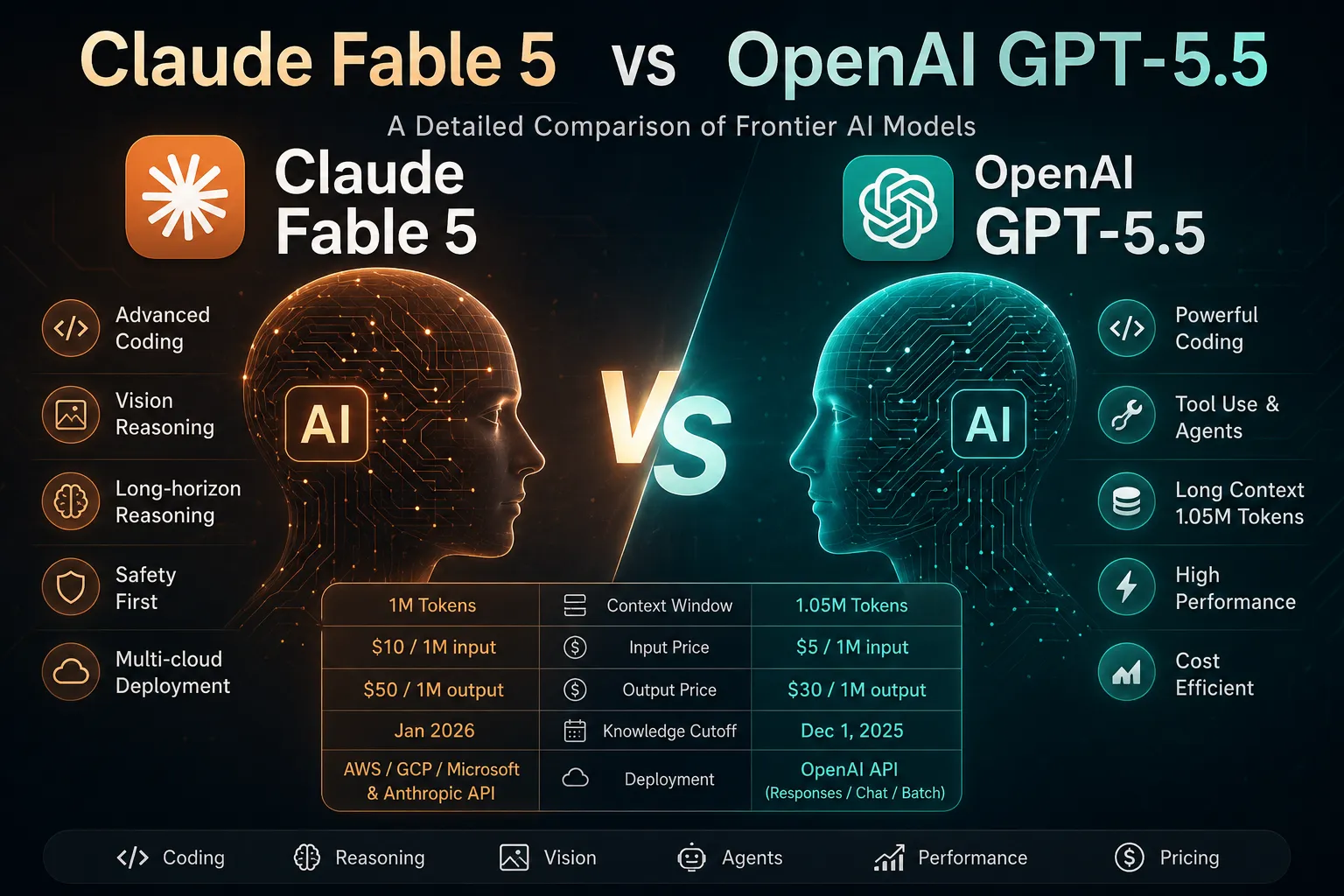
| Dimension | Claude Fable 5 | Claude Opus 4.8 | Claude Haiku 4.5 |
|---|---|---|---|
| Input price | $10 / 1M tokens | $5 / 1M tokens | $1 / 1M tokens |
| Output price | $50 / 1M tokens | $25 / 1M tokens | $5 / 1M tokens |
| 5-minute cache write | $12.50 / 1M tokens | $6.25 / 1M tokens | $1.25 / 1M tokens |
| 1-hour cache write | $20 / 1M tokens | $10 / 1M tokens | Not always the right comparison tier |
| Cache hit / refresh | $1 / 1M tokens | $0.50 / 1M tokens | $0.10 / 1M tokens |
| Best fit | Complex coding, research, agents, long-context work | Advanced general reasoning at lower cost | Fast, low-cost, high-volume tasks |
| Main trade-off | Highest capability, highest cost | Strong reasoning, half the Fable price | Lowest cost, lower ceiling |
Claude Fable 5 costs $10 per million input tokens and $50 per million output tokens. That makes it 2× the price of Claude Opus 4.8 and 10× the input price of Claude Haiku 4.5 under standard API pricing. Anthropic’s current pricing page also lists prompt caching rates, batch processing discounts, and US-only inference options. ([Claude平台][1])
The headline number is simple, but the real cost depends on four variables:
- Input tokens: how much context, code, documents, or chat history the model reads.
- Output tokens: how much text, code, analysis, or structured data the model generates.
- Caching: whether repeated context can be reused at a discount.
- Model routing: whether every request really needs Fable 5 or can be handled by a cheaper model.
Claude Fable 5 Pricing Breakdown
Claude Fable 5 uses token-based API pricing. A token is a small unit of text. In English, 1,000 tokens is roughly 700–800 words, depending on formatting, code, and punctuation.
The standard pricing structure is:
| Cost Type | Claude Fable 5 Price |
|---|---|
| Input tokens | $10 / 1M tokens |
| Output tokens | $50 / 1M tokens |
| 5-minute cache write | $12.50 / 1M tokens |
| 1-hour cache write | $20 / 1M tokens |
| Cache hit / refresh | $1 / 1M tokens |
The most important point is that output tokens are 5× more expensive than input tokens.
That means a task with a small prompt but a long answer can become expensive quickly. For example, generating a 20,000-token technical report costs more than reading a 20,000-token document.
Basic cost formula:
text Total cost = input tokens × input rate + output tokens × output rate
For Claude Fable 5:
text Total cost = input tokens × $10 / 1,000,000 + output tokens × $50 / 1,000,000
Real-World Cost Examples
Example 1: Short Coding Question
A developer asks Fable 5 to explain a bug and suggest a fix.
| Usage | Tokens | Cost |
|---|---|---|
| Input | 3,000 | $0.03 |
| Output | 1,000 | $0.05 |
| Total | 4,000 | $0.08 |
For an individual technical question, Fable 5 can be inexpensive. The problem is not the cost of one request. The problem is repeated high-volume use.
Example 2: Medium Code Review
A developer provides several files, asks for a review, and receives a detailed response.
| Usage | Tokens | Cost |
|---|---|---|
| Input | 30,000 | $0.30 |
| Output | 5,000 | $0.25 |
| Total | 35,000 | $0.55 |
This is where Fable 5 starts to make economic sense. A half-dollar model call may be justified if it saves even a few minutes of senior engineering time.
Example 3: Large Research Task
An analyst gives Fable 5 multiple long documents and asks for a structured comparison.
| Usage | Tokens | Cost |
|---|---|---|
| Input | 150,000 | $1.50 |
| Output | 12,000 | $0.60 |
| Total | 162,000 | $2.10 |
For professional research, this can be cost-effective if the output reduces manual reading time. But if the same task is repeated many times per day, caching and routing become essential.
Example 4: Long-Horizon Agent Session
An AI coding agent uses Fable 5 across a larger implementation task.
| Usage | Tokens | Cost |
|---|---|---|
| Input | 500,000 | $5.00 |
| Output | 80,000 | $4.00 |
| Total | 580,000 | $9.00 |
This is the type of scenario where Fable 5 is most relevant. The cost is materially higher than a simple chatbot query, but the task may also replace hours of manual analysis, debugging, or implementation planning.
Example 5: Very Large Context Workflow
A team sends a very large context package, such as codebase summaries, documents, logs, and prior discussion.
| Usage | Tokens | Cost |
|---|---|---|
| Input | 1,000,000 | $10.00 |
| Output | 50,000 | $2.50 |
| Total | 1,050,000 | $12.50 |
Large context is useful, but it should not be treated as free memory. Every unnecessary document, log, or repeated instruction adds cost.
Fable 5 vs Opus 4.8 Cost
Claude Opus 4.8 is the most direct cost comparison because it is also a high-end Claude model.
| Usage Type | Fable 5 | Opus 4.8 | Difference |
|---|---|---|---|
| Input | $10 / 1M | $5 / 1M | Fable 5 is 2× higher |
| Output | $50 / 1M | $25 / 1M | Fable 5 is 2× higher |
| Cache hit | $1 / 1M | $0.50 / 1M | Fable 5 is 2× higher |
A workload that costs $100 on Opus 4.8 would cost about $200 on Fable 5, assuming identical token usage.
However, identical token usage is not guaranteed. Fable 5 may reduce total cost in some workflows if it:
- Completes the task in fewer attempts
- Requires less human correction
- Avoids failed tool calls
- Produces more complete code on the first pass
- Reduces back-and-forth clarification
- Handles longer context without manual preprocessing
The trade-off is clear:
Opus 4.8 is cheaper per token. Fable 5 may be cheaper per completed high-value task if it reduces retries and human intervention.
Fable 5 vs Haiku 4.5 Cost
Claude Haiku 4.5 is a very different type of model. It is designed for speed and cost efficiency, not maximum reasoning depth.
| Usage Type | Fable 5 | Haiku 4.5 | Difference |
|---|---|---|---|
| Input | $10 / 1M | $1 / 1M | Fable 5 is 10× higher |
| Output | $50 / 1M | $5 / 1M | Fable 5 is 10× higher |
| Cache hit | $1 / 1M | $0.10 / 1M | Fable 5 is 10× higher |
For high-volume workloads, this difference is significant.
A customer support classification system using 1 billion input tokens per month would cost approximately:
| Model | Input Cost for 1B Tokens |
|---|---|
| Haiku 4.5 | $1,000 |
| Fable 5 | $10,000 |
That does not mean Haiku is always better. It means Fable 5 should be reserved for tasks where its deeper reasoning changes the outcome.
Use Haiku-style models for:
- Classification
- Basic extraction
- Short summaries
- Routing
- Tagging
- Simple transformations
- High-volume support automation
Use Fable 5 for:
- Difficult coding
- Multi-document reasoning
- Complex research
- Long-context analysis
- Agent workflows
- High-stakes professional review
Input Cost vs Output Cost
Fable 5’s output cost is the main driver in many workflows.
Input is priced at $10 / 1M tokens. Output is priced at $50 / 1M tokens.
That means:
text 10,000 input tokens = $0.10 10,000 output tokens = $0.50
For applications that generate long reports, code files, or verbose explanations, output control matters.
Ways to reduce output cost:
- Ask for tables instead of long prose when appropriate.
- Request only changed code, not full files.
- Use concise final formats.
- Ask for summaries first, details only on demand.
- Limit unnecessary explanation.
- Separate planning from execution.
- Avoid asking for repeated restatements of the same context.
Example:
`text Instead of: “Write a complete detailed report with all reasoning.”
Use: “Return a concise risk table, top 5 findings, and only include detailed explanation for high-severity items.” `
This can materially reduce output tokens while preserving decision value.
Prompt Caching Economics
Prompt caching is one of the most important ways to reduce Fable 5 cost.
Caching helps when the same long context is reused across multiple requests. Examples include:
- Codebase architecture summaries
- Product documentation
- Legal templates
- Company policies
- API specifications
- Style guides
- Agent system prompts
- Compliance rules
Fable 5 cache pricing:
| Cache Type | Cost |
|---|---|
| 5-minute cache write | $12.50 / 1M tokens |
| 1-hour cache write | $20 / 1M tokens |
| Cache hit / refresh | $1 / 1M tokens |
The first cache write is more expensive than normal input. But later cache hits are much cheaper.
Example with 100,000 repeated input tokens:
| Scenario | Approximate Cost |
|---|---|
| No cache, read once | $1.00 |
| 5-minute cache write | $1.25 |
| Later cache hit | $0.10 |
Caching becomes useful when the same context is reused multiple times.
A simple break-even pattern:
- If context is used once, caching may not help.
- If context is reused several times, caching can reduce total cost.
- If context is reused heavily, caching becomes essential.
Batch Processing and Volume Discounts
Anthropic pricing also includes batch processing, which can reduce cost for workloads that do not need immediate responses. The current Claude pricing page describes batch processing as offering up to 50% savings for eligible workloads. ([Claude][2])
Batch processing is useful for:
- Offline document analysis
- Dataset enrichment
- Large-scale classification
- Content audits
- Back-office processing
- Evaluation runs
- Non-urgent research jobs
Batch processing is less suitable for:
- Live chat
- Coding agents
- Interactive tools
- Real-time customer support
- User-facing applications that require immediate answers
The trade-off is latency versus cost.
Batch mode can lower spending, but it is not designed for instant interaction.
US-Only Inference Cost
For workloads that require US-only inference, Anthropic lists a 1.1× price multiplier for input and output tokens. ([Claude][2])
For Fable 5, that changes pricing approximately to:
| Token Type | Standard Price | US-Only Inference Price |
|---|---|---|
| Input | $10 / 1M | $11 / 1M |
| Output | $50 / 1M | $55 / 1M |
This matters for regulated industries, enterprise procurement, and data residency requirements.
The trade-off:
- Standard inference: lower cost.
- US-only inference: higher cost, stronger location control.
For companies with strict compliance requirements, the 10% premium may be acceptable. For consumer apps or low-margin workloads, it may be unnecessary.
Cost by Application Type
Coding Assistant
A coding assistant may use Fable 5 for complex requests and a cheaper model for simple ones.
Typical cost drivers:
- Large file context
- Long generated code
- Repeated debugging loops
- Test output and logs
- Multi-turn conversations
Recommended strategy:
- Use Fable 5 for architecture, refactors, and hard debugging.
- Use a cheaper model for quick explanations and simple snippets.
- Cache project instructions and coding standards.
- Return diffs instead of full files when possible.
AI Research Assistant
Research workflows often involve large input context and medium-length output.
Typical cost drivers:
- PDFs
- Reports
- Long transcripts
- Web research summaries
- Tables and appendices
Recommended strategy:
- Deduplicate documents before sending them.
- Ask for structured outputs.
- Use caching for repeated source material.
- Separate extraction from final synthesis.
Legal or Compliance Review
Legal workflows may justify Fable 5 because mistakes are costly.
Typical cost drivers:
- Long contracts
- Multiple versions
- Attachments and exhibits
- Detailed risk memos
Recommended strategy:
- Use Fable 5 for risk analysis and cross-document comparison.
- Use cheaper models for initial extraction.
- Require citations to clauses or sections.
- Keep human review in the loop.
Customer Support Automation
Fable 5 is usually too expensive for first-line support automation.
Typical cost drivers:
- High request volume
- Repetitive questions
- Long chat histories
- Verbose answers
Recommended strategy:
- Use cheaper models for first response.
- Escalate to Fable 5 only for complex, high-value, or unresolved cases.
- Summarize chat history before escalation.
- Limit final answer length.
Enterprise Agent Workflows
Agent workflows are one of the strongest use cases for Fable 5.
Typical cost drivers:
- Tool calls
- Iteration loops
- Large context
- Long outputs
- Planning and verification steps
Recommended strategy:
- Set a token budget per task.
- Define stop conditions.
- Use intermediate summaries.
- Cache reusable instructions.
- Route simple subtasks to cheaper models.
Ease of Cost Control
Fable 5 cost can be controlled, but it requires more discipline than using a cheaper model.
Important controls include:
- Max output tokens: prevents runaway responses.
- Prompt caching: reduces repeated input cost.
- Batch mode: lowers cost for offline workloads.
- Model routing: reserves Fable 5 for hard tasks.
- Task budgets: limits agent loops.
- Structured output: reduces verbose prose.
- Context pruning: avoids sending irrelevant documents.
The biggest mistake is using Fable 5 as a default model for all requests.
A better architecture is:
text Simple task → low-cost model Medium reasoning → mid-tier model Complex coding/research/agent task → Claude Fable 5 Sensitive or high-stakes task → Fable 5 + safeguards + human review
This approach aligns cost with task value.
Performance vs Cost Trade-Off
Fable 5 costs more because it is positioned for more difficult tasks, including software engineering, knowledge work, visual reasoning, and long-horizon agent behavior. Recent launch coverage describes it as Anthropic’s most powerful public model and a safeguarded public version of its Mythos-class system. ([The Verge][3])
The economic question is not whether Fable 5 is expensive per token. It is.
The better question is:
Does Fable 5 reduce the cost per completed task?
For simple tasks, the answer is usually no.
For complex tasks, the answer may be yes if it reduces:
- Retry attempts
- Human correction time
- Failed code changes
- Missed edge cases
- Manual document review
- Context preparation work
- Multi-turn back-and-forth
Example:
| Scenario | Cheaper Model | Fable 5 |
|---|---|---|
| Simple summary | Lower cost, likely sufficient | Overkill |
| Large code migration | May require many retries | Higher per-token cost, potentially fewer failed attempts |
| Contract comparison | Cheaper extraction possible | Better for cross-document reasoning |
| Long agent workflow | May lose task focus | Better suited to persistent execution |
The trade-off is unit cost versus completion quality.
Hidden Cost Factors
1. Repeated Context
Sending the same long prompt repeatedly is one of the fastest ways to overspend.
Use caching or summaries when context repeats.
2. Verbose Outputs
Output tokens are expensive. A verbose model response can cost more than the input.
Use concise formats when possible.
3. Agent Loops
Agents can call the model many times. A single user request may trigger dozens of model calls.
Set budgets and stop conditions.
4. Failed Attempts
A cheaper model can become more expensive if it fails repeatedly.
Measure cost per successful task, not cost per call.
5. Unfiltered Documents
Large context windows encourage users to send everything. That increases cost and may reduce focus.
Send only relevant documents, or provide a document map.
Which Should You Choose?
Choose Claude Fable 5 When
Use Fable 5 when the task is complex enough that better reasoning can materially change the outcome.
Best scenarios:
- Large codebase analysis
- Multi-file coding tasks
- Long-context research
- Visual document analysis
- Agentic workflows
- Legal or financial review with human oversight
- High-value enterprise automation
- Tasks where failed output is expensive
Fable 5 is most justified when the output saves professional time or reduces high-cost mistakes.
Choose Claude Opus 4.8 When
Use Opus 4.8 when the task still requires strong reasoning but does not need Fable 5’s highest-end long-horizon capability.
Best scenarios:
- Advanced writing
- General technical analysis
- Medium-complexity coding
- Research summaries
- Internal planning documents
- Lower-budget professional workflows
Opus 4.8 is the more cost-controlled option when Fable 5’s extra capability is not necessary.
Choose Claude Haiku 4.5 When
Use Haiku 4.5 when volume, speed, and cost efficiency matter more than maximum reasoning depth.
Best scenarios:
- Classification
- Extraction
- Tagging
- Short summaries
- Routing
- Customer support triage
- Data cleanup
- High-volume automation
Haiku-style routing can reduce total system cost by keeping Fable 5 away from easy tasks.
Use a Hybrid Strategy When
Most production teams should not pick only one model.
A practical hybrid strategy:
`text
- Use a low-cost model to classify the task.
- Send simple tasks to Haiku-class models.
- Send medium tasks to Opus-class models.
- Send complex coding, research, and agent tasks to Fable 5.
- Cache repeated context.
- Batch non-urgent jobs.
- Monitor cost per completed task. `
This is usually more efficient than using Fable 5 everywhere.
Cost Optimization Checklist
Before deploying Claude Fable 5, teams should answer these questions:
- Does this task require Fable 5, or can a cheaper model handle it?
- How many input tokens are repeated across requests?
- Can prompt caching reduce repeated context cost?
- Can the output be shorter without losing value?
- Can offline tasks use batch processing?
- Does the workflow require US-only inference?
- What is the maximum allowed cost per task?
- How many retries happen before success?
- Is the model being evaluated by cost per call or cost per completed task?
The most important metric is not token price alone.
The key metric is cost per useful outcome.
Conclusion
Claude Fable 5 costs $10 per million input tokens and $50 per million output tokens, making it one of Anthropic’s premium API models. It is roughly 2× the price of Claude Opus 4.8 and 10× the price of Claude Haiku 4.5 for standard input and output tokens.
That makes Fable 5 expensive for simple workloads, but potentially cost-effective for complex tasks where better reasoning, longer context, and stronger agentic behavior reduce retries and human labor.
For most teams, the best approach is not to use Fable 5 everywhere. The better strategy is model routing:
- Use cheaper models for simple, high-volume tasks.
- Use Opus-class models for strong general reasoning.
- Use Fable 5 for complex coding, research, visual reasoning, and long-horizon agent workflows.
- Use caching and batch processing wherever possible.
Claude Fable 5 is not the lowest-cost model. It is a premium model for high-value work. The right decision depends on whether the task benefits enough from its capability to justify the higher token price.
Continue Reading
More articles connected to the same themes, protocols, and tools.

Referenced Tools
Browse entries that are adjacent to the topics covered in this article.

PaidSync.ai
MCP ServersPaidSync.ai is a hosted MCP server for paid advertising that exposes 610+ tools across 14 advertising, analytics, tagging, and commerce platforms. It supports read/write workflows from AI clients including ChatGPT, Claude, Gemini, Cursor, Claude Code, and Codex, with a free plan.

Hyper3D MCP
MCP ServersHyper3D MCP is Hyper3D's hosted Rodin MCP server for creating 3D assets from natural-language instructions or supported references, checking asynchronous generation progress, and retrieving model download links inside AI coding clients. Official setup is documented for Codex, Claude Code, and Kimi Code CLI.