What Is TurboQuant? Google's Breakthrough AI Compression for 6x Smaller KV Cache and 8x Faster Inference
Key Takeaways
- TurboQuant is Google Research's online vector quantization algorithm that compresses key-value (KV) cache in large language models to just 3 bits per value while achieving zero accuracy loss across benchmarks like LongBench, Needle-in-a-Haystack, and RULER.
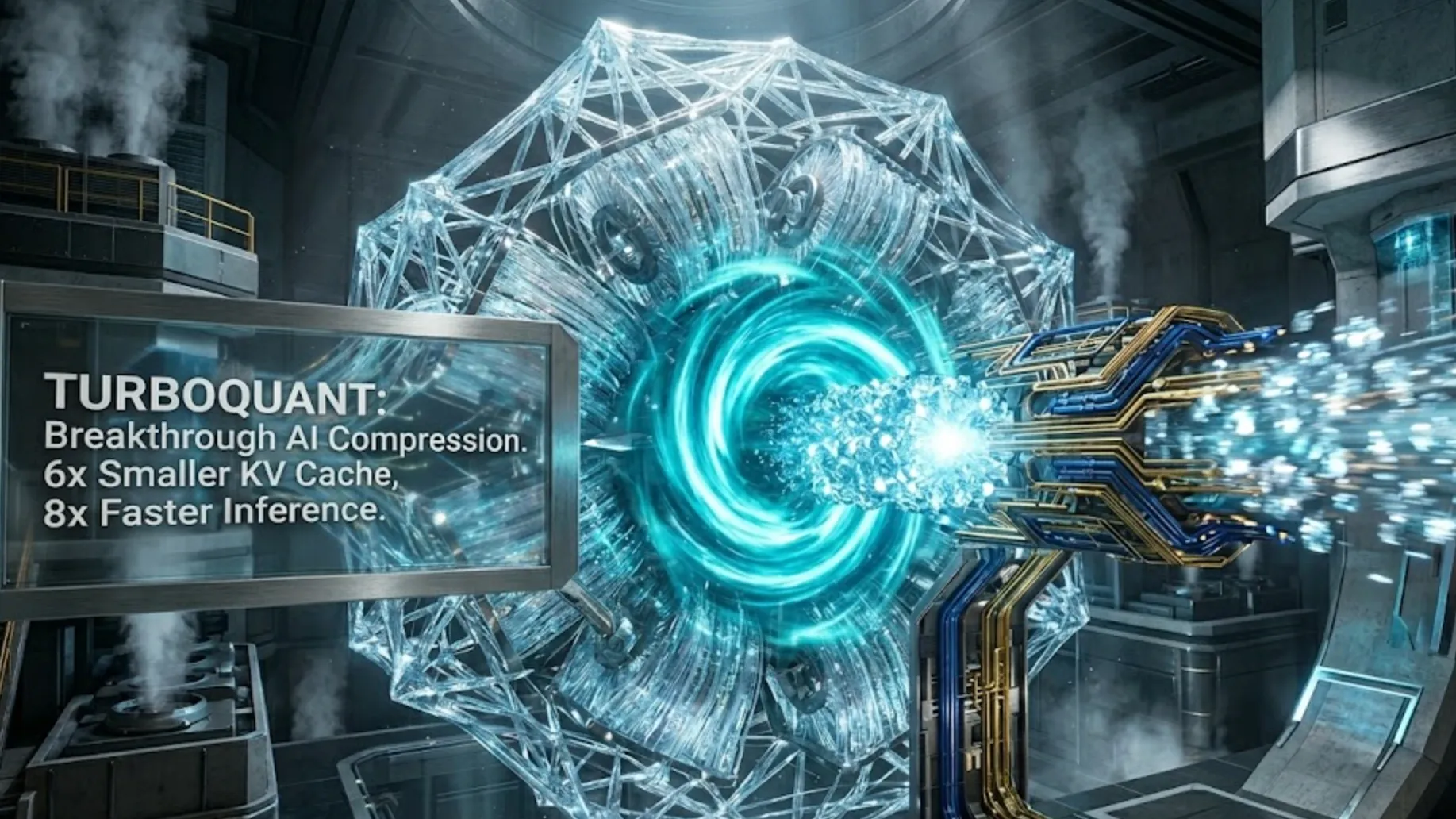
- Benchmarks indicate 6x memory reduction in KV cache and up to 8x speedup in attention logit computation on NVIDIA H100 GPUs compared to 32-bit baselines.
- It requires no training or fine-tuning, making it immediately applicable to existing models such as Gemma, Mistral, Llama, and Qwen.
- Community feedback suggests it enables consumer-grade hardware to handle dramatically longer context windows with near-identical output quality to full-precision inference.
- The technique combines random orthogonal rotation, PolarQuant for main compression, and 1-bit Quantized Johnson-Lindenstrauss (QJL) for residual correction.
What Is TurboQuant?
TurboQuant is an advanced vector quantization method developed by Google Research that redefines efficiency for large language models and high-dimensional vector search. Announced in late March 2026 and set for presentation at ICLR 2026, it targets the critical memory bottleneck in transformer inference: the KV cache.
Analysis shows that as context lengths grow into the tens or hundreds of thousands of tokens, the KV cache—storing precomputed key and value vectors for every token—can consume gigabytes of GPU memory and dominate inference costs. TurboQuant compresses these high-dimensional vectors (typically 16- or 32-bit floats) to ultra-low precision without the usual trade-offs in model quality or speed.
Unlike traditional post-training quantization that often requires calibration data and still incurs accuracy degradation, TurboQuant is data-oblivious and mathematically proven to approach information-theoretic limits for both mean-squared error (MSE) and inner-product distortion.
The KV Cache Bottleneck in Modern LLMs
In transformer architectures, self-attention relies on the KV cache to avoid recomputing keys and values for previously seen tokens. For a model with hidden dimension d and sequence length n, the cache grows linearly as O(n × d × layers × heads × bytes per value).
Benchmarks indicate this cache can exceed model weights in size during long-context tasks. Standard 16-bit KV storage quickly becomes prohibitive on consumer GPUs or in high-throughput serving environments like vLLM. Prior compression attempts (e.g., 4-bit or 8-bit quantization with per-block scales) introduced memory overhead from storing normalization constants, limiting real-world gains to 2-3x at best while risking output drift.
TurboQuant eliminates this overhead entirely, enabling practical deployment of models with 32k–128k+ context windows on hardware that previously struggled at 8k.
How TurboQuant Works: Technical Deep Dive
TurboQuant operates as a two-stage, online algorithm optimized for both MSE and inner-product preservation—critical for accurate attention scores.
Stage 1: Random Rotation + PolarQuant Compression
-
Random Orthogonal Rotation: Each input KV vector undergoes a data-independent random orthogonal transformation (via QR decomposition of a Gaussian matrix). This redistributes coefficient magnitudes evenly across dimensions, converting the quasi-sparse structure typical of LLM activations into a well-behaved distribution.
Post-rotation, each coordinate follows a known Beta((d-1)/2, (d-1)/2) distribution on [-1, 1]. This predictability allows precomputing optimal quantization centroids analytically.
-
PolarQuant (High-Quality Scalar Quantization):
- Vectors are normalized and transformed from Cartesian to polar coordinates by pairing dimensions recursively.
- Radius captures magnitude; angles encode directional (semantic) information.
- Because angular distributions are concentrated and predictable, expensive per-block normalization constants are eliminated.
- A Lloyd-Max quantizer—optimized for MSE over the Beta distribution—maps each coordinate to a low-bit discrete value (e.g., 3 bits total for the main stage).
This stage delivers the bulk of the compression (majority of bits) while preserving nearly all vector information.
Stage 2: QJL Residual Correction
A tiny residual error remains after PolarQuant. TurboQuant applies the Quantized Johnson-Lindenstrauss (QJL) transform using just 1 bit per vector (+1 or -1 sign). This corrects inner-product bias without adding memory overhead.
The result: reconstructed vectors achieve near-perfect cosine similarity and inner-product correlation to the original (0.983+ at 3 bits in community tests).
The full process is accelerator-friendly, with fused Triton kernels enabling direct computation of attention logits from compressed indices—no full dequantization required during inference.
Benchmarks and Real-World Performance
Independent benchmarks and Google’s internal evaluations confirm exceptional results:
- Memory: 3-bit KV cache yields ~6x reduction versus 16-bit baselines; 4-bit variants achieve 8x effective gains in some workloads.
- Speed: 4-bit TurboQuant delivers up to 8x faster attention computation on H100 GPUs versus unquantized 32-bit keys.
- Accuracy: Perfect recall on Needle-in-a-Haystack across 8k–64k contexts. Zero degradation on LongBench, ZeroSCROLLS, RULER, and L-Eval for models including Gemma, Mistral, and Qwen3.5.
- Community Tests (e.g., Gemma-3-4B on RTX 4090):
- 2-bit fused kernel: identical output to fp16 baseline, KV cache reduced from 26 MB to 7 MB.
- End-to-end throughput matches or exceeds baseline while using 70%+ less VRAM.
Vector search evaluations on GloVe (d=200) show superior top-k recall compared to Product Quantization (PQ) and RabbiQ, despite smaller codebooks and no dataset tuning.
How to Implement TurboQuant: Step-by-Step Guide
Google has not released official production code, but the open-source community delivered working implementations within days of the announcement. Here’s how to get started today.
1. Quick Start with PyTorch (Research/Prototyping)
Use the from-scratch implementation at tonbistudio/turboquant-pytorch:
- Clone the repo and install dependencies (PyTorch + Triton).
- Precompute Lloyd-Max codebooks for your model’s hidden dimension and target bit-width.
- Patch Hugging Face
DynamicCacheto quantize on everycache.update()call. - Run the demo script:
python run_demo.py --fused --bits 3for Gemma-3-4B or similar.
Fused Triton kernels pre-rotate queries once and compute dot products directly from uint8 indices, delivering 1.2x+ end-to-end speedup.
2. Production Serving with vLLM
Forked vLLM integrations (e.g., mitkox/vllm-turboquant or flash7777/vllm turboquant branch):
- Install the custom vLLM build.
- Enable TurboQuant in the engine arguments (supports 2–4 bit keys/values).
- Deploy with your existing OpenAI-compatible server—no model changes required.
- Expect immediate KV cache savings and higher throughput for long-context workloads.
3. Local Inference on Apple Silicon (MLX)
MLX-native ports (e.g., helgklaizar/turboquant_mlx) enable TurboQuant on M-series Macs:
pip install mlx-turboquant(community packages available).- Load models via MLX and apply the cache wrapper.
- Ideal for on-device experimentation with 32k+ contexts.
4. llama.cpp Integration (CPU/GPU)
Experimental branches (TheTom/llama-cpp-turboquant) are under active optimization for GGUF-compatible models.
Pro Tips:
- Start with 3- or 4-bit for zero perceptible quality loss.
- Use pre-rotated query paths in fused kernels to minimize overhead.
- Test on Needle-in-a-Haystack first to validate fidelity.
- Monitor VRAM with tools like
nvidia-smi—expect 4–7x effective context scaling.
Mainstream support in vLLM, TensorRT-LLM, and llama.cpp is expected within weeks as optimizations mature.
TurboQuant vs. Traditional Quantization Methods
Traditional approaches (e.g., GPTQ, AWQ, or basic int4) rely on per-group scales and calibration, often introducing 1–2 bits of overhead per value and degrading long-context performance. Product Quantization requires large, dataset-specific codebooks and offline tuning.
TurboQuant stands apart:
- Zero overhead: No stored constants or per-block metadata.
- Data-oblivious: Works out-of-the-box on any model.
- Near-optimal distortion: Proven mathematically for both MSE and inner products.
- Online-friendly: Runs during inference with negligible latency.
Community implementations demonstrate that even aggressive 2-bit TurboQuant can match full-precision output quality where standard 4-bit methods fail.
Applications and Future Impact
TurboQuant unlocks:
- Longer contexts on consumer hardware (e.g., 128k tokens on a single RTX 4090).
- Cost reduction: Up to 50%+ lower inference expenses for cloud providers.
- Edge AI: Efficient semantic search and on-device LLMs.
- Vector databases: Faster, denser indices with state-of-the-art recall.
As adoption grows, expect hybrid weight + KV cache quantization pipelines that push 70B+ models into mobile and laptop realms.
Conclusion
TurboQuant represents a rare leap in AI systems engineering: extreme efficiency gains without compromising quality. By solving the KV cache bottleneck through elegant mathematical insights—random rotation, polar geometry, and residual correction—Google Research has provided a blueprint that the community is already turning into production-ready tools.
Whether you run local models, serve high-throughput APIs, or build vector search applications, now is the time to experiment. Clone a community implementation, benchmark against your current setup, and scale your context windows dramatically. The era of memory-constrained AI is ending—TurboQuant makes larger, faster, and cheaper inference a practical reality today.
Continue Reading
More articles connected to the same themes, protocols, and tools.

Ostris AI Toolkit Guide: The Practical LoRA Training Suite for FLUX, Qwen, Z-Image, Wan, and Modern Diffusion Models

What Is Taste Skill? The Most Valuable Creative Superpower in the AI Era

Google Invests Up to $40 Billion in Anthropic with 5GW Compute Support: AI Arms Race Enters New Era
Referenced Tools
Browse entries that are adjacent to the topics covered in this article.


Hyper3D MCP
MCP ServersHyper3D MCP is Hyper3D's hosted Rodin MCP server for creating 3D assets from natural-language instructions or supported references, checking asynchronous generation progress, and retrieving model download links inside AI coding clients. Official setup is documented for Codex, Claude Code, and Kimi Code CLI.