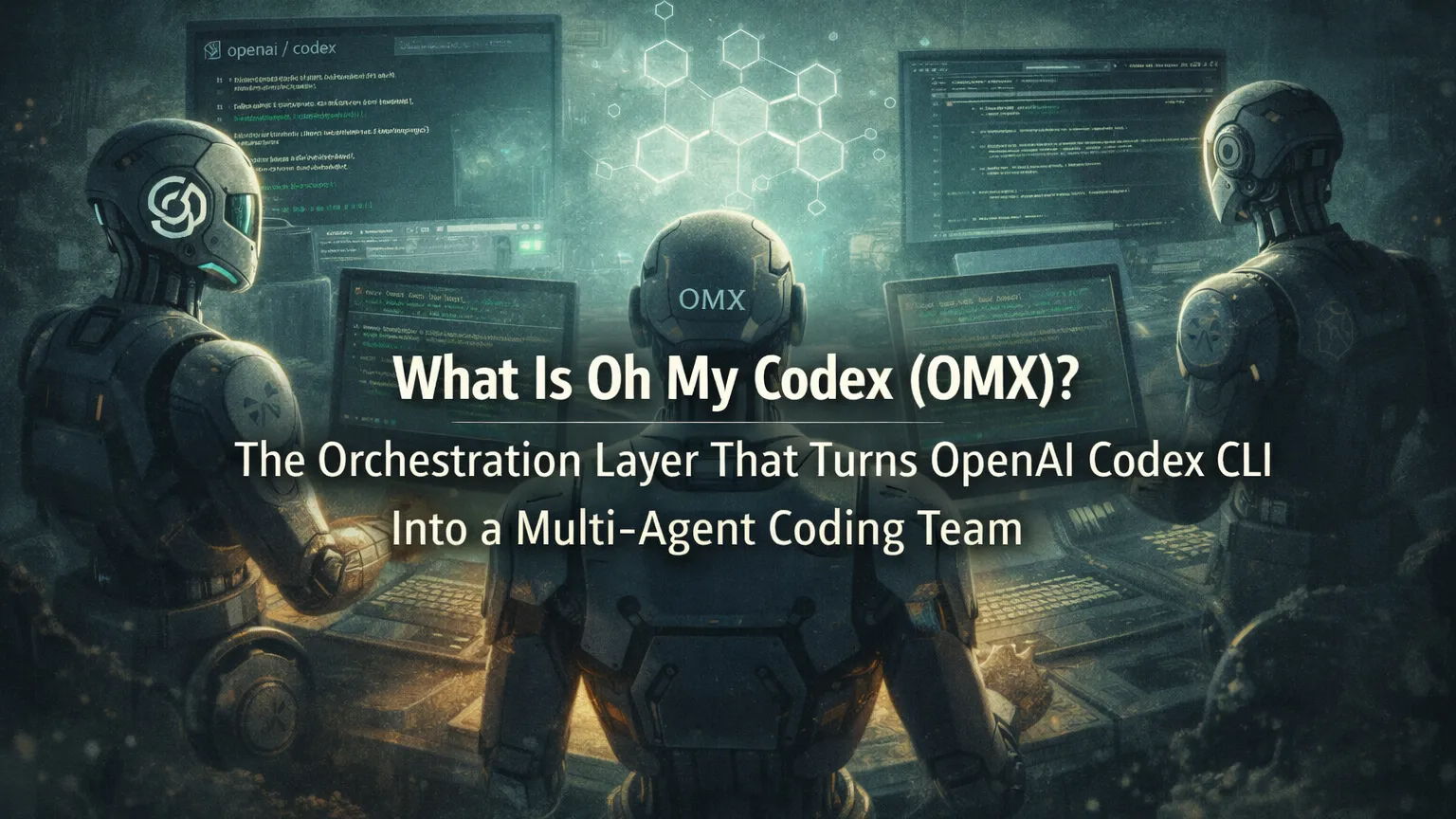
What Is Oh My Codex (OMX)? The Orchestration Layer That Turns OpenAI Codex CLI Into a Multi-Agent Coding Team
Key Takeaways
- Oh My Codex (OMX) is an open-source orchestration layer built on top of the official OpenAI Codex CLI that adds multi-agent coordination, persistent state, hooks, and structured workflows without replacing the core Codex execution engine.
- Analysis of project architecture shows OMX functions like oh-my-zsh for Codex: it provides reusable skills ($deep-interview, $ralplan, $ralph, $team), 33 specialized agent prompts, and tmux-based parallel workers while Codex handles actual reasoning and code generation.
- Community feedback on GitHub and Discord indicates OMX enables safe parallel development through isolated git worktrees, reducing context loss in complex projects via the
.omx/directory and resilient notepad memory. - Installation and setup take under 2 minutes with
npm install -g oh-my-codexfollowed byomx setup; it supports tmux on macOS/Linux or psmux on Windows. - Advanced capabilities include autonomous research, autopilot mode, OpenClaw notification integrations, and model routing based on task complexity, making it ideal for large refactors, full-stack builds, and team-style AI development.
What Is Oh My Codex?
Oh My Codex, abbreviated as OMX, serves as a dedicated workflow and orchestration layer for the OpenAI Codex CLI. Developed primarily by Yeachan Heo with contributions from maintainers like HaD0Yun, it addresses key limitations in the base Codex CLI—such as absent native multi-agent support, hooks, session persistence, and advanced runtime tooling—while preserving Codex as the primary execution engine.
Project documentation and v0.10.0 release notes confirm OMX does not fork or modify Codex itself. Instead, it wraps sessions with enhanced prompts, skills, state management, and tmux-driven parallelism. The mental model is straightforward: Codex performs agentic coding tasks; OMX handles task routing, team coordination, and developer experience.
Benchmarks from real-world demos and user reports show OMX accelerates complex workflows by enabling coordinated “teams” of agents, where one specializes in planning, another in execution, and a third in verification—reducing errors in multi-file changes or architecture-level decisions.
Core Features of Oh My Codex
OMX delivers production-grade enhancements through several tightly integrated systems:
- Multi-Agent Orchestration via tmux: Spawns parallel workers in isolated git worktrees (
.omx/team/<name>/worktrees/worker-N). This prevents write conflicts during simultaneous edits. - Structured Skills and Keywords: Built-in commands like
$deep-interviewfor intent clarification,$ralplanfor consensus planning with trade-off review,$ralphfor persistent “boulder” execution until verified, and$team N:executorfor parallel teams. - Persistent State and Memory: The
.omx/directory stores plans, logs, project memory (.omx/project-memory.json), and a priority notepad system that survives context pruning. - Hooks and HUD: Extensible hooks (
.omx/hooks/*.mjsand Codex-native.codex/hooks.json) plus a live Heads-Up Display (omx hud --watch) for real-time monitoring. - 33 Specialized Agent Prompts: Organized into build/analysis, review, domain, and coordination lanes—automatically loaded via
AGENTS.md. - Autonomous and Advanced Modes: Autopilot for end-to-end execution, autonomous research (
omx autoresearch), ultrawork for maximum parallelism, and intelligent model routing by complexity.
These features transform vague prompts into reliable, multi-step deliverables.
How Oh My Codex Works: Technical Deep Dive
OMX initializes an enhanced Codex session when launched with omx. It injects canonical prompts, installs skills, generates AGENTS.md for delegation rules, and configures MCP servers for state, memory, code intelligence (LSP tools, AST grep), and team orchestration.
Core workflow pipeline (as shown in official demos):
- Intent classification and deep interview — Reduces ambiguity before execution.
- Planning and approval — Uses
$ralplanfor architectural consensus. - Team execution — Spawns tmux panes with isolated worktrees; workers commit changes before reporting completion.
- Verification and merge — Leader incrementally merges via strategies like
--no-ff -X theirsor cherry-pick; conflicts are logged automatically.
Example team command:
omx team 3:executor "parallelize auth migration across modules"
The system includes claim-safe task lifecycle, mailbox messaging between workers, and durable state that survives session interruptions.
Advanced tip: Use OMX_TEAM_WORKER_CLI_MAP=codex,codex,claude (in compatible setups) for mixed-provider teams, though the primary focus remains Codex-native.
Oh My Codex vs. Base Codex CLI and Other Tools
| Aspect | OpenAI Codex CLI (Base) | Oh My Codex (OMX) | Cursor / Claude Code |
|---|---|---|---|
| Execution Engine | Single agent | Orchestrates multiple Codex agents + skills | Editor-first or single-agent focused |
| Multi-Agent Support | None | Native tmux teams with worktree isolation | Limited or emerging |
| Persistent State | Session-only | .omx/ directory + notepad memory | Project context only |
| Hooks & Extensibility | Basic | Full custom hooks + OpenClaw integration | Extensions/plugins |
| Workflows | Manual prompting | Pre-built: autopilot, $ralph, $team | GUI-driven |
| Safety & Monitoring | None | Safety hooks + live HUD | Varies |
OMX shines in CLI-first, large-scale engineering where orchestration and parallelism matter most.
Installation, Setup, and Common Pitfalls
Quick start (under 2 minutes):
npm install -g @openai/codex oh-my-codex
omx setup
omx doctor
omx --madmax --high
Common pitfalls and how to avoid them:
- Forgetting
omx setup— Skips prompt/skills installation andAGENTS.mdgeneration, leading to weak sessions. - Intel Mac high CPU — Caused by Gatekeeper; mitigate with
xattr -dr com.apple.quarantine $(which omx)and lower concurrency flags. - Team mode without clean workspace — Leader must stash/commit before starting; otherwise worktrees fail.
- Worker commit protocol ignored — Agents must
git add -A && git commitor runtime auto-commits as fallback. - Hooks disabled by default — Enable with
OMX_HOOK_PLUGINS=1for production safety.
Advanced tip: Run omx explore --prompt "..." for read-only repo analysis or omx sparkshell for safe shell inspection before delegation.
Edge Cases and Advanced Use Cases
- Large refactors: Feed entire TypeScript codebases into OMX for clean Python rewrites via coordinated agents.
- Long-running projects: Persistent
.omx/state/and notepad enable resumable sessions across days. - Production integrations: OpenClaw hooks send notifications for session events, idle states, or user questions.
- Custom extensions: Add skills via plugin system or extend MCP tools for Python REPL data analysis.
These capabilities make OMX particularly powerful for autonomous research, full application bootstrapping, or experiments requiring deep interview-style clarification.
Conclusion
Oh My Codex represents the next evolution in CLI-based AI coding by turning a powerful single agent into a coordinated, stateful team. Analysis of its architecture and real-world usage shows it delivers measurable gains in reliability, speed, and safety for complex development tasks.
Ready to upgrade your Codex workflow? Run npm install -g oh-my-codex && omx setup today and start with $deep-interview on your next vague requirement. The official repository and documentation provide everything needed to begin orchestrating at scale.
Continue Reading
More articles connected to the same themes, protocols, and tools.

Referenced Tools
Browse entries that are adjacent to the topics covered in this article.
Hyper3D MCP
MCP ServersHyper3D MCP is Hyper3D's hosted Rodin MCP server for creating 3D assets from natural-language instructions or supported references, checking asynchronous generation progress, and retrieving model download links inside AI coding clients. Official setup is documented for Codex, Claude Code, and Kimi Code CLI.

PaidSync.ai
MCP ServersPaidSync.ai is a hosted MCP server for paid advertising that exposes 610+ tools across 14 advertising, analytics, tagging, and commerce platforms. It supports read/write workflows from AI clients including ChatGPT, Claude, Gemini, Cursor, Claude Code, and Codex, with a free plan.