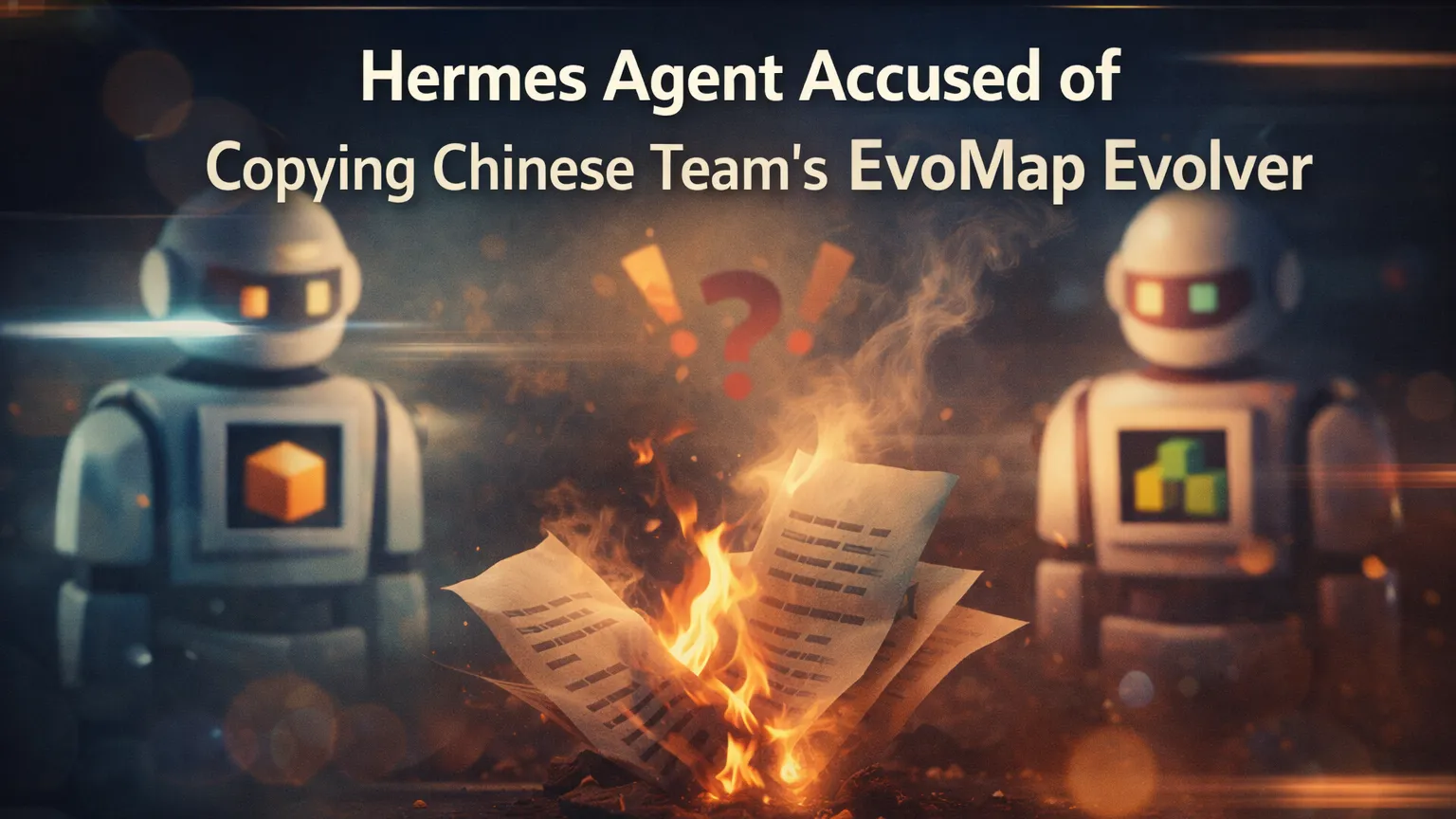
Hermes Agent Accused of Copying Chinese Team's EvoMap Evolver
Key Takeaways
- Timeline Priority: EvoMap open-sourced the Evolver engine and GEP protocol on February 1, 2026; Nous Research’s Hermes Agent introduced highly similar self-evolution features weeks later.
- Core Accusation: Significant architectural overlaps in three-layer memory systems, experience-to-skill extraction loops, periodic reflection mechanisms, and dynamic skill loading — with zero public attribution from Hermes to EvoMap.
- Technical Differences: EvoMap emphasizes network-level gene propagation and cross-agent inheritance; Hermes focuses on single-agent lifelong deep learning using DSPy + GEPA and local Markdown/SQLite storage.
- Independent Verdict: No evidence of direct code copying; similarities more likely result from convergent design solving the same industry pain points, though the open-source community strongly calls for proper attribution.
- Current Impact: Hermes Agent rapidly gained tens of thousands of GitHub stars, while EvoMap’s detailed comparison sparked widespread discussion in Chinese AI communities.
The Rise of Self-Evolving AI Agents and the Emerging Controversy
In 2026, AI agents are evolving from stateless tools into systems with persistent memory and autonomous improvement. Traditional agents forget everything between sessions, leading to repetitive work and poor long-term performance. Both Hermes Agent from Nous Research and EvoMap Evolver tackle this challenge by enabling agents to learn from experience, extract reusable skills, and continuously evolve.
However, in April 2026, the Chinese EvoMap team publicly accused Hermes Agent of closely copying their earlier open-source architecture, igniting heated debate across global open-source and Chinese developer communities.
EvoMap Evolver: The Early Chinese Innovation
EvoMap (evomap.ai), a project rooted in addressing platform moderation challenges faced by Chinese developers, released the Evolver engine and Genome Evolution Protocol (GEP) on February 1, 2026.
Core Architecture of Evolver/GEP:
- Three-layer memory system: Facts, procedural skills (Genes/Capsules), and event history.
- Evolution cycle: Scan → Select → Mutate → Validate → Solidify, with built-in periodic reflection.
- Network-level propagation: Skills and fixes automatically spread across agents through global scoring and a state machine.
- Implementation: Node.js-based with JSON structures, designed for auditable and shareable “genes.”
The project gained solid traction in Chinese AI circles, reaching around 1,800 GitHub stars while aiming to build a decentralized global agent evolution network.
Hermes Agent by Nous Research: Rapid Adoption and Features
Nous Research, creators of the Hermes model series, launched Hermes Agent on February 25, 2026 as an MIT-licensed, model-agnostic self-hosting framework. The project quickly accumulated significant GitHub stars and supports integrations with Telegram, Discord, Slack, and CLI.
Key Features of Hermes Agent:
- Built-in learning loop: Automatically extracts SKILL.md files from task outcomes and stores persistent memory in SQLite with full-text search.
- Skills Ecosystem: Over 70 reusable skills by v0.2.0, with dynamic loading and self-improvement guides.
- Optimization stack: Powered by DSPy + GEPA (an academic Genetic-Pareto Prompt Evolution framework) along with optional Darwinian Evolver for code-level changes.
- Single-agent focus: Emphasizes deep personalization and cross-session knowledge retention for individual users.
Positioned as “the agent that grows with you,” Hermes Agent has seen strong adoption in developer workflows.
Detailed Architecture Comparison
Public repositories, documentation, and EvoMap’s April comparison posts reveal clear functional similarities alongside important implementation differences.
Major Similarities Highlighted by EvoMap:
- Experience-to-reusable-skill extraction process.
- Three-layer memory architecture.
- Periodic reflection and skill validation mechanisms.
- Dynamic discovery and loading of capabilities.
Key Differences:
- Design Focus: EvoMap/GEP prioritizes network-scale evolution with automatic cross-agent inheritance and revocable assets. Hermes targets local single-agent depth optimized for personal, long-term use.
- Technology Stack: Evolver uses Node.js and JSON; Hermes relies on Python, Markdown files, and SQLite, heavily integrated with established academic tools.
- Evolution Strategy: GEP treats skills as inheritable genomes for ecosystem sharing. Hermes uses guarded prompt and skill mutation within a closed personal loop.
Third-party reviews confirm no direct code-level copying. The overlaps appear to stem from both projects independently addressing the same core problem of agent forgetfulness in a rapidly maturing field.
Timeline of the Controversy and Community Response
- February 1, 2026: EvoMap open-sources Evolver + GEP with in-depth technical blogs.
- February 25, 2026: Hermes Agent v0.1.0 is released.
- March 2026: Hermes expands its Skills Ecosystem.
- April 9–11, 2026: EvoMap publishes detailed side-by-side analyses pointing out near 1:1 structural parallels and complete lack of references to Evolver or GEP.
- April 15, 2026: Discussions explode in Chinese communities (X, forums, etc.), with some calling it “architectural copying” while others view it as typical convergent innovation.
Hermes has not issued an official response but has referenced its own earlier internal work and academic precedents. EvoMap has stated they seek only public acknowledgment rather than legal action.
Common Pitfalls in Open-Source Attribution Debates:
- Mistaking convergent solutions for copying when solving identical pain points.
- Underestimating the influence of widely published academic frameworks like DSPy and GEPA.
- Confusing legal permissions (MIT license allows modification) with community ethical expectations of crediting prior public work.
Why This Controversy Matters for the AI Agent Ecosystem
Self-evolving agents represent a critical step toward truly adaptive AI systems. This dispute highlights several important lessons:
- Best Practices for Attribution: Even independently developed solutions benefit from citing visible prior art to foster trust.
- Speed of Innovation: Well-resourced teams can quickly polish and popularize ideas from smaller groups, ultimately benefiting end users.
- Complementary Potential: Hermes’ local depth pairs well with EvoMap’s network propagation, opening doors for hybrid implementations.
- Practical Edge Cases: Developers should test both — Hermes for personal productivity pipelines, EvoMap for multi-agent collaborative scenarios.
Conclusion
The accusation that Hermes Agent copied EvoMap Evolver reflects the intense pace and occasional overlaps in 2026’s open-source AI development. While functional similarities exist, available evidence points more toward design convergence driven by shared challenges than outright plagiarism.
Developers building self-improving agents should evaluate both projects on their strengths: choose Hermes for deep single-user evolution or EvoMap for ecosystem-scale gene propagation. Experiment with both, contribute back to the community, and promote transparent referencing of prior work.
Recommended Action: Visit the official GitHub repositories for Hermes Agent and EvoMap Evolver, run your own side-by-side tests on real workflows, and participate constructively in the ongoing discussion. Responsible collaboration and clear attribution will accelerate progress across the entire self-evolving AI agent ecosystem.
Follow developments in frameworks like DSPy, GEP, and related self-improvement tools to stay ahead in agent architecture design.
Continue Reading
More articles connected to the same themes, protocols, and tools.

Referenced Tools
Browse entries that are adjacent to the topics covered in this article.