OpenMemory MCP
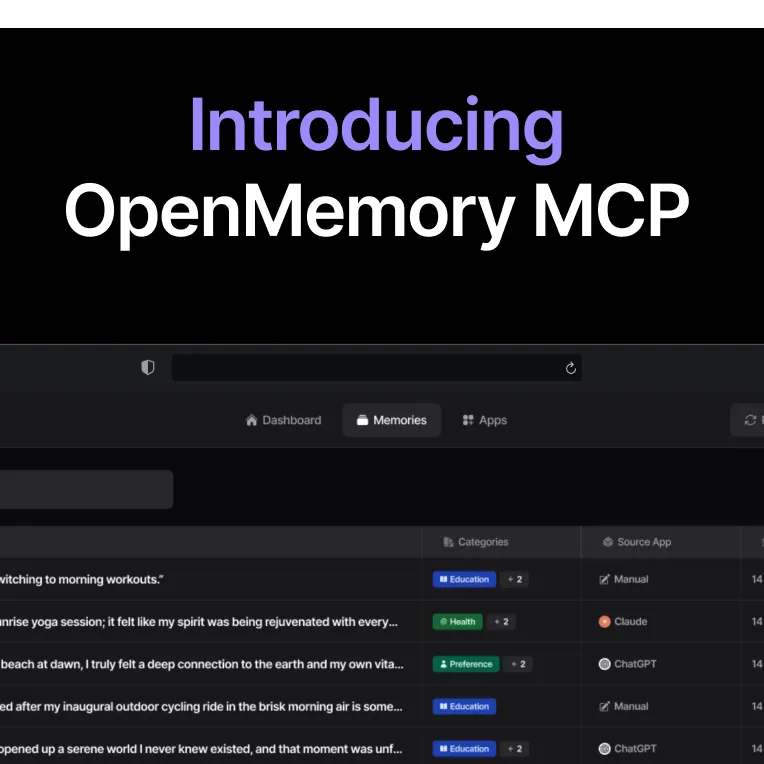
OpenMemory MCP is a local‑first, privacy‑focused memory server that implements the Model Context Protocol (MCP) to enable persistent, shared memory across compatible AI clients.
Overview
OpenMemory MCP is an open‑source, local‑first memory server built around the Model Context Protocol (MCP). It provides a standardized memory infrastructure that lets AI clients share and persist context across sessions and applications without relying on cloud storage — ensuring full user ownership and privacy of stored data. :contentReference[oaicite:0]{index=0}
The project was introduced by Mem0 in May 2025 and quickly gathered interest as a foundational layer for AI tools that need to retain and query user or system memory across workflows. :contentReference[oaicite:1]{index=1}
Features
- Local‑First Architecture: Runs entirely on the user's machine with no automatic cloud sync, preserving privacy and control. :contentReference[oaicite:2]{index=2}
- Standardized MCP APIs: Exposes core operations like
add_memories,search_memory,list_memories, anddelete_all_memoriesfor persistent memory management. :contentReference[oaicite:3]{index=3} - Cross‑Client Context Sharing: Enables context stored by one MCP‑compatible tool (e.g., Claude Desktop) to be retrieved by another (e.g., Cursor). :contentReference[oaicite:4]{index=4}
- Unified Dashboard: Built‑in web UI for browsing, managing, and controlling memory and client access in real time. :contentReference[oaicite:5]{index=5}
- Semantic Search: Uses vector‑backed search (via databases like Qdrant) to retrieve memories based on meaning. :contentReference[oaicite:6]{index=6}
Use Cases
- Persistent Project Memory: Store key details, preferences, or context once and reuse them across sessions and tools without repeat prompts. :contentReference[oaicite:7]{index=7}
- Cross‑Tool Collaboration: Maintain shared context in complex workflows involving multiple AI clients (e.g., planning in one tool and execution in another). :contentReference[oaicite:8]{index=8}
- Developer Workflows: Developers benefit from consistent context when switching between environments or tools, reducing overhead and improving productivity. :contentReference[oaicite:9]{index=9}
Architecture
OpenMemory MCP leverages containerized microservices, vector databases for semantic indexing, and server‑sent events (SSE) for real‑time updates across connected clients. It can be set up via Docker and configured to interface with MCP clients over the protocol's REST/SSE endpoints. :contentReference[oaicite:10]{index=10}
Getting Started
The server can be launched locally by cloning the repository, satisfying prerequisites (Docker, OpenAI API key for certain setups), and running the provided deployment scripts. Once running, AI tools that support MCP can connect to the server's endpoint to store and retrieve memory data. :contentReference[oaicite:11]{index=11}
Benefits and Considerations
Benefits: Keeps all memory local and under user control; standardizes how AI tools share memory; avoids token overhead from repeated context re‑entry. :contentReference[oaicite:12]{index=12} Considerations: Requires installation and setup (e.g., Docker); MCP client compatibility is necessary for integration. :contentReference[oaicite:13]{index=13}
Community and Contributions
OpenMemory MCP is open source, with contributions encouraged via the GitHub repository. Documentation, dashboards, and guides help both developers and power users extend or customize the system. :contentReference[oaicite:14]{index=14}
Tags
Related Entries
Keep exploring similar tools and resources in this category.

Hyper3D MCP
MCP ServersHyper3D MCP is Hyper3D's hosted Rodin MCP server for creating 3D assets from natural-language instructions or supported references, checking asynchronous generation progress, and retrieving model download links inside AI coding clients. Official setup is documented for Codex, Claude Code, and Kimi Code CLI.





Related Reads
Background, tutorials, and protocol context connected to this entry.