
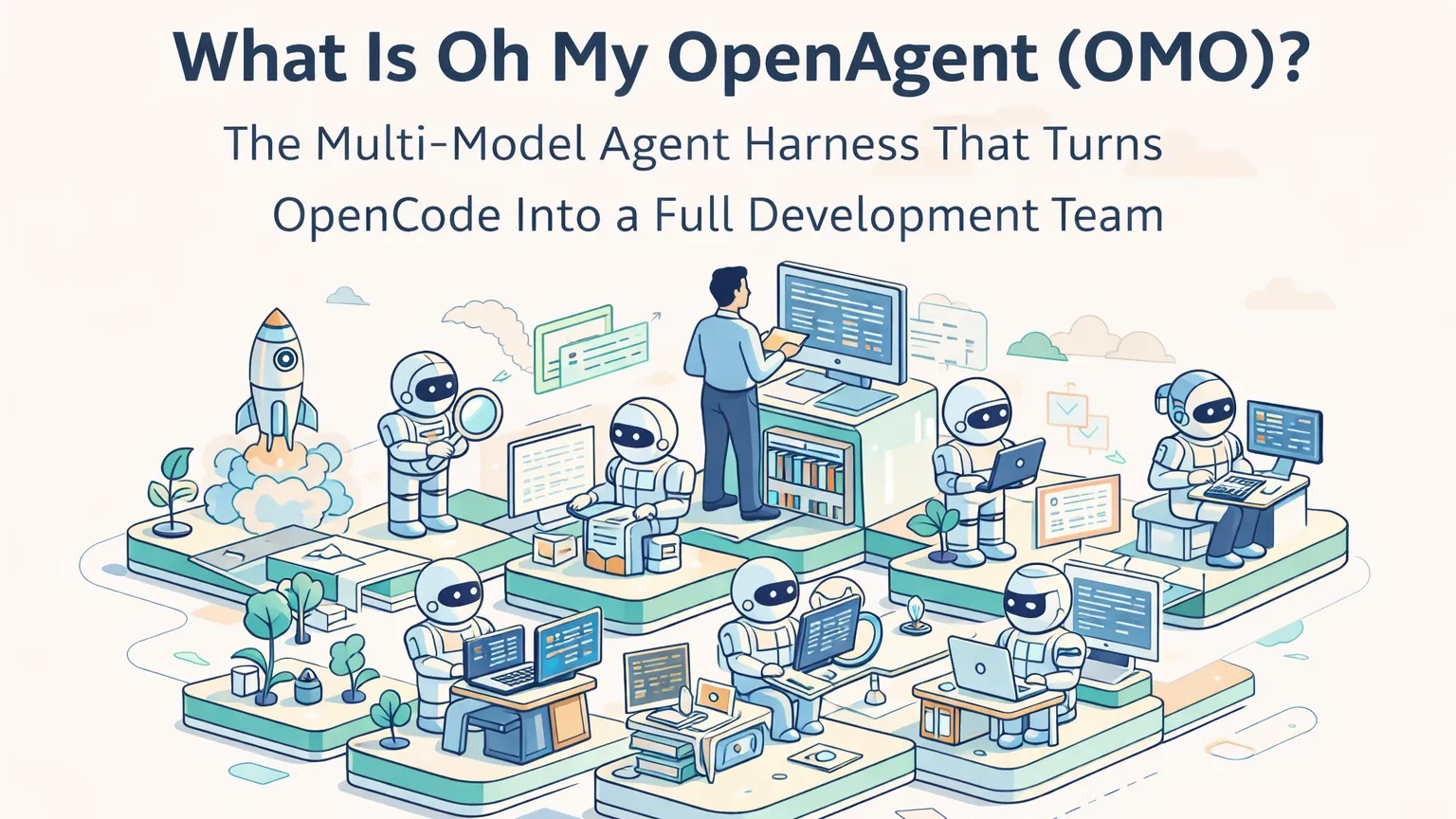
What Is Oh My OpenAgent (OMO)? The Multi-Model Agent Harness That Turns OpenCode Into a Full Development Team
Key Takeaways
- Oh My OpenAgent (OMO), previously known as oh-my-opencode, is an open-source multi-model agent orchestration harness and plugin for OpenCode that transforms a single AI coding agent into a coordinated virtual development team.
- Analysis of its architecture reveals a three-layer system: planning (Prometheus/Metis), orchestration (Atlas), and execution (Sisyphus-Junior + 9+ specialized agents like Oracle, Librarian, Frontend) with model-specific prompt tuning.
- Community feedback and GitHub metrics (over 48k stars, 1.6M+ downloads as of April 2026) indicate OMO delivers superior results on complex engineering tasks by enabling parallel execution, specialized roles, and intelligent routing across providers like Claude, GPT, Gemini, and Grok.
- It includes 40+ lifecycle hooks, built-in skills, MCP integrations, and “ultrawork” mode for full autonomy with self-correcting loops.
- Installation integrates seamlessly into OpenCode via plugin configuration; the package name remains
oh-my-opencodeduring the branding transition.
What Is Oh My OpenAgent?
Oh My OpenAgent, abbreviated as OMO, functions as the premier orchestration layer and community plugin for OpenCode — the open-source terminal-based AI coding agent. Originally released as oh-my-opencode, the project rebranded to oh-my-openagent while maintaining backward compatibility in package naming and configuration.
Developed primarily by YeonGyu Kim with over 160 contributors, OMO breaks the limitations of single-agent systems. It does not replace OpenCode but extends it into a full multi-agent engineering platform where a lead orchestrator delegates tasks to specialized agents with distinct roles, permissions, and model preferences.
The philosophy centers on provider independence: users route tasks to the optimal model (e.g., Claude Opus for planning, Gemini for frontend, Grok for exploration) without vendor lock-in, resulting in better performance and lower costs for complex workflows.
Core Features of Oh My OpenAgent
OMO stands out through its sophisticated orchestration capabilities:
- Sisyphus Orchestration System: A lead agent (often Sisyphus or Atlas) coordinates planning, delegation, execution, and verification with parallel background workers.
- 10+ Specialized Agents: Includes roles such as Oracle (architecture), Librarian (documentation/OSS research), Frontend Engineer, Explorer (codebase search), Reviewer (Momus), and task executors tuned per model family.
- Multi-Model Routing: Dynamically assigns tasks based on complexity, cost, and capability — e.g., heavy reasoning to Claude Opus 4.6, fast exploration to Gemini Flash.
- Ultrawork and Autonomous Modes: One-command full autonomy combining auto-planning, deep research, parallel execution, and self-correction loops.
- 40+ Lifecycle Hooks and Skills: Extensible hooks for pre/post-task actions, safety checks, and integrations like OpenClaw notifications.
- Persistent State and Permissions: Explicit tool permissions per agent, shared memory, and project context management to prevent conflicts and cognitive drift.
These elements enable scenarios where a single prompt leads to complete feature implementation with internal code review before final commit.
How Oh My OpenAgent Works: Technical Deep Dive
OMO operates via a three-layer architecture within the OpenCode harness:
- Planning Layer — Prometheus (planner) and Metis (consultant) break down user intent, often using high-capability models for trade-off analysis.
- Orchestration Layer — Atlas (conductor) routes subtasks, manages worker lifecycles, and merges results using git worktree-like isolation or safe commit protocols.
- Execution Layer — Specialized workers (Sisyphus-Junior, Oracle, etc.) perform targeted actions with model-optimized prompts and gated tools.
Example configuration snippet for opencode.json:
{
  "plugins": ["oh-my-openagent"],
  "omo": {
    "orchestration": {
      "enabled": true,
      "ultrawork": true
    },
    "agents": {
      "planner": "claude-opus-4.6",
      "executor": "claude-sonnet-4.6",
      "research": "gemini-3-flash"
    }
  }
}
When running opencode with OMO enabled, users can invoke commands like /team or simply describe complex tasks, triggering the full orchestration pipeline. The system handles context management, parallel execution in background sessions, and verification loops automatically.
Benchmarks from community demos show significant improvements in task completion rates and code quality for large refactors or multi-module features compared to base single-agent OpenCode.
Oh My OpenAgent vs. Other AI Coding Harnesses
| Aspect | Base OpenCode | Oh My OpenAgent (OMO) | Oh My Codex (OMX) | Claw Code |
|---|---|---|---|---|
| Core Focus | Single-agent terminal coding | Multi-model team orchestration | Codex CLI workflows | Claude-style agent rewrite |
| Agent Count | 1 | 10+ specialized + orchestrator | tmux-based teams | Hierarchical agents |
| Model Flexibility | Provider catalog | Intelligent routing across all major LLMs | Primarily Codex | Native Claude + others |
| Autonomy Level | Manual iteration | Ultrawork full autonomy with loops | Structured workflows | Permission-gated autonomy |
| Extensibility | Plugins | 40+ hooks, skills, MCPs | Strong skills system | Plugin tools |
| Best For | Quick tasks | Complex engineering projects | CLI Codex users | Self-hosted Claude-like |
Analysis shows OMO excels in scenarios requiring division of labor and model optimization, complementing tools like OMX for Codex users or Claw Code for permission-focused setups.
Installation and Getting Started
Prerequisites: OpenCode installed and configured with API keys for desired models.
Installation (package uses legacy name for compatibility):
# Inside an OpenCode session or via plugin manager
/plugin install oh-my-opencode

# Or edit ~/.config/opencode/opencode.json
{
  "plugins": ["oh-my-openagent"]
}
Run opencode doctor or the built-in setup command to validate configuration. Transitioning from oh-my-opencode requires removing duplicate entries in the plugin array to avoid warnings.
First Run Recommendation: Start with a simple task to observe orchestration, then enable ultrawork for autonomous experiments in a git branch.
Advanced Tips, Edge Cases, and Common Pitfalls
- Model Tuning: Customize prompts per agent and family for optimal performance — e.g., shorter context for fast executors.
- Safety and Permissions: Review per-agent tool allowances; overly broad settings risk unintended changes in large codebases.
- Resource Management: Ultrawork with many parallel agents increases API costs and token usage; monitor with hooks or OpenClaw integration.
- Edge Cases: Very large monorepos benefit from explicit codebase exploration agents; long sessions leverage persistent state but may require periodic memory pruning.
- Common Pitfalls: Neglecting the naming transition (use
oh-my-opencodefor install commands); disabling orchestration for simple tasks (adds unnecessary overhead); ignoring hook configuration for production safety.
Community experiments highlight best results when combining OMO with external notification tools for long-running ultrawork sessions.
Conclusion
Oh My OpenAgent (OMO) has emerged as one of the most impactful open-source advancements in AI agent tooling by turning single-model coding assistants into sophisticated, multi-agent development teams. Its provider-agnostic orchestration, specialized roles, and autonomous capabilities deliver measurable gains in productivity and code quality for complex projects.
Developers seeking to move beyond manual prompting should install OMO into their OpenCode setup today. Explore the official GitHub repository, configure model routing for your workflow, and experience ultrawork autonomy on your next engineering task. The era of coordinated AI development teams is here — and it’s fully open source.
Continue Reading
More articles connected to the same themes, protocols, and tools.
Ostris AI Toolkit Guide: The Practical LoRA Training Suite for FLUX, Qwen, Z-Image, Wan, and Modern Diffusion Models
What Is OC Maker? The AI Tool Revolutionizing Original Character Creation in 2026

How to Use Claude Fable 5: Complete 2026 Guide to Anthropic’s Most Powerful Public AI Model
Referenced Tools
Browse entries that are adjacent to the topics covered in this article.





PaidSync.ai
MCP ServersPaidSync.ai is a hosted MCP server for paid advertising that exposes 610+ tools across 14 advertising, analytics, tagging, and commerce platforms. It supports read/write workflows from AI clients including ChatGPT, Claude, Gemini, Cursor, Claude Code, and Codex, with a free plan.

Hyper3D MCP
MCP ServersHyper3D MCP is Hyper3D's hosted Rodin MCP server for creating 3D assets from natural-language instructions or supported references, checking asynchronous generation progress, and retrieving model download links inside AI coding clients. Official setup is documented for Codex, Claude Code, and Kimi Code CLI.