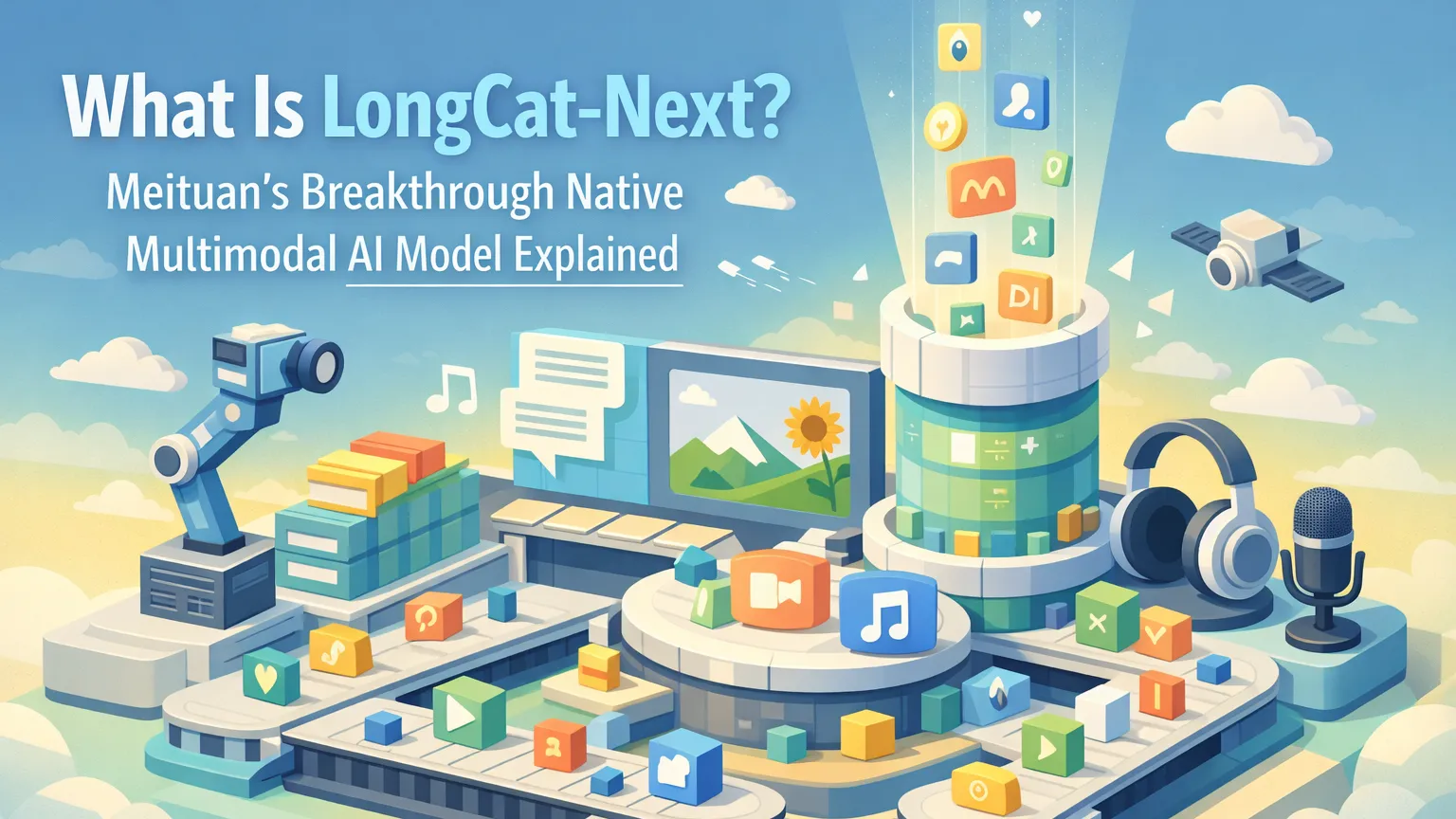
What Is LongCat-Next? Meituan's Breakthrough Native Multimodal AI Model Explained
Key Takeaways
- LongCat-Next is an open-source native multimodal foundation model developed by Meituan's LongCat team, released in March 2026.
- It unifies text, vision (images), and audio into a single discrete token space using the Discrete Native Autoregression (DiNA) paradigm and next-token prediction (NTP).
- Built on the LongCat-Flash-Lite MoE backbone (A3B: ~68.5B total parameters, 3B active), it supports understanding and generation across modalities with minimal inductive bias.
- Key innovations include the dNaViT (Discrete Native any-Resolution Vision Transformer) tokenizer, enabling high compression (up to 28×) while preserving quality, especially in text rendering.
- Benchmarks show competitive performance against specialized models in visual understanding, image generation, speech comprehension, and low-latency voice interaction.
- Fully open-sourced under MIT license on Hugging Face and GitHub, with inference code and a live demo available.
What Is LongCat-Next?
LongCat-Next represents a significant shift in multimodal AI architecture. Unlike traditional "patchwork" systems that bolt vision encoders or speech modules onto a language model core, this model treats all modalities as native elements within one unified framework.
Developed by Meituan's LongCat team, LongCat-Next lexicalizes modalities as discrete tokens. Images, audio waveforms, and text are tokenized into a shared vocabulary, allowing the model to process and generate them using the same autoregressive objective: predicting the next token.
This "Discrete Native Autoregression" (DiNA) approach minimizes architectural complexity and inductive biases beyond the language modeling paradigm. The result is a more elegant, scalable system capable of true any-to-any multimodal capabilities.
Core Architecture and Technical Innovations
Discrete Native Autoregression (DiNA)
At its heart, LongCat-Next extends the next-token prediction paradigm to all modalities. Paired tokenizers convert inputs into discrete IDs:
- Text: Standard subword tokenization.
- Vision: Processed via dNaViT — a discrete native any-resolution Vision Transformer that handles variable image sizes without fixed patching or resizing artifacts.
- Audio: Converted into discrete tokens supporting comprehension, generation, and low-latency conversation.
All tokens feed into a shared MoE (Mixture of Experts) backbone. This enables seamless cross-modal reasoning, such as describing an image while generating related audio or vice versa.
Model Scale and Efficiency
- Backbone: LongCat-Flash-Lite MoE with approximately 68.5 billion total parameters and 3 billion active parameters per inference step.
- Efficiency: The discrete token approach and MoE design keep inference lightweight compared to dense models of similar capability.
- Compression: Achieves strong generative quality at high compression ratios (e.g., 28× for images), particularly excelling in accurate text rendering within generated visuals.
The architecture supports both multimodal understanding (e.g., visual question answering, speech transcription with context) and generation (e.g., text-to-image, image editing via tokens, voice synthesis).
Performance and Benchmarks
Analysis of released technical reports and community evaluations indicates LongCat-Next delivers industrial-strength results across domains:
- Visual Understanding: Competitive with specialized vision-language models on benchmarks involving complex scenes, documents, and any-resolution inputs. It handles dense mathematical formulas, OCR-heavy images, and real-world photos effectively.
- Image Generation: Maintains high fidelity and coherence, with notable strength in rendering legible text within images — a common weakness in many multimodal systems.
- Audio/Speech: Excels in advanced speech comprehension, low-latency voice conversations, and customizable voice cloning. It supports natural multimodal interactions, such as speaking while referencing visual content.
- Cross-Modal Tasks: Strong performance in unified tasks like image captioning with audio descriptions or generating visuals from spoken prompts.
Benchmarks position it as highly competitive within discrete frameworks, often matching or approaching larger or specialized systems while offering greater architectural simplicity.
Community feedback suggests particular advantages in real-world edge cases, such as low-light document scanning or mixed-modality dialogues.
How LongCat-Next Differs from Traditional Multimodal Models
Most current multimodal large language models (MLLMs) rely on a language-centric core with auxiliary encoders:
- Vision data is projected into the LLM's embedding space via adapters or cross-attention.
- Audio modules are often separate pipelines.
This creates alignment challenges, increased latency, and training instabilities.
LongCat-Next's advantages:
- Unified Token Space: All modalities become "native language" for the model, reducing modality gaps.
- Single Objective: Pure next-token prediction across everything simplifies training and scaling.
- Reduced Bias: Minimal additional inductive biases beyond autoregression.
- Deployment Simplicity: Shared backbone eases inference optimization and multi-modal serving.
This paradigm shift aims to bring AI closer to handling the physical world's intertwined signals (sight, sound, text) in a cohesive manner.
Getting Started with LongCat-Next
Access and Resources
- Hugging Face: meituan-longcat/LongCat-Next — model weights, safetensors, and Transformers integration.
- GitHub: Full repository including inference code, modular implementation, and technical report PDF.
- Demo: Interactive experience at longcat.chat/longcat-next.
- License: MIT — suitable for research and commercial applications.
Basic Usage Tips
The model supports standard Transformers pipelines with custom extensions for multimodal inputs. Example code patterns (from repository):
# Pseudocode for multimodal inference
from transformers import AutoModelForCausalLM

model = AutoModelForCausalLM.from_pretrained("meituan-longcat/LongCat-Next")

# Tokenize mixed inputs (text + image + audio)
inputs = tokenizer.process_multimodal(prompt, image=image_tensor, audio=audio_tensor)
outputs = model.generate(inputs)
Advanced Tips:
- Leverage dNaViT for any-resolution images to avoid quality loss from resizing.
- For generation tasks, experiment with token-level control for finer cross-modal consistency.
- Use quantization (e.g., 4-bit versions available in community repos) for consumer hardware deployment.
Common Pitfalls and Edge Cases
- Token Budget Management: High-resolution or long audio inputs consume more tokens; prioritize key regions or use compression strategies.
- Cross-Modal Alignment: While unified, complex interleaved tasks may require careful prompt engineering for optimal coherence.
- Inference Optimization: MoE models benefit from expert-parallelism setups; refer to the dedicated inference repository for best practices.
- Hardware Considerations: Full precision requires significant VRAM; start with quantized variants for testing.
Monitor community discussions for emerging fine-tuning techniques and application-specific adaptations.
Potential Applications and Future Implications
LongCat-Next opens doors to more integrated AI systems:
- Real-World Agents: Robots or apps that perceive visuals, process speech, and respond multimodally in one model.
- Creative Tools: Unified image+audio+text generation for content creation.
- Accessibility: Enhanced document understanding with voice interaction.
- Physical World AI: A step toward models that treat sensory inputs as fluently as language.
As an open-source release, it invites developers to build extensions, fine-tunes, and domain-specific variants, accelerating multimodal progress.
Conclusion
LongCat-Next stands out as a thoughtful advancement in native multimodal modeling. By unifying modalities under a discrete autoregressive framework, it simplifies architecture while delivering capable performance in seeing, creating, and talking.
For developers, researchers, and AI enthusiasts, this open-source model provides a practical foundation to experiment with true any-to-any capabilities. Explore the Hugging Face repository, review the technical report, and test the live demo to experience the DiNA paradigm firsthand.
Start building with LongCat-Next today and contribute to the evolving landscape of unified multimodal AI.
Ready to dive in? Visit the official demo or clone the GitHub repo to begin experimenting.
Continue Reading
More articles connected to the same themes, protocols, and tools.

Fable 5 Explained: The Mythos-Class Claude Model Built for Long-Horizon AI Work
Ostris AI Toolkit Guide: The Practical LoRA Training Suite for FLUX, Qwen, Z-Image, Wan, and Modern Diffusion Models
Seed3D 2.0: ByteDance's Next-Gen 3D Model Just Dropped – Full Breakdown & Benchmarks
Referenced Tools
Browse entries that are adjacent to the topics covered in this article.

Hyper3D MCP
MCP ServersHyper3D MCP is Hyper3D's hosted Rodin MCP server for creating 3D assets from natural-language instructions or supported references, checking asynchronous generation progress, and retrieving model download links inside AI coding clients. Official setup is documented for Codex, Claude Code, and Kimi Code CLI.