
What is MiniCPM? The Tiny Open-Source Multimodal LLM Running GPT-4o Level AI on Your Phone
Key Takeaways
- MiniCPM is a family of highly efficient open-source small language models (SLMs) and multimodal large language models (MLLMs) developed by OpenBMB (TsinghuaNLP and ModelBest).
- The latest MiniCPM-V 4.5 (8B parameters) and MiniCPM-o 4.5 (9B parameters) achieve state-of-the-art vision-language performance, often surpassing GPT-4o-latest, Gemini 2.0 Pro, and much larger models like Qwen2.5-VL 72B on benchmarks such as OpenCompass.
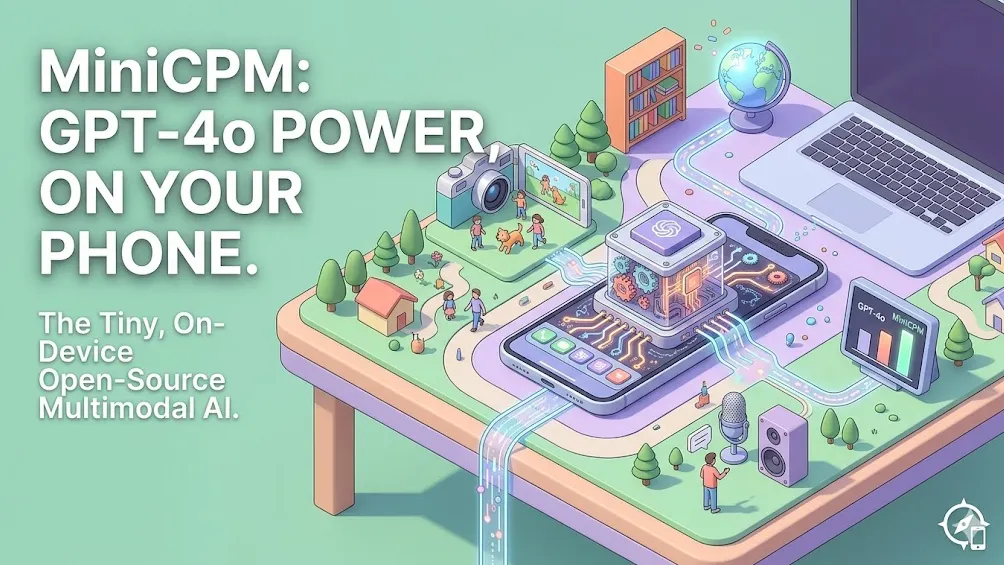
- Designed for on-device deployment: runs efficiently on smartphones, Macs, and edge hardware with low memory and fast inference via llama.cpp, Ollama, and optimized frameworks.
- MiniCPM-o adds full-duplex multimodal live streaming — simultaneous real-time input (video + audio) and output (text + speech) with proactive interaction capabilities.
- Key innovations include Warmup-Stable-Decay (WSD) learning rate scheduling, unified 3D-Resampler for efficient video/image encoding, hybrid reasoning modes, and strong multilingual/OCR support.
What is MiniCPM?
MiniCPM refers to a series of compact yet powerful open-source models focused on end-side (on-device) deployment. Unlike massive cloud-only models, MiniCPM prioritizes efficiency, low resource consumption, and local privacy while delivering competitive or superior performance.
The project originated with text-only MiniCPM (1.2B–2.4B non-embedding parameters), which demonstrated that small models could match 7B–13B models through advanced training strategies. It later expanded into the multimodal domain with MiniCPM-V (Vision) and MiniCPM-o (Omni/multimodal with speech).
As of 2026, the flagship models are:
- MiniCPM-V 4.5: 8B parameters (Qwen3-8B + SigLIP2-400M), excelling in image, multi-image, and high-FPS video understanding.
- MiniCPM-o 4.5: 9B parameters end-to-end model supporting image, video, text, and audio inputs with text + speech outputs.
These models run locally on consumer devices, enabling private, low-latency AI experiences without constant cloud dependency.
Core Architecture and Innovations
MiniCPM stands out through several technical advancements:
- Scalable Training Strategies: Early versions used extensive “model wind tunnel” experiments and the Warmup-Stable-Decay (WSD) learning rate scheduler. This enables better data-model scaling laws, often exceeding traditional Chinchilla-optimal ratios for continued training and domain adaptation.
- Efficient Multimodal Fusion: MiniCPM-V 4.5 introduces a unified 3D-Resampler that compresses video tokens with a 96× ratio while preserving spatial-temporal information, drastically reducing memory and inference time.
- Hybrid Reasoning Modes: Supports both fast (short) and deep (long) thinking modes in a single model, balancing speed and complex problem-solving.
- Full-Duplex Streaming (MiniCPM-o): Output streams (speech/text) and input streams (video/audio) operate without blocking each other, enabling natural real-time conversations, proactive reminders, and voice cloning.
- High-Resolution Handling: Processes images with any aspect ratio up to 1.8 million pixels and delivers state-of-the-art OCR across 30+ languages.
These optimizations result in models that use significantly less GPU memory and inference time compared to larger competitors while maintaining or exceeding performance.
Performance Benchmarks and Comparisons
Benchmarks indicate MiniCPM models punch well above their weight class:
- On OpenCompass (comprehensive vision-language evaluation), MiniCPM-V 4.5 scores approximately 77.0–77.6, outperforming GPT-4o-latest, Gemini 2.0 Pro, and Qwen2.5-VL 72B despite having far fewer parameters.
- VideoMME and streaming benchmarks show MiniCPM-o achieving strong results with only a fraction of the inference cost of larger models (e.g., 8.7%–42.9% of the time/memory of comparable systems).
- Text-only variants like MiniCPM3-4B and MiniCPM4 series often match or exceed Phi-3.5-mini, Llama 3.1 8B, and Qwen2-7B in reasoning and general capabilities.
- Efficiency gains are notable: MiniCPM-V 4.5 delivers competitive VideoMME performance using just 28G memory and dramatically lower inference time than prior state-of-the-art MLLMs.
Community feedback and independent evaluations consistently highlight MiniCPM’s edge in on-device scenarios, where latency, battery life, and privacy matter most.
Key Use Cases and Applications
MiniCPM’s efficiency makes it ideal for:
- Mobile and Edge AI Assistants: Real-time vision, document scanning, OCR, and voice interaction directly on smartphones.
- Video Understanding: High-FPS video analysis, summarization, and live streaming comprehension.
- Multimodal Live Streaming: Full-duplex conversations where the model sees, listens, speaks, and thinks simultaneously (MiniCPM-o).
- Privacy-Sensitive Applications: Local processing for healthcare, finance, or personal data without sending information to the cloud.
- Rapid Prototyping and Deployment: Easy integration via Hugging Face, Ollama, llama.cpp, and WebRTC demos.
Developers have used it for intelligent photo/video apps, real-time translation with visual context, assistive tools for the visually impaired, and offline multimodal agents.
Common Pitfalls and Advanced Tips
While powerful, users should note:
- Quantization Trade-offs: Aggressive quantization (e.g., Q4) enables phone deployment but may slightly reduce complex reasoning quality. Test multiple precision levels for your use case.
- Context and Token Limits: Although efficient, video processing still benefits from intelligent frame sampling and the 3D-Resampler.
- Inference Framework Choice: llama.cpp-omni and optimized WebRTC demos provide the best real-time experience for MiniCPM-o; standard Hugging Face may require additional tuning for speed.
- Multilingual Strengths: Excels in English and Chinese; performance in low-resource languages may vary — fine-tuning or prompt engineering helps.
Advanced Tip: Combine MiniCPM with sparse attention variants (e.g., MiniCPM-S) or MoE versions for further efficiency gains in specialized domains. For production, leverage the official cookbook and community forks for optimized Android/iOS deployment.
Conclusion
MiniCPM represents a significant step toward democratizing advanced AI by proving that compact, open-source models can deliver frontier-level multimodal capabilities on everyday devices. With MiniCPM-V 4.5 and MiniCPM-o 4.5, developers and users gain access to GPT-4o-class vision, video, and speech intelligence without relying on expensive cloud APIs or sacrificing privacy.
Whether building the next generation of mobile AI apps, privacy-first tools, or efficient edge solutions, MiniCPM offers a compelling balance of performance, efficiency, and accessibility.
Explore the official repositories on GitHub (OpenBMB/MiniCPM-V and OpenBMB/MiniCPM-o), experiment with Ollama or llama.cpp, and join the growing community pushing on-device multimodal AI forward in 2026 and beyond.
Continue Reading
More articles connected to the same themes, protocols, and tools.

Referenced Tools
Browse entries that are adjacent to the topics covered in this article.






Hyper3D MCP
MCP ServersHyper3D MCP is Hyper3D's hosted Rodin MCP server for creating 3D assets from natural-language instructions or supported references, checking asynchronous generation progress, and retrieving model download links inside AI coding clients. Official setup is documented for Codex, Claude Code, and Kimi Code CLI.