
What is Harness? The AI Software Delivery Platform Explained
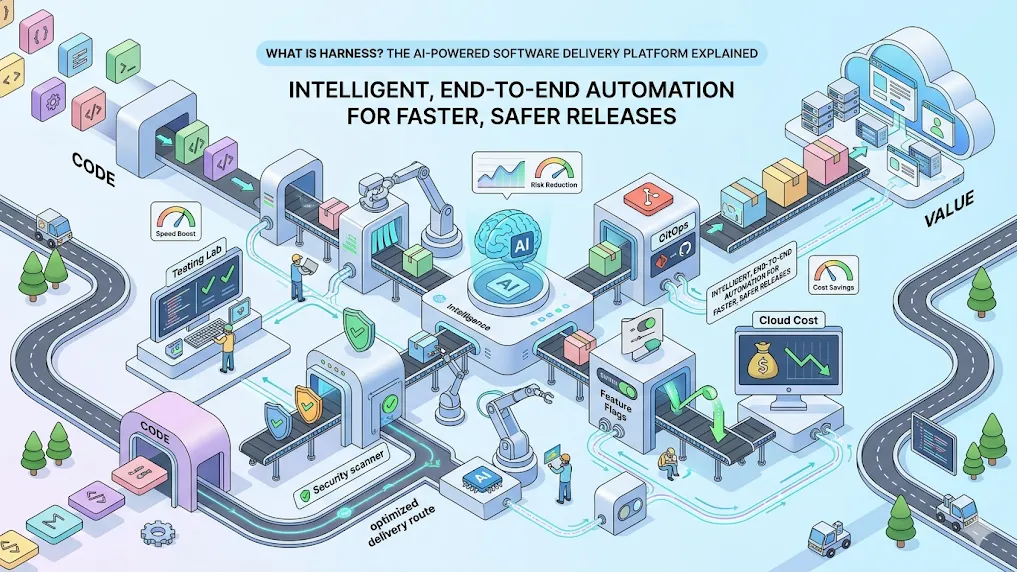
Key Takeaways
- Harness is the AI Software Delivery Platform that unifies Continuous Integration, Continuous Delivery & GitOps, Feature Flags, Security Testing, AI Security, Cloud Cost Management, and more—powered by purpose-built AI agents and the Software Delivery Knowledge Graph.
- It delivers script-free pipelines, AI-driven continuous verification with automated rollbacks, and builds accelerated up to 8x via intelligent caching and optimized infrastructure.
- The delegate-based architecture ensures secure hybrid execution while centralizing governance, supporting multi-cloud, on-prem, and Kubernetes environments.
- Benchmarks indicate teams achieve 75% faster releases, 60% cloud cost reduction, and 10x DevOps efficiency, addressing the AI Velocity Paradox where AI coding outpaces traditional delivery maturity.
- In 2026, new capabilities include AI Security and Secure AI Coding for AI-native applications, upgraded DevOps Agents, and enterprise-grade GitOps promotions—adopted by organizations like Workday, United Airlines, and Morningstar.
What is Harness?
Harness is an end-to-end AI-native software delivery platform that automates and optimizes every stage of the software development lifecycle (SDLC) after code is written. It integrates CI/CD, GitOps, testing, security, feature management, and cost optimization into one intelligent system designed for speed, safety, and scale.
Unlike legacy tools reliant on heavy scripting and manual intervention, Harness leverages AI agents, policy-as-code, and developer self-service to eliminate toil. Its architecture supports SaaS or self-managed control planes with execution delegates running securely in customer environments.
Analysis shows it helps engineering teams ship software faster and more securely across cloud, hybrid, and on-premises setups—making it ideal for enterprises facing the challenges of AI-accelerated development.
Core Components and Architecture
Harness operates on a control plane + execution plane model:
-
Harness Manager (Control Plane): The central SaaS or self-managed hub for pipelines, policies, templates, and dashboards. Pipelines are authored visually or as YAML with full GitOps support.
-
Harness Delegates (Execution Plane): Lightweight, outbound-only agents deployed in Kubernetes, VMs, or containers. They handle secure interactions with clouds, repos, databases, and observability tools without exposing credentials.
-
Connectors, Templates, and Knowledge Graph: Reusable integrations plus the Software Delivery Knowledge Graph that powers AI insights across the platform.
Key modules include:
- Continuous Integration (CI): AI-powered builds with Test Intelligence, Cache Intelligence, and hyper-optimized runners for up to 8x faster execution.
- Continuous Delivery & GitOps (CD): Script-free deployments with canary, blue/green, rolling, and progressive strategies plus AI-assisted verification.
- Feature Flags: Controlled experimentation without redeploys.
- Software Test Orchestration (STO) and Security: Integrated SAST, SCA, runtime protection, plus 2026 AI Security for discovering, testing, and protecting AI components.
- Cloud Cost Management (CCM): Deployment-linked spend optimization.
- AI Capabilities: Continuous Verification for anomaly detection and automated rollbacks; DevOps Agents for pipeline generation, troubleshooting, and SRE runbooks (upgraded in February 2026 with advanced models).
In practice, a commit triggers CI, artifacts flow to CD via delegates, and AI continuously verifies production impact—triggering intelligent rollbacks if needed.
Key Features and Benefits
Benchmarks from 2026 reports and customer data highlight:
- Velocity: CI builds run up to 8x faster; full releases accelerate by 75% through AI automation.
- Reliability: AI-driven verification and rollbacks reduce change failure rates significantly.
- Security: Shift-left testing plus new AI Security and Secure AI Coding modules address risks from AI-generated code and models.
- Governance: Policy-as-code, RBAC, audit trails, and GitOps promotions ensure compliance at scale.
- Efficiency: Cloud Cost Management delivers up to 60% savings; developer self-service reduces context switching.
Unique insight: Harness directly tackles the AI Velocity Paradox—AI tools speed code generation, but fragmented delivery systems create bottlenecks. Its Knowledge Graph and agents provide unified intelligence across the SDLC, turning potential fragility into measurable business velocity.
Harness vs. Alternatives
Objective comparisons in 2026 show distinct advantages:
- vs. GitHub Actions: Strong for simple repository-native workflows but limited in enterprise CD governance, advanced verification, and multi-cloud scale. Harness excels in centralized policies and AI automation, though it involves more setup for small teams.
- vs. Jenkins: Offers extreme customization but requires ongoing maintenance. Harness provides out-of-the-box reliability, lower ops overhead, and native AI features.
- vs. Argo CD / GitOps tools: Harness builds on GitOps with full pipeline orchestration, promotions, verification, and consolidated dashboards—extending Argo/Flux for enterprise needs.
Community and analyst feedback positions Harness as a leader for organizations prioritizing speed, security, and governance at scale.
Pricing and Plans
Harness offers flexible, usage-based options:
- Open Source / Free tiers: Core CI/CD, GitOps, and basic features for individuals and small teams.
- DevOps Essentials: All-inclusive plan combining key modules for growing organizations (contact sales for details).
- Enterprise: Full platform access with advanced AI agents, AI Security, Database DevOps, dedicated support, and custom SLAs. Pricing scales by modules, services, and team size.
Total cost of ownership evaluations typically factor in time savings, risk reduction, and efficiency gains against per-developer or usage metrics.
Advanced Tips, Edge Cases, and Common Pitfalls
To maximize ROI:
- Adopt Templates and GitOps Early: Version-control all pipelines and manifests for auditability and drift detection.
- Delegate Strategy: Use Kubernetes delegates for auto-scaling; deploy multiples per environment for high availability.
- Leverage AI Agents: Start with DevOps Agents for pipeline troubleshooting and policy generation to accelerate onboarding.
- Tune Verification: Calibrate Continuous Verification thresholds to your application's baselines for optimal anomaly detection.
Common Pitfalls:
- Treating visual editors as the sole source of truth instead of Git-backed YAML, leading to sprawl.
- Under-provisioning delegates during high-velocity periods.
- Delaying policy enforcement, creating later compliance gaps.
- Overlooking new AI Security modules when incorporating AI-generated code.
Edge Cases:
- Monorepos: Enable selective test execution and smart caching in CI.
- Hybrid/multi-region setups: Combine delegates with infrastructure-as-code steps.
- AI-heavy applications: Activate Secure AI Coding and AI Security to mitigate LLM-specific risks.
- Large-scale GitOps: Use Harness promotions and centralized reporting for Argo/Flux estates.
Regular analytics reviews help refine configurations over time.
Conclusion
Harness has evolved into the definitive AI Software Delivery Platform, intelligently bridging the gap between accelerated coding and reliable production delivery. Its combination of speed, AI intelligence, security, and governance equips modern engineering organizations to ship value faster while minimizing risk and cost.
For teams modernizing pipelines or scaling cloud-native and AI initiatives, Harness delivers measurable advantages in 2026's high-velocity landscape.
Ready to evaluate? Visit harness.io to explore the platform, start a free trial, or schedule a customized demo. Assess your delivery maturity and pinpoint where AI-powered automation can drive the greatest impact.
Continue Reading
More articles connected to the same themes, protocols, and tools.
Referenced Tools
Browse entries that are adjacent to the topics covered in this article.





Hyper3D MCP
MCP ServersHyper3D MCP is Hyper3D's hosted Rodin MCP server for creating 3D assets from natural-language instructions or supported references, checking asynchronous generation progress, and retrieving model download links inside AI coding clients. Official setup is documented for Codex, Claude Code, and Kimi Code CLI.