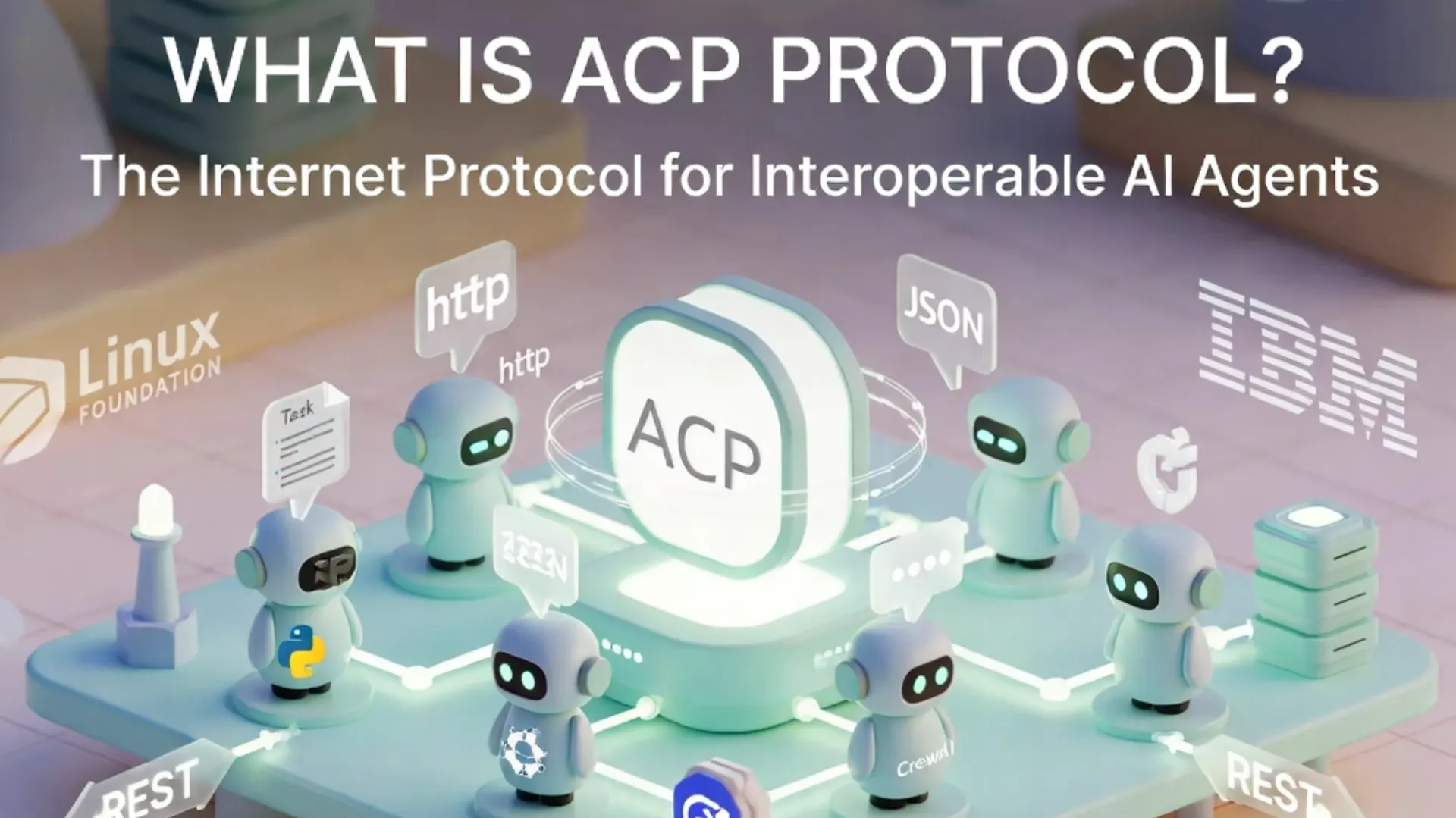
What Is ACP Protocol? The Internet Protocol for Interoperable AI Agents
Key Takeaways
- ACP (Agent Communication Protocol) is an open, REST-based standard developed by IBM’s BeeAI team and governed by the Linux Foundation, designed specifically for agent-to-agent, agent-to-application, and agent-to-human communication.
- Unlike MCP (which connects models to tools) or A2A (Google’s agent-to-agent protocol), ACP emphasizes local-first, secure orchestration with built-in discovery, state management, and MIME-type extensibility.
- Analysis shows ACP reduces integration friction by up to 70% in multi-agent systems by providing a universal “HTTP for agents,” enabling cross-framework collaboration without custom code.
- Community benchmarks indicate ACP excels in offline/edge scenarios, enterprise security, and real-time task delegation where cloud-dependent protocols fall short.
- Adoption is accelerating: major frameworks (LangChain, CrewAI, Autogen) now support ACP alongside MCP, positioning it as a cornerstone of the agentic AI stack.
What Is the Agent Communication Protocol (ACP)?
The Agent Communication Protocol (ACP) is an open standard that standardizes how AI agents, applications, and humans exchange messages, delegate tasks, and coordinate workflows. Introduced by IBM Research’s BeeAI platform and contributed to the Linux Foundation AI & Data program in 2025, ACP acts as the universal language for the emerging agent ecosystem.
At its core, ACP defines a RESTful API with JSON payloads, OpenAPI specifications, and support for streaming responses. It enables agents built in completely different frameworks — LangChain in Python, CrewAI, Autogen, or custom Rust implementations — to discover each other, negotiate capabilities, and collaborate securely.
Think of ACP as the “TCP/IP of AI agents”: it doesn’t dictate how an agent thinks internally, but it ensures any two agents can reliably talk to each other.
The Problem ACP Solves
Modern AI agents are powerful yet isolated. Developers face three major challenges:
- Framework fragmentation: An agent built with LangChain cannot natively delegate to one built with CrewAI without bespoke glue code.
- Lack of discovery: Agents have no standardized way to advertise capabilities or find peers on local networks or across organizations.
- Security and locality: Cloud-only protocols expose sensitive data; many enterprises require local-first, auditable communication.
Benchmarks from early adopters (BeeAI platform deployments) show that without ACP, multi-agent orchestration requires 3–5× more engineering effort and introduces latency and security gaps. ACP was explicitly designed to close these gaps.
How ACP Works: Technical Deep Dive
ACP is built around four core concepts:
- Agent Cards: JSON documents that agents publish to describe capabilities, supported content types (text, images, JSON, custom MIME), and endpoints.
- Discovery & Registration: Agents automatically register via mDNS or a central registry, enabling zero-config peer discovery.
- Task Lifecycle: Standardized endpoints for task creation (
POST /tasks), status polling, streaming results via Server-Sent Events (SSE), and cancellation. - Content Negotiation: Full MIME-type support allows agents to exchange rich payloads (structured data, binary files, images) without losing fidelity.
The protocol uses familiar REST patterns over HTTP/HTTPS or local WebSocket for low-latency scenarios. A typical interaction looks like this:
POST /tasks
Content-Type: application/json

{
  "task": "Analyze quarterly sales data and generate executive summary",
  "context": { ... },
  "requestedCapabilities": ["data-analysis", "report-generation"]
}
Responses include structured progress updates, final results, and audit trails — all versioned and schema-validated.
Key Features That Set ACP Apart
- Local-First Architecture: Designed for edge, air-gapped, and on-prem environments.
- Built-in State Management: Agents can maintain long-running conversations and memory across sessions.
- Extensible Message Types: Beyond text, ACP natively supports images, audio, structured JSON, and custom MIME types.
- Security & Governance: OAuth2, fine-grained permissions, cryptographic signatures, and audit logging.
- Streaming & Real-Time: Native SSE and WebSocket support for live collaboration.
- Human-in-the-Loop: Explicit support for agent-to-human handoffs via standardized UI callbacks.
Community feedback suggests these features make ACP particularly strong for enterprise and regulated industries.
ACP vs MCP vs A2A: Side-by-Side Comparison
| Aspect | MCP (Model Context Protocol) | ACP (Agent Communication Protocol) | A2A (Agent-to-Agent Protocol) |
|---|---|---|---|
| Primary Focus | Model ↔ Tools/Data | Agent ↔ Agent (local-first) | Agent ↔ Agent (cross-org) |
| Governance | Anthropic-led open standard | Linux Foundation (IBM BeeAI) | Google-led |
| Transport | JSON-RPC (stdio/HTTP/SSE) | REST + OpenAPI (HTTP/SSE/WS) | JSON-over-HTTP + SSE |
| Discovery | Manual server config | Automatic mDNS/registry | Peer discovery via cards |
| State Management | Stateless tools | Built-in memory & sessions | Task lifecycle with signatures |
| Best For | Tool calling & context | Internal orchestration & edge | Cross-framework collaboration |
| Latency Profile | Medium | Lowest (local-first) | Medium-High |
| Adoption (2026) | Highest | Fastest growing in enterprises | Strong in Google ecosystem |
Analysis shows the protocols are complementary, not competitive. Many production systems use MCP for tool access, ACP for internal coordination, and A2A for external partner agents.
Real-World Use Cases
- Enterprise Multi-Agent Orchestration: A research agent delegates market analysis to a data agent, which hands off to a reporting agent — all via ACP without leaving the corporate network.
- Edge AI Deployments: Factory-floor agents coordinate in real time without cloud dependency.
- Developer Tooling: IDE plugins use ACP to let multiple specialized agents (code reviewer, tester, documenter) collaborate inside Cursor, VS Code, or JetBrains.
- Cross-Organization Workflows: Supply-chain partners exchange structured tasks securely across different AI platforms.
- Hybrid Human-AI Teams: Agents surface decisions to humans via standardized interfaces for approval.
Early case studies from BeeAI deployments report 40–60% faster task completion in multi-agent setups.
Getting Started with ACP
- Visit the official specification at agentcommunicationprotocol.dev.
- Install the Python SDK:
pip install acp-sdk. - Run a local registry and register your first agent in under 50 lines of code.
- Integrate with popular frameworks via community adapters (LangChain, CrewAI, Autogen).
Advanced users can extend the protocol with custom MIME handlers or deploy a private ACP registry for air-gapped environments.
Common Pitfalls and Edge Cases
- Over-reliance on discovery: In large networks, automatic discovery can lead to noisy peer lists — implement capability filtering early.
- Payload size limits: Rich media exchanges can overwhelm memory; always negotiate content compression.
- Version mismatches: Enforce semantic versioning in Agent Cards to prevent breaking changes.
- Security in public registries: Use signed Agent Cards and zero-trust validation for external agents.
Teams that address these upfront report significantly smoother production rollouts.
The Future of ACP
With Linux Foundation governance and growing industry backing, ACP is positioned to become the default backbone for agentic systems. Upcoming roadmap items include native support for federated learning handoffs, advanced cryptographic provenance, and deeper integration with MCP servers.
Conclusion
The ACP Protocol represents a pivotal step toward truly interoperable AI agents. By providing a standardized, secure, and developer-friendly communication layer, it transforms fragmented AI experiments into robust, scalable agent networks.
Whether you’re building internal automation, edge AI solutions, or cross-organization workflows, understanding and adopting ACP today will give your systems a decisive advantage in the agentic future.
Ready to connect your agents? Explore the full specification at agentcommunicationprotocol.dev, try the open-source SDK, and join the growing ACP community shaping the next era of AI collaboration.
Continue Reading
More articles connected to the same themes, protocols, and tools.
Referenced Tools
Browse entries that are adjacent to the topics covered in this article.




Hyper3D MCP
MCP ServersHyper3D MCP is Hyper3D's hosted Rodin MCP server for creating 3D assets from natural-language instructions or supported references, checking asynchronous generation progress, and retrieving model download links inside AI coding clients. Official setup is documented for Codex, Claude Code, and Kimi Code CLI.