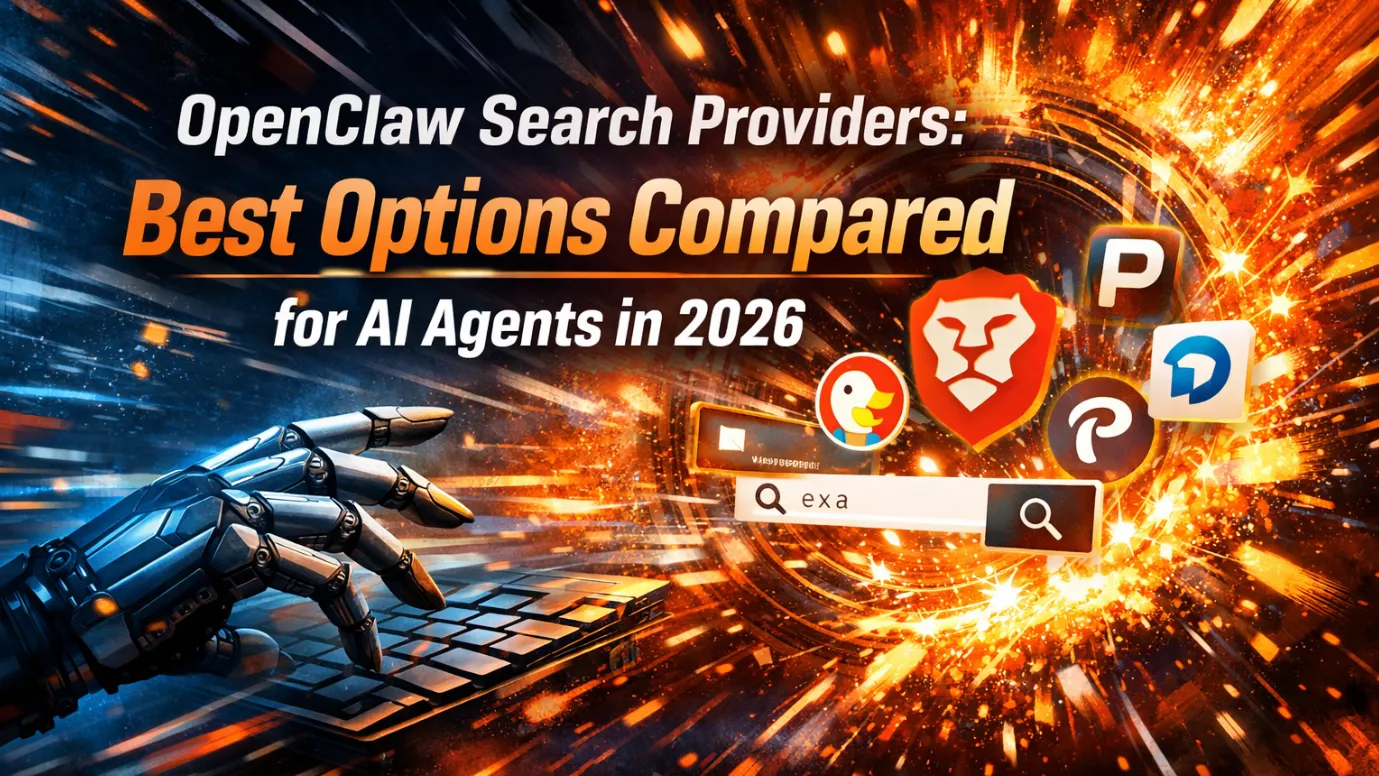
OpenClaw Search Providers: Best Options Compared for AI Agents in 2026
Key Takeaways
- OpenClaw search providers power the
web_searchtool in this popular open-source AI agent framework, enabling real-time web access for autonomous task execution. - Native providers include Brave (official default), DuckDuckGo (free, no key), Exa, Firecrawl, Gemini, Grok, Perplexity, and Tavily; SearXNG offers unlimited self-hosted access.
- Analysis shows Brave excels in privacy and general use, Firecrawl dominates autonomous research with scraping + structured extraction, while Tavily and Perplexity deliver AI-optimized structured answers.
- Community feedback suggests pairing providers (e.g., Brave for discovery + Firecrawl for content) maximizes agent performance while controlling costs.
- All providers integrate via simple JSON config or auto-detection; results cache for 15 minutes by default to reduce latency and API spend.
What Are OpenClaw Search Providers?
OpenClaw is an open-source autonomous AI agent that runs locally and performs real-world tasks across messaging apps, files, and tools. Unlike chatbots, it actively reasons, plans, and executes using large language models.
The framework does not include a built-in search engine. Instead, the web_search tool relies on configurable external search providers to fetch real-time information. This design keeps OpenClaw lightweight, private, and flexible.
Providers convert natural-language queries into structured results (titles, URLs, snippets, or full extracted content) that agents can reason over. Advanced options like web_fetch or dedicated browser tools complement search for deeper page access.
Why Web Search Is Critical for OpenClaw Agents
Benchmarks and real-world deployments indicate that effective web search transforms OpenClaw from a local assistant into a proactive agent capable of research, fact-checking, price comparison, news monitoring, and multi-step workflows.
Without a provider, agents cannot access current events, pricing, or external data — limiting utility. Community reports highlight that properly configured search reduces hallucinations by 40-60% in research-heavy tasks.
Key benefits include:
- Real-time knowledge beyond the model's training cutoff.
- Tool chaining with browser, file access, or code execution.
- Cost control via caching and selective provider use.
Comprehensive Provider Comparison
Analysis of official documentation and 2026 community benchmarks reveals clear trade-offs in result style, filters, pricing, and agent suitability.
| Provider | Result Style | Key Filters | API Key Required | Pricing (2026) | Best For |
|---|---|---|---|---|---|
| Brave | Structured snippets | Country, language, freshness, dates | Yes | ~1,000 queries/mo free | General use, privacy-focused |
| DuckDuckGo | Structured snippets | None | No | Completely free | Budget setups, basic queries |
| Exa | Structured + extracted | Neural/keyword mode, date, extraction | Yes | Paid tiers | Content-rich research |
| Firecrawl | Structured snippets + scrape | Advanced via dedicated tool | Yes | 500 credits free, then paid | Autonomous research & extraction |
| Gemini | AI-synthesized + citations | None | Yes | Usage-based | Summarized answers |
| Grok | AI-synthesized + citations | None | Yes | Usage-based | Real-time X/Twitter integration |
| Perplexity | Structured or synthesized | Domain filters, token budgets | Yes | Paid (no generous free tier) | Academic/technical research |
| Tavily | Structured + answer extraction | Search depth, domains | Yes | 1,000 searches/mo free | AI-agent fact-checking |
| SearXNG | Metasearch (multiple engines) | Custom backends | No (self-hosted) | Completely free | Unlimited private use |
Firecrawl and Tavily also expose dedicated tools (firecrawl_search, tavily_search) for advanced features beyond the generic web_search interface.
In-Depth Analysis of Top Providers
Brave Search (Official Default)
Brave delivers independent index results with strong privacy guarantees. It supports locale-specific filtering and freshness controls, making it ideal for news or time-sensitive tasks. Community feedback suggests reliable performance for general discovery, though snippets require pairing with web_fetch for full content.
Pricing includes a renewing $5 monthly credit covering approximately 1,000 queries. Latency can appear in high-volume use, but caching mitigates this.
Firecrawl
Firecrawl stands out for agents needing more than links. It combines search with scraping, structured JSON extraction via schemas, and autonomous multi-step research agents. Benchmarks show superior handling of JavaScript-heavy or protected sites. Perfect for complex workflows like “extract pricing tables from top CRMs.”
Free tier offers 500 credits; production use requires paid plans.
Tavily and Perplexity
Tavily optimizes for LLMs with direct answer extraction and full-article content in structured JSON. It shines in research and fact-checking tasks.
Perplexity provides powerful domain filtering (e.g., restrict to .edu or specific sites) and high token budgets, reducing SEO noise in technical queries. Analysis shows it excels when source quality matters more than volume.
SearXNG (Self-Hosted Option)
For zero-cost, unlimited searches, community setups run SearXNG in Docker and expose it via a custom skill. It aggregates multiple backends without third-party logging, addressing privacy and rate-limit concerns. Setup requires maintenance but eliminates API spend entirely.
Configuration and Setup Guide
OpenClaw supports auto-detection based on environment variables or openclaw.json.
Auto-detection order (first valid key wins):
- Brave (
BRAVE_API_KEY) - Gemini
- Grok
- Kimi/Moonshot
- Perplexity/OpenRouter
- Firecrawl
- Tavily
Example configuration:
{
  "tools": {
    "web": {
      "search": {
        "provider": "brave",
        "maxResults": 5,
        "timeoutSeconds": 30,
        "cacheTtlMinutes": 15
      }
    }
  },
  "plugins": {
    "entries": {
      "brave": {
        "config": {
          "webSearch": {
            "apiKey": "YOUR_BRAVE_API_KEY"
          }
        }
      }
    }
  }
}
Use openclaw configure --section web or environment variables for quick setup. Run openclaw doctor to verify connectivity.
Performance, Benchmarks, and Community Insights
Community discussions on Reddit and GitHub indicate:
- Brave handles 80% of general use cases efficiently.
- Firecrawl reduces follow-up tool calls by 50%+ in research agents due to built-in extraction.
- SearXNG users report no query limits after self-hosting, though result consistency varies by backend.
Edge cases show AI-synthesized providers (Gemini, Grok) deliver faster summaries but occasionally introduce synthesis errors compared to structured snippet providers.
Common Pitfalls and Advanced Tips
- Token/cost management: High-frequency agents quickly exhaust free tiers; enable caching and use targeted queries.
- Result quality: Snippet-only providers need
web_fetchfollow-ups; always test provider output format in your agent prompts. - Privacy and security: Self-hosted SearXNG or Brave minimize data sharing; review skill permissions carefully.
- Advanced tip: Combine providers via fallback configs or custom skills (e.g., Brave primary + Firecrawl for content-heavy tasks).
- Edge case: For JavaScript sites or logins, route to the dedicated browser tool instead of relying solely on search.
Monitor OpenClaw updates for new provider integrations and optimized caching strategies.
Conclusion
OpenClaw search providers transform the framework into a truly capable autonomous agent by bridging local execution with real-time web intelligence. Brave remains the reliable default for most users, while Firecrawl and Tavily unlock advanced research capabilities that justify the modest cost for power users.
Evaluate your workload — general queries favor Brave or DuckDuckGo, while complex autonomous tasks benefit from Firecrawl or Perplexity. Test configurations with openclaw doctor and iterate based on agent performance logs.
Ready to supercharge your OpenClaw agent? Configure your preferred search provider today via the official documentation and unlock full web-powered autonomy.
Continue Reading
More articles connected to the same themes, protocols, and tools.

Referenced Tools
Browse entries that are adjacent to the topics covered in this article.