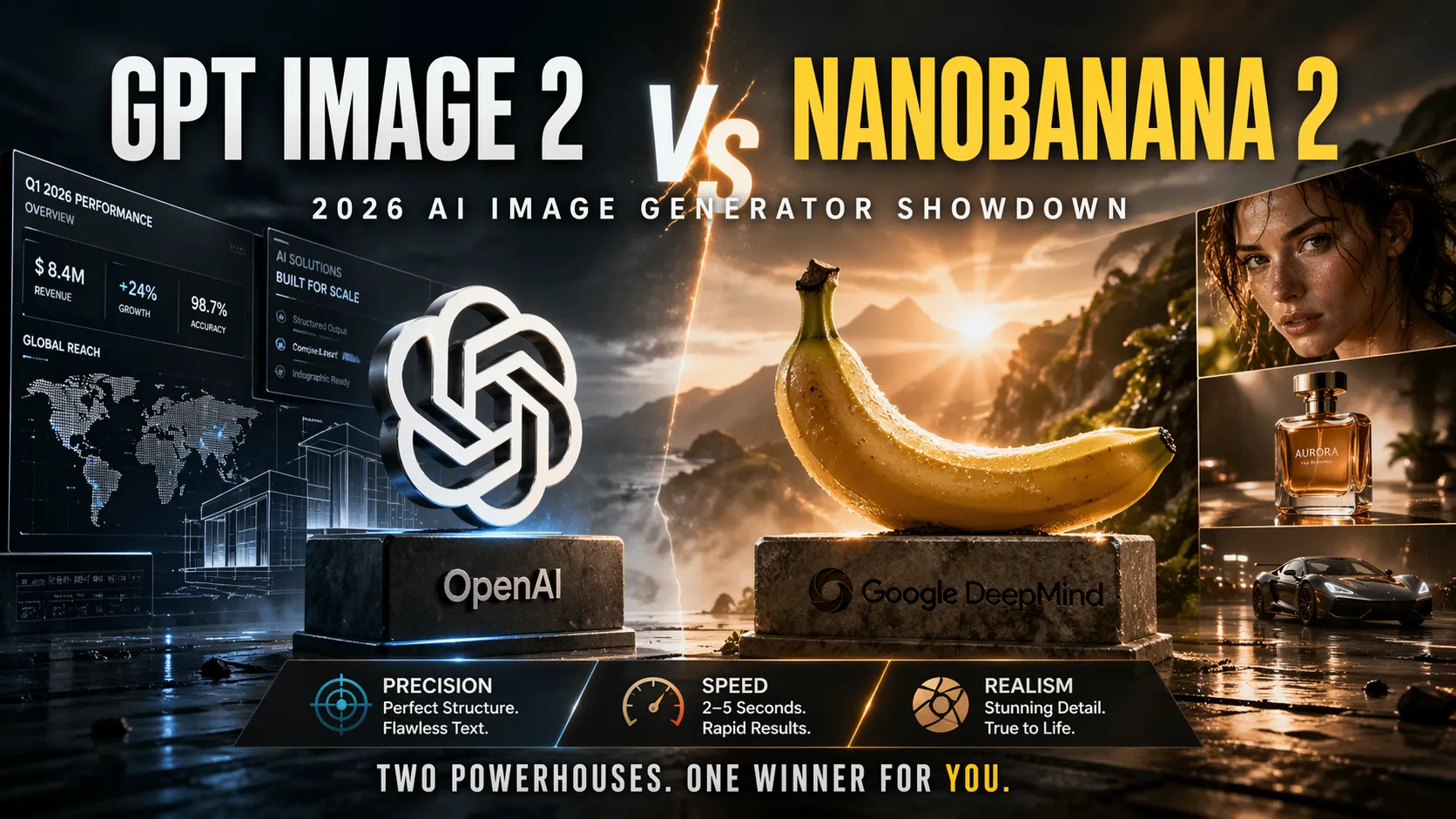
GPT Image 2 vs NanoBanana 2: 2026 AI Image Generator Showdown
Quick Comparison
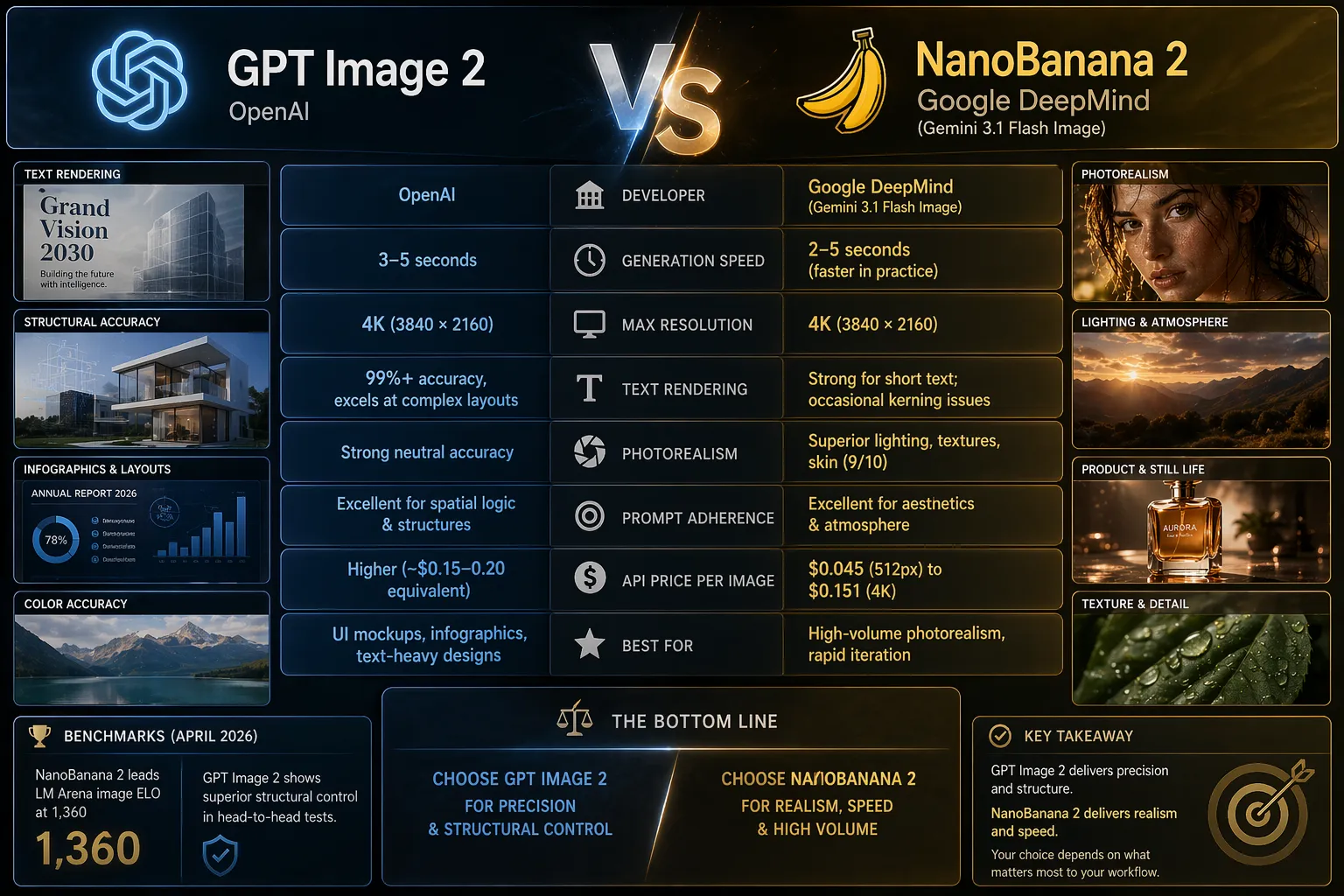
| Feature | GPT Image 2 | NanoBanana 2 |
|---|---|---|
| Developer | OpenAI | Google DeepMind (Gemini 3.1 Flash Image) |
| Generation Speed | 3–5 seconds | 2–5 seconds (faster in practice) |
| Max Resolution | 4K | 4K |
| Text Rendering | 99%+ accuracy, excels at complex layouts | Strong for short text; occasional kerning issues |
| Photorealism | Strong neutral accuracy | Superior lighting, textures, skin |
| Prompt Adherence | Excellent for spatial logic & structures | Excellent for aesthetics & atmosphere |
| API Price per Image | Higher (~$0.15–0.20 equivalent) | $0.045 (512px) to $0.151 (4K) |
| Best For | UI mockups, infographics, text-heavy designs | High-volume photorealism, rapid iteration |
Benchmarks (as of April 2026): NanoBanana 2 leads LM Arena image ELO at 1,360; GPT Image 2 shows superior structural control in head-to-head tests.
Image Quality & Photorealism
Analysis of side-by-side tests shows clear trade-offs. NanoBanana 2 consistently delivers higher tactile realism, dynamic lighting, and natural textures. In portrait and product shots, it scores higher on skin detail (9/10) and shadow accuracy (9/10).
GPT Image 2 produces more neutral, color-accurate results with fewer stylized artifacts. It performs better when precise color fidelity matters over cinematic flair.
Key Insight: NanoBanana 2 wins for lifestyle, cinematic, or hyper-real visuals. GPT Image 2 excels when balanced, accurate representation is required.
Speed & Generation Efficiency
NanoBanana 2 generates images in 2–5 seconds on average, making it ideal for rapid iteration. GPT Image 2 matches closely at 3–5 seconds but can feel slower in complex reasoning modes.
For high-volume workflows (20+ images daily), NanoBanana 2’s Flash-based architecture provides measurable throughput advantages.
Text Rendering & Typography
GPT Image 2 leads with near-perfect text accuracy (99%+ in community tests), handling long strings, handwritten fonts, labels, and complex layouts without distortion. It shines in posters, infographics, and UI mockups.
NanoBanana 2 handles short text well but shows occasional kerning or alignment issues in multi-line or stylized scenarios.
Real-World Test Example: Prompts requiring labeled grids or elegant subtitles consistently favor GPT Image 2 for legibility and layout precision.
Prompt Adherence & Structural Control
GPT Image 2 demonstrates superior understanding of spatial relationships and complex instructions. In grid layouts, catalog deconstruction, and multi-element compositions, it maintains boundaries and logical organization where NanoBanana 2 may blend or approximate.
NanoBanana 2 excels at atmospheric interpretation and creative freedom, producing more visually compelling results when strict structure is not required.
Pricing & Accessibility
- NanoBanana 2: $0.045 per 512px image up to $0.151 per 4K image via Gemini API. Batch processing further reduces costs. Available in Gemini interface and multiple third-party platforms.
- GPT Image 2: Higher token-based pricing (approximately $0.15–0.20 per image equivalent via OpenAI API). Integrated natively in ChatGPT for seamless conversational use.
NanoBanana 2 offers better cost-efficiency for scale. GPT Image 2 provides stronger value within the OpenAI ecosystem for users already subscribed to ChatGPT.
Features & Ecosystem
NanoBanana 2:
- Native Google Search grounding for real-world accuracy
- Strong character/object consistency (up to 5 characters, 14 references)
- Excellent native image editing
- Broad availability across Google tools and partners
GPT Image 2:
- Deep conversational editing inside ChatGPT
- Advanced reasoning (“thinking”) modes
- Superior multilingual support
- Tight integration with Microsoft Foundry and developer workflows
Both support image-to-image editing, but GPT Image 2’s instruction-following edge benefits complex edits.
Which Should You Choose?
Choose NanoBanana 2 if you need:
- Fast, cost-effective high-volume generation
- Hyper-realistic portraits, products, or lifestyle imagery
- Rapid prototyping and iteration
- Real-time search-grounded visuals
Choose GPT Image 2 if you need:
- Precise text rendering and typography
- Complex layouts, infographics, UI/UX mockups
- Strict spatial control and prompt adherence
- Seamless workflow inside ChatGPT or OpenAI API
Use both for maximum flexibility — many professionals run tests through aggregator platforms to select the best output per task.
Conclusion
GPT Image 2 and NanoBanana 2 represent the current frontier of AI image generation in 2026. NanoBanana 2 leads in speed, photorealism, and value. GPT Image 2 dominates in precision, control, and structured creativity. The optimal choice depends on your specific workflow, budget, and output requirements.
Test both models with your real prompts today — the differences become clear within the first few generations.
Continue Reading
More articles connected to the same themes, protocols, and tools.
Referenced Tools
Browse entries that are adjacent to the topics covered in this article.
PaidSync.ai
MCP ServersPaidSync.ai is a hosted MCP server for paid advertising that exposes 610+ tools across 14 advertising, analytics, tagging, and commerce platforms. It supports read/write workflows from AI clients including ChatGPT, Claude, Gemini, Cursor, Claude Code, and Codex, with a free plan.
Hyper3D MCP
MCP ServersHyper3D MCP is Hyper3D's hosted Rodin MCP server for creating 3D assets from natural-language instructions or supported references, checking asynchronous generation progress, and retrieving model download links inside AI coding clients. Official setup is documented for Codex, Claude Code, and Kimi Code CLI.