OpenAI Suddenly Shuts Down Sora: Why the Half-Year AI Video Sensation Crashed and Burned?
Key Takeaways
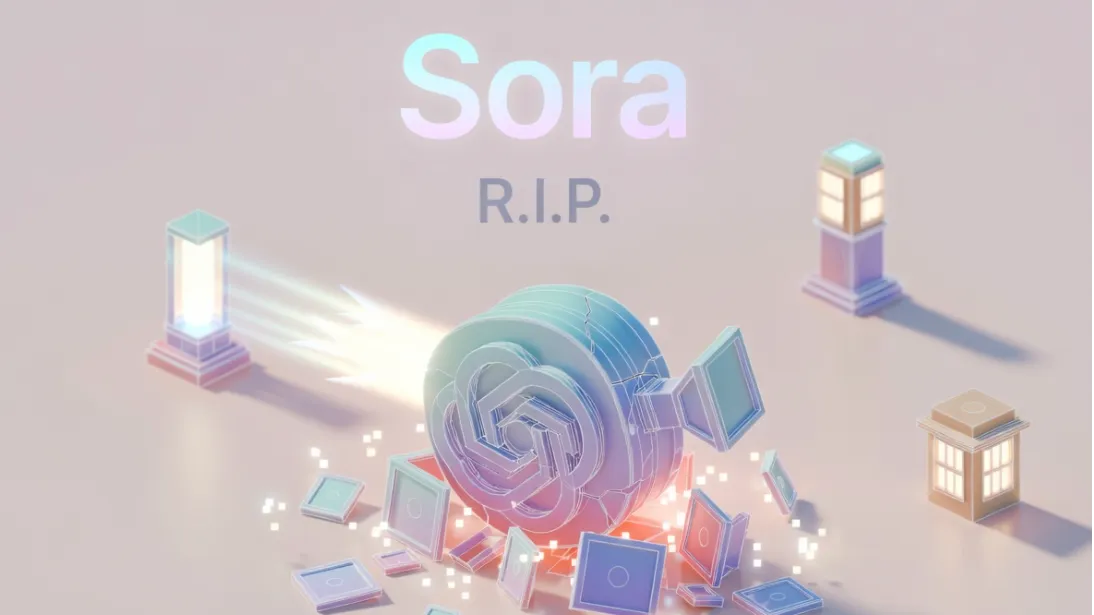
- OpenAI Officially Announces: On March 24, 2026, the Sora team posted a farewell message on social media, confirming the gradual shutdown of the standalone app and API, with a detailed timeline for discontinuation and user content preservation to be released soon.
- Core Reasons: Streamlining the product lineup, focusing on core business, and paving the way for a potential IPO. In December 2025, the company had already launched a "Code Red" plan to pause Sora development and redirect resources to ChatGPT and enterprise applications.
- Sora's Rise and Fall: Launched as a standalone app in late September 2025, it quickly topped the U.S. App Store with surging downloads. However, downloads dropped 32% month-over-month in December and another 45% in January 2026 to just 1.2 million installs, with user retention declining rapidly.
- Major Impacts: Termination of Disney's $1 billion investment and IP licensing deal; reshaping of the AI video generation competitive landscape, potentially opening opportunities for Chinese players like Kling and Hailuo.
- User Action Recommendations: Immediately back up all generated content, monitor official announcements, and explore alternatives such as Runway Gen-3 and Luma Dream Machine.
Sora's Rise and Technical Highlights
Sora, OpenAI's first native text-to-video generation model, has attracted widespread attention since its technical preview in early 2024. After the official launch of the standalone app in late September 2025, users could simply enter text prompts to generate highly realistic videos up to 1080p resolution and over 10 seconds in length, with support for image inputs and social sharing features.
Technically: Sora employs an advanced spatiotemporal diffusion Transformer architecture capable of understanding complex physical laws, camera movements, and multi-character interactions. Benchmarks show its temporal consistency and physical realism far surpass early competitors like Runway's Gen-2 model. Community feedback highlights Sora's exceptional performance in generating complex scenes such as city nightscapes and dynamic water surfaces, once hailed as a "watershed moment in AI video generation."
However, analysis indicates that Sora's high computational demands (each generation consumes significant GPU resources) led to prohibitively high costs for large-scale deployment, laying the groundwork for its eventual shutdown.
Deep Reasons Behind the Shutdown: Strategic Adjustment and Practical Considerations
OpenAI's decision to shut down Sora was not sudden but the result of long-term product strategy corrections. In December 2025, CEO Sam Altman initiated a "Code Red" plan, pausing non-core projects like Sora across the company to concentrate resources on refining GPT-5.2 in response to competition from Anthropic and Google.
Primary Drivers:
- Product Line Simplification: The company had previously launched multiple consumer products including the Sora app and Atlas browser, leading to organizational complexity and scattered priorities. The CFO explicitly stated the need to build a "IPO-ready" company, focusing on enterprise programming and agentic AI.
- User Data and Commercial Performance: Although the app experienced viral growth initially, downloads and spending continued to decline. Appfigures data shows installs dropped 45% month-over-month in January 2026, with user retention far below platforms like TikTok. Sora failed to build a strong enough network effect to sustain the operational costs of a standalone app.
- Copyright and Safety Controversies: After launch, Sora frequently generated content infringing on Disney, Marvel, and Japanese anime IPs. The Motion Picture Association publicly called for stronger opt-out mechanisms. The Japanese government even intervened, demanding an end to infringing generations. Multiple pauses on specific character generations (such as Martin Luther King Jr. imagery) highlighted compliance pressures.
- Resource Allocation: Video generation compute costs far exceed those of text models. Leadership decided to redirect the Sora team to world simulation research for robotics, serving more strategically important AGI directions.
These factors combined to mark OpenAI's pragmatic shift from "all-out expansion" to "core focus."
Multiple Impacts on Users, Creators, and the Industry
For Users: Millions of generated videos face the risk of being taken offline. The Sora team has promised export tools, but users must act before the deadline. Creators commonly used Sora for short video marketing, concept demos, or artistic experiments and will need to migrate to alternative platforms after shutdown.
Industry Impact:
- Reshaping Competition: Chinese vendors clearly benefit. Kuaishou's Kling model leads in user scale and localization, while Hailuo MiniMax and Vidu are iterating rapidly. Internationally, Runway Gen-3, Luma Dream Machine, and Pika Labs will fill the market gap left by Sora.
- Technology Trends: Video generation is evolving from standalone apps toward integrated tools, such as direct embedding in ChatGPT. In the long term, high-consistency long-video generation remains a pain point; future models must address challenges like 60+ second durations and multi-shot storytelling.
- Regulatory Signals: The shutdown reinforces the importance of AI copyright compliance. The industry needs to proactively implement opt-in mechanisms and watermarking technologies to avoid similar controversies.
Common Pitfalls and Advanced Tips: Many users over-relied on a single platform without backing up local assets. Creators should adopt a "multi-tool parallel" strategy (standardized text prompts + multi-model testing) and monitor open-source alternatives like Stable Video Diffusion to mitigate risks.
The Future Outlook for AI Video Generation
Sora's shutdown does not mark the end of the AI video era but the beginning of a new round of reshuffling. Benchmark comparisons show that current top models still have 20-30% room for improvement in physical simulation, especially in complex interactions and long-sequence generation. OpenAI's strategic pivot signals that future AI will emphasize practical value: enterprise video automation and robotics training data generation, rather than pure consumer entertainment.
Edge cases deserve attention: generating long documentaries or real-time interactive videos still faces compute bottlenecks; tightening regulations may drive the popularization of "traceable generation" technologies. Overall, Sora's experience offers the industry a valuable lesson—technological leadership does not equal commercial sustainability; focusing on core competitiveness is the path to longevity.
Conclusion
OpenAI's shutdown of Sora signals that AI consumer products are moving from "wild growth" into a "rational refinement" phase. While this decision may disappoint some creators, it also injects a pragmatic signal into the industry. Developers and enterprises should take this opportunity to evaluate their tool stacks, prioritize stable and highly compliant platforms, and continue monitoring OpenAI's future integration plans.
Take action now: back up your Sora creations, explore alternatives like Kling or Runway to boost AI video production efficiency, and follow official OpenAI updates as we witness the next breakthrough in AI video generation.
Continue Reading
More articles connected to the same themes, protocols, and tools.

Referenced Tools
Browse entries that are adjacent to the topics covered in this article.



Hyper3D MCP
MCP ServersHyper3D MCP is Hyper3D's hosted Rodin MCP server for creating 3D assets from natural-language instructions or supported references, checking asynchronous generation progress, and retrieving model download links inside AI coding clients. Official setup is documented for Codex, Claude Code, and Kimi Code CLI.