MCP 2026 Roadmap: 4 Priorities Transforming AI Agent Integrations and Enterprise Readiness
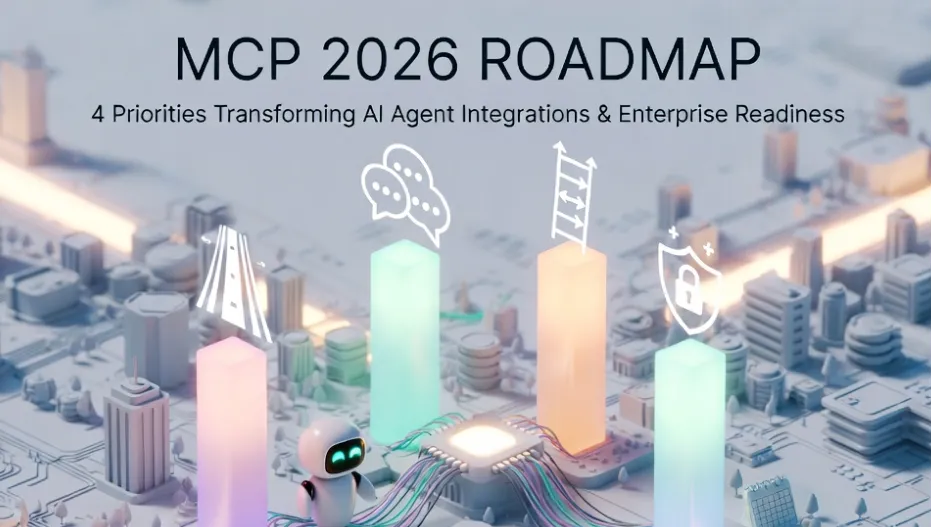
Key Takeaways
- Transport Evolution and Scalability leads the 2026 priorities, solving stateful session bottlenecks to enable true horizontal scaling behind load balancers and proxies.
- Agent Communication refines the Tasks primitive with retry semantics and expiry policies for reliable asynchronous operations in production.
- Governance Maturation introduces a contributor ladder and delegation model, reducing bottlenecks while maintaining quality in this Linux Foundation-hosted standard.
- Enterprise Readiness addresses audit trails, SSO integration, and gateway patterns—most outputs as lightweight extensions rather than core changes.
- SEPs aligned with these areas receive expedited review; community Working Groups now drive timelines and deliverables.
- Analysis shows these priorities directly tackle production pain points observed in 2025 deployments, positioning MCP as the de facto “USB-C for AI” by year-end.
What Is the Model Context Protocol (MCP)?
MCP is the open standard that standardizes connections between AI applications and external systems. Launched by Anthropic in late 2024 and now governed under the Linux Foundation’s Agentic AI efforts, it functions as a universal interface for AI clients to discover, connect to, and interact with MCP servers exposing data sources, tools, databases, and workflows.
Benchmarks from major providers—including Anthropic’s Claude, OpenAI, Google, Microsoft, and Amazon—confirm MCP’s ecosystem dominance, with over 97 million monthly SDK downloads by early 2026. Unlike fragmented custom integrations, MCP enables any compliant AI agent to plug into calendars, Notion workspaces, code repositories, or enterprise databases using a consistent JSON-RPC-based protocol over Streamable HTTP.
Why the 2026 Roadmap Matters Now
By March 2026, MCP has transitioned from experimental local-tool wiring to powering large-scale agent workflows. Community feedback and production telemetry reveal recurring friction points: load-balancer incompatibility with stateful sessions, unclear task lifecycles, governance bottlenecks, and enterprise compliance gaps.
The updated roadmap—published March 5, 2026, and summarized in the official blog—shifts from date-based releases to priority areas owned by Working Groups. This structure reflects mature open-standard governance while accelerating the most critical fixes. Analysis of deployment data indicates these four focus areas will unlock the reliability and scale required for mainstream enterprise adoption.
1. Transport Evolution and Scalability: Fixing Horizontal Scaling
Streamable HTTP unlocked remote MCP servers in 2025, yet stateful sessions clash with modern cloud architectures. Servers holding session state in memory prevent straightforward horizontal scaling, force sticky routing, and complicate restarts.
Key deliverables in 2026:
- Stateless or near-stateless session models with explicit creation, resumption, and migration protocols.
- Load-balancer and proxy-friendly patterns that eliminate workarounds.
- MCP Server Cards—a standardized metadata format served at a
.well-knownendpoint for discovery by registries, browsers, and crawlers without live connections.
The Transports Working Group owns wire-format updates, session resumption specs, and SDK conformance guidance. No new official transports will be added to preserve compatibility; community experiments remain encouraged. Edge case: multi-cluster deployments across Kubernetes pods will benefit most, eliminating Redis-based session mapping hacks observed in 2025 pilots.
Common pitfall to avoid: Continuing to rely on in-memory state without planning for Server Cards—teams that prototype discovery metadata now will migrate seamlessly once the spec lands.
2. Agent Communication: Refining Asynchronous Tasks
The Tasks primitive (introduced via SEP-1686) enables “call-now / fetch-later” patterns ideal for long-running agent work. Production usage, however, exposed gaps in failure handling and result management.
2026 focus areas:
- Retry semantics for transient failures, including decision logic and exponential backoff guidelines.
- Expiry policies defining result retention duration and client notification mechanisms.
The Agents Working Group will triage real-world operational issues as task volume scales. This iteration mirrors MCP’s proven approach: ship experimental features, gather telemetry, then harden. Developers building multi-step agent orchestrations will see dramatically higher success rates once these semantics stabilize.
3. Governance Maturation: Scaling Open-Standard Decision-Making
With MCP now under formal Linux Foundation governance, every SEP previously required full core-maintainer review—a bottleneck as participation grows.
Planned advancements:
- Contributor Ladder defining clear progression paths (participant → WG contributor → lead maintainer).
- Delegation model allowing trusted Working Groups to approve domain-specific SEPs and publish extensions independently.
- Standardized charter templates for each group, reviewed quarterly.
These changes maintain strategic oversight while empowering specialized teams. Community data suggests governance maturation will accelerate SEP throughput by 3–4× for priority-aligned proposals.
4. Enterprise Readiness: Bridging to Production Compliance
Enterprises deploying MCP encounter needs absent from the core spec: end-to-end audit trails, corporate SSO flows, gateway/proxy behavior, and portable configuration.
The newly forming Enterprise Working Group will collect problem statements and deliver most solutions as extensions (e.g., audit logging schemas, Cross-App Access integration patterns). Keeping core changes minimal preserves simplicity for smaller deployments while giving large organizations the controls required for compliance.
Practical enterprise adoption roadmap for 2026:
- Q1–Q2: Implement Server Cards and stateless transport prototypes; map existing auth to OAuth 2.1 baselines.
- Q3: Integrate audit extensions and test gateway patterns in staging.
- Q4: Achieve full conformance testing and roll out configuration portability across multi-client environments.
Advanced tip: Organizations using MCP gateways should prioritize auth-propagation testing early—propagation failures represent the top reported integration blocker in 2025 enterprise pilots.
On the Horizon: Emerging Capabilities
Areas with strong community interest but lower core-maintainer allocation include:
- Triggers and event-driven updates (webhooks with ordering guarantees).
- Streamed and reference-based result types for incremental delivery of large payloads.
- Deeper security enhancements (DPoP, Workload Identity Federation).
- Extensions ecosystem maturation (Skills primitive, registry support).
These will advance via community-formed groups, ensuring MCP remains extensible without core bloat.
MCP vs. A2A and Other Agent Protocols: Strategic Context
MCP focuses on AI-to-tool connections, making it complementary to Agent-to-Agent (A2A) protocols that handle inter-agent orchestration. Analysis of 2026 adoption trends shows organizations using MCP for data/tool access and A2A for multi-agent collaboration achieve 40–60% faster workflow development than single-protocol approaches.
Common pitfall: Attempting to force inter-agent messaging through MCP alone leads to unnecessary complexity—hybrid architectures deliver superior results.
Common Pitfalls and Advanced Implementation Tips
- Pitfall: Ignoring session migration planning—leads to downtime during scale events.
- Tip: Prototype Server Cards immediately using the experimental-ext template; they future-proof discovery regardless of exact spec timing.
- Pitfall: Over-customizing transports—violates compatibility principles and fragments the ecosystem.
- Tip: Leverage tiered SDK conformance tests (SEP-1730) to validate implementations early.
- Pitfall: Treating enterprise features as core requirements—results in bloated clients for non-enterprise use cases.
Teams following Working Group discussions via official channels stay ahead of these issues.
Conclusion
The MCP 2026 roadmap marks the transition from promising standard to production powerhouse. By prioritizing transport scalability, refined agent communication, mature governance, and enterprise-grade extensions, the protocol directly addresses the friction points holding back widespread agentic AI adoption.
Developers, platform teams, and enterprises ready to shape the future should join a Working Group today, review the official roadmap document, and align upcoming SEPs with these priorities. The window for meaningful contribution is open—those who engage now will influence the protocol that powers AI systems through 2027 and beyond.
Continue Reading
More articles connected to the same themes, protocols, and tools.


Referenced Tools
Browse entries that are adjacent to the topics covered in this article.